Tian Lan, Mingjun Xie, Yuanyuan Li, Meijing Chen, Danhua Lin
{"title":"不仅仅是感觉压力:青少年日常生活中的应对、情绪和身体功能。","authors":"Tian Lan, Mingjun Xie, Yuanyuan Li, Meijing Chen, Danhua Lin","doi":"10.1111/aphw.70235","DOIUrl":null,"url":null,"abstract":"<p><p>Daily stress is a pervasive experience during adolescence and is linked to emotional and physical health, yet few studies have examined multiple coping strategies in relation to different domains of emotional and somatic functioning within the same daily context. This study used a daily diary approach to examine whether coping strategies moderate associations between daily stress and adolescents' positive affect, negative affect, and somatic symptoms. Data were drawn from a 7-day daily diary study of 208 Chinese adolescents. Participants reported stress, affect, somatic symptoms, and coping strategies. Multilevel models disaggregated within-person and between-person associations and tested moderation effects. At the within-person level, higher-than-usual daily stress was associated with lower positive affect and higher negative affect on the same day. Emotion-focused coping amplified these associations, whereas affiliation-focused coping attenuated them; task-focused coping was nonsignificant. At the between-person level, higher average stress was related to poorer emotional and somatic functioning. Emotion-focused coping amplified these associations, and task-focused coping strengthened the association between stress and lower positive affect. Lagged associations were generally weaker. These findings highlight the importance of distinguishing within-person processes from between-person differences in understanding adolescents' responses to daily stress. Coping strategies play distinct roles in shaping emotional and physical functioning in daily life and may represent targets for intervention.</p>","PeriodicalId":8127,"journal":{"name":"Applied psychology. Health and well-being","volume":"18 5","pages":"e70235"},"PeriodicalIF":3.3000,"publicationDate":"2026-10-01","publicationTypes":"Journal Article","fieldsOfStudy":null,"isOpenAccess":false,"openAccessPdf":"","citationCount":"0","resultStr":"{\"title\":\"Not just feeling stressed: Coping, emotional, and somatic functioning in adolescents' daily lives.\",\"authors\":\"Tian Lan, Mingjun Xie, Yuanyuan Li, Meijing Chen, Danhua Lin\",\"doi\":\"10.1111/aphw.70235\",\"DOIUrl\":null,\"url\":null,\"abstract\":\"<p><p>Daily stress is a pervasive experience during adolescence and is linked to emotional and physical health, yet few studies have examined multiple coping strategies in relation to different domains of emotional and somatic functioning within the same daily context. This study used a daily diary approach to examine whether coping strategies moderate associations between daily stress and adolescents' positive affect, negative affect, and somatic symptoms. Data were drawn from a 7-day daily diary study of 208 Chinese adolescents. Participants reported stress, affect, somatic symptoms, and coping strategies. Multilevel models disaggregated within-person and between-person associations and tested moderation effects. At the within-person level, higher-than-usual daily stress was associated with lower positive affect and higher negative affect on the same day. Emotion-focused coping amplified these associations, whereas affiliation-focused coping attenuated them; task-focused coping was nonsignificant. At the between-person level, higher average stress was related to poorer emotional and somatic functioning. Emotion-focused coping amplified these associations, and task-focused coping strengthened the association between stress and lower positive affect. Lagged associations were generally weaker. These findings highlight the importance of distinguishing within-person processes from between-person differences in understanding adolescents' responses to daily stress. Coping strategies play distinct roles in shaping emotional and physical functioning in daily life and may represent targets for intervention.</p>\",\"PeriodicalId\":8127,\"journal\":{\"name\":\"Applied psychology. Health and well-being\",\"volume\":\"18 5\",\"pages\":\"e70235\"},\"PeriodicalIF\":3.3000,\"publicationDate\":\"2026-10-01\",\"publicationTypes\":\"Journal Article\",\"fieldsOfStudy\":null,\"isOpenAccess\":false,\"openAccessPdf\":\"\",\"citationCount\":\"0\",\"resultStr\":null,\"platform\":\"Semanticscholar\",\"paperid\":null,\"PeriodicalName\":\"Applied psychology. Health and well-being\",\"FirstCategoryId\":\"102\",\"ListUrlMain\":\"https://doi.org/10.1111/aphw.70235\",\"RegionNum\":2,\"RegionCategory\":\"心理学\",\"ArticlePicture\":[],\"TitleCN\":null,\"AbstractTextCN\":null,\"PMCID\":null,\"EPubDate\":\"\",\"PubModel\":\"\",\"JCR\":\"Q1\",\"JCRName\":\"PSYCHOLOGY, APPLIED\",\"Score\":null,\"Total\":0}","platform":"Semanticscholar","paperid":null,"PeriodicalName":"Applied psychology. Health and well-being","FirstCategoryId":"102","ListUrlMain":"https://doi.org/10.1111/aphw.70235","RegionNum":2,"RegionCategory":"心理学","ArticlePicture":[],"TitleCN":null,"AbstractTextCN":null,"PMCID":null,"EPubDate":"","PubModel":"","JCR":"Q1","JCRName":"PSYCHOLOGY, APPLIED","Score":null,"Total":0}
Not just feeling stressed: Coping, emotional, and somatic functioning in adolescents' daily lives.
Daily stress is a pervasive experience during adolescence and is linked to emotional and physical health, yet few studies have examined multiple coping strategies in relation to different domains of emotional and somatic functioning within the same daily context. This study used a daily diary approach to examine whether coping strategies moderate associations between daily stress and adolescents' positive affect, negative affect, and somatic symptoms. Data were drawn from a 7-day daily diary study of 208 Chinese adolescents. Participants reported stress, affect, somatic symptoms, and coping strategies. Multilevel models disaggregated within-person and between-person associations and tested moderation effects. At the within-person level, higher-than-usual daily stress was associated with lower positive affect and higher negative affect on the same day. Emotion-focused coping amplified these associations, whereas affiliation-focused coping attenuated them; task-focused coping was nonsignificant. At the between-person level, higher average stress was related to poorer emotional and somatic functioning. Emotion-focused coping amplified these associations, and task-focused coping strengthened the association between stress and lower positive affect. Lagged associations were generally weaker. These findings highlight the importance of distinguishing within-person processes from between-person differences in understanding adolescents' responses to daily stress. Coping strategies play distinct roles in shaping emotional and physical functioning in daily life and may represent targets for intervention.
期刊介绍:
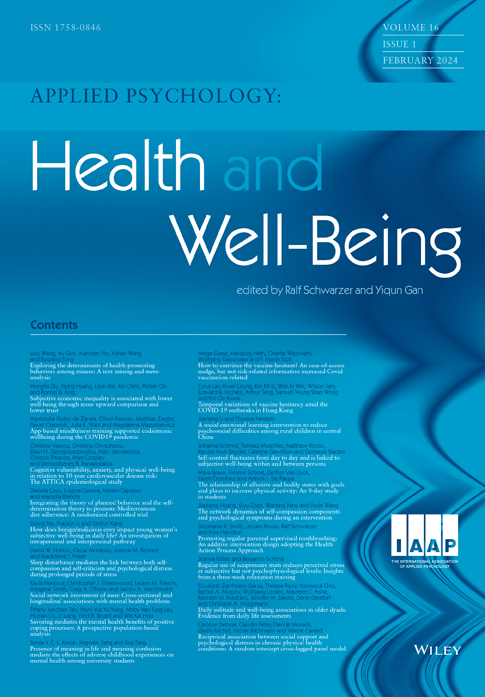
Applied Psychology: Health and Well-Being is a triannual peer-reviewed academic journal published by Wiley-Blackwell on behalf of the International Association of Applied Psychology. It was established in 2009 and covers applied psychology topics such as clinical psychology, counseling, cross-cultural psychology, and environmental psychology.

 求助内容:
 应助结果提醒方式:


 京公网安备 11010802042870号


