{"title":"两阶段随机试验设计评估抗菌治疗策略的优势:一项模拟研究。","authors":"Juan Gago, Christopher Boyer, Marc Lipsitch","doi":"10.1093/aje/kwag220","DOIUrl":null,"url":null,"abstract":"<p><p>Antimicrobial prescribing policies affect treated patients and, through altered transmission, their contacts. Two-stage randomized (2SR) designs can estimate these spillover effects but have not been applied to antimicrobial strategies. We built a stochastic agent-based model of a hospital ward with two competing strains (susceptible and resistant) to emulate a 2SR trial. Drug A covers only the susceptible strain, while Drug B covers both. Six clusters were randomized to a 90/10 or 50/50 Drug A/Drug B allocation, with individuals randomized to treatments within clusters. We estimated direct, indirect, total, and overall effects on mortality. Drug A recipients had higher mortality than Drug B recipients in every cluster, because Drug A does not cover the resistant strain (direct effect +4.75 to +7.08 percentage points [pp]). Among Drug A recipients, mortality was higher when the ward followed 90/10 than 50/50 (indirect effect +2.10 pp), driven by higher resistant-strain prevalence; the effect on Drug B recipients was minimal. The 50/50 strategy reduced total mortality (overall effect -4.00 pp), but this concealed a redistribution: resistant-strain deaths fell while susceptible-strain deaths rose. Findings were robust across sensitivity scenarios. The 2SR design captures spillover effects invisible to individually randomized trials.</p>","PeriodicalId":7472,"journal":{"name":"American journal of epidemiology","volume":" ","pages":""},"PeriodicalIF":4.1000,"publicationDate":"2026-09-11","publicationTypes":"Journal Article","fieldsOfStudy":null,"isOpenAccess":false,"openAccessPdf":"","citationCount":"0","resultStr":"{\"title\":\"Advantages of a Two-Stage Randomized Trial Design to Evaluate Antimicrobial Treatment Strategies: a Simulation Study.\",\"authors\":\"Juan Gago, Christopher Boyer, Marc Lipsitch\",\"doi\":\"10.1093/aje/kwag220\",\"DOIUrl\":null,\"url\":null,\"abstract\":\"<p><p>Antimicrobial prescribing policies affect treated patients and, through altered transmission, their contacts. Two-stage randomized (2SR) designs can estimate these spillover effects but have not been applied to antimicrobial strategies. We built a stochastic agent-based model of a hospital ward with two competing strains (susceptible and resistant) to emulate a 2SR trial. Drug A covers only the susceptible strain, while Drug B covers both. Six clusters were randomized to a 90/10 or 50/50 Drug A/Drug B allocation, with individuals randomized to treatments within clusters. We estimated direct, indirect, total, and overall effects on mortality. Drug A recipients had higher mortality than Drug B recipients in every cluster, because Drug A does not cover the resistant strain (direct effect +4.75 to +7.08 percentage points [pp]). Among Drug A recipients, mortality was higher when the ward followed 90/10 than 50/50 (indirect effect +2.10 pp), driven by higher resistant-strain prevalence; the effect on Drug B recipients was minimal. The 50/50 strategy reduced total mortality (overall effect -4.00 pp), but this concealed a redistribution: resistant-strain deaths fell while susceptible-strain deaths rose. Findings were robust across sensitivity scenarios. The 2SR design captures spillover effects invisible to individually randomized trials.</p>\",\"PeriodicalId\":7472,\"journal\":{\"name\":\"American journal of epidemiology\",\"volume\":\" \",\"pages\":\"\"},\"PeriodicalIF\":4.1000,\"publicationDate\":\"2026-09-11\",\"publicationTypes\":\"Journal Article\",\"fieldsOfStudy\":null,\"isOpenAccess\":false,\"openAccessPdf\":\"\",\"citationCount\":\"0\",\"resultStr\":null,\"platform\":\"Semanticscholar\",\"paperid\":null,\"PeriodicalName\":\"American journal of epidemiology\",\"FirstCategoryId\":\"3\",\"ListUrlMain\":\"https://doi.org/10.1093/aje/kwag220\",\"RegionNum\":2,\"RegionCategory\":\"医学\",\"ArticlePicture\":[],\"TitleCN\":null,\"AbstractTextCN\":null,\"PMCID\":null,\"EPubDate\":\"\",\"PubModel\":\"\",\"JCR\":\"Q1\",\"JCRName\":\"PUBLIC, ENVIRONMENTAL & OCCUPATIONAL HEALTH\",\"Score\":null,\"Total\":0}","platform":"Semanticscholar","paperid":null,"PeriodicalName":"American journal of epidemiology","FirstCategoryId":"3","ListUrlMain":"https://doi.org/10.1093/aje/kwag220","RegionNum":2,"RegionCategory":"医学","ArticlePicture":[],"TitleCN":null,"AbstractTextCN":null,"PMCID":null,"EPubDate":"","PubModel":"","JCR":"Q1","JCRName":"PUBLIC, ENVIRONMENTAL & OCCUPATIONAL HEALTH","Score":null,"Total":0}
Advantages of a Two-Stage Randomized Trial Design to Evaluate Antimicrobial Treatment Strategies: a Simulation Study.
Antimicrobial prescribing policies affect treated patients and, through altered transmission, their contacts. Two-stage randomized (2SR) designs can estimate these spillover effects but have not been applied to antimicrobial strategies. We built a stochastic agent-based model of a hospital ward with two competing strains (susceptible and resistant) to emulate a 2SR trial. Drug A covers only the susceptible strain, while Drug B covers both. Six clusters were randomized to a 90/10 or 50/50 Drug A/Drug B allocation, with individuals randomized to treatments within clusters. We estimated direct, indirect, total, and overall effects on mortality. Drug A recipients had higher mortality than Drug B recipients in every cluster, because Drug A does not cover the resistant strain (direct effect +4.75 to +7.08 percentage points [pp]). Among Drug A recipients, mortality was higher when the ward followed 90/10 than 50/50 (indirect effect +2.10 pp), driven by higher resistant-strain prevalence; the effect on Drug B recipients was minimal. The 50/50 strategy reduced total mortality (overall effect -4.00 pp), but this concealed a redistribution: resistant-strain deaths fell while susceptible-strain deaths rose. Findings were robust across sensitivity scenarios. The 2SR design captures spillover effects invisible to individually randomized trials.
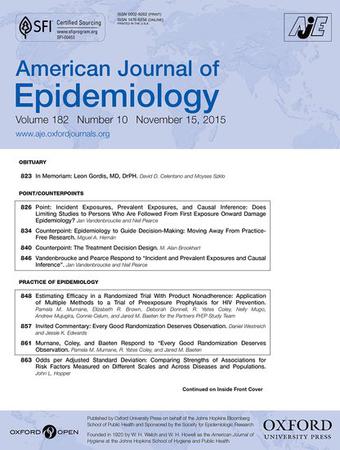
期刊介绍:
The American Journal of Epidemiology is the oldest and one of the premier epidemiologic journals devoted to the publication of empirical research findings, opinion pieces, and methodological developments in the field of epidemiologic research.
It is a peer-reviewed journal aimed at both fellow epidemiologists and those who use epidemiologic data, including public health workers and clinicians.

 求助内容:
 应助结果提醒方式:


 京公网安备 11010802042870号


