{"title":"四足机器人在不同任务指令下的自适应观察状态选择","authors":"Tianyu Zhang, Jieliang Zhao, Qun Niu, Xuemei Chen","doi":"10.1007/s42235-026-00954-2","DOIUrl":null,"url":null,"abstract":"<div><p>Reinforcement-learning-based controllers for lightweight robot control in structured, rather than complex, scenarios have received comparatively little attention. Lightweight control aims to achieve performance comparable to full observation-based control by relying on a minimal set of key observation factors. This study finds that different key observation factors become important under different commands. Therefore, the effectiveness of such methods still requires further enhancement. To better understand the influence of observation states on action generation and enhance lightweight control performance, this paper proposes a method based on an improved Integrated Gradients algorithm to quantify the importance of observation variables in quadruped robot control. By combining sampling and fitting techniques, the variation pattern of observation importance weights is derived with respect to different velocity commands, and the optimal observation subsets are identified under specific command conditions. To enable real-time switching of observation subsets during inference based on command input, a multi-encoder training framework is introduced. This framework encodes and learns multiple observation subsets using a shared replay buffer and a Multi-stage Encoder Switching Architecture. Simulation results demonstrate that different observation subsets are optimal for different command ranges. The proposed command-driven observation selection strategy improves the overall performance score by 5.33% compared with fixed Determined State Observation configurations. Real-world experiments validate similar trends, highlighting the potential of this approach for lightweight robot control and the exploration of biologically inspired locomotion mechanisms.</p></div>","PeriodicalId":614,"journal":{"name":"Journal of Bionic Engineering","volume":"23 5","pages":"2985 - 3000"},"PeriodicalIF":4.4000,"publicationDate":"2026-07-31","publicationTypes":"Journal Article","fieldsOfStudy":null,"isOpenAccess":false,"openAccessPdf":"","citationCount":"0","resultStr":"{\"title\":\"Adaptive Observation State Selection for a Quadruped Robot Under Varying Task Commands\",\"authors\":\"Tianyu Zhang, Jieliang Zhao, Qun Niu, Xuemei Chen\",\"doi\":\"10.1007/s42235-026-00954-2\",\"DOIUrl\":null,\"url\":null,\"abstract\":\"<div><p>Reinforcement-learning-based controllers for lightweight robot control in structured, rather than complex, scenarios have received comparatively little attention. Lightweight control aims to achieve performance comparable to full observation-based control by relying on a minimal set of key observation factors. This study finds that different key observation factors become important under different commands. Therefore, the effectiveness of such methods still requires further enhancement. To better understand the influence of observation states on action generation and enhance lightweight control performance, this paper proposes a method based on an improved Integrated Gradients algorithm to quantify the importance of observation variables in quadruped robot control. By combining sampling and fitting techniques, the variation pattern of observation importance weights is derived with respect to different velocity commands, and the optimal observation subsets are identified under specific command conditions. To enable real-time switching of observation subsets during inference based on command input, a multi-encoder training framework is introduced. This framework encodes and learns multiple observation subsets using a shared replay buffer and a Multi-stage Encoder Switching Architecture. Simulation results demonstrate that different observation subsets are optimal for different command ranges. The proposed command-driven observation selection strategy improves the overall performance score by 5.33% compared with fixed Determined State Observation configurations. Real-world experiments validate similar trends, highlighting the potential of this approach for lightweight robot control and the exploration of biologically inspired locomotion mechanisms.</p></div>\",\"PeriodicalId\":614,\"journal\":{\"name\":\"Journal of Bionic Engineering\",\"volume\":\"23 5\",\"pages\":\"2985 - 3000\"},\"PeriodicalIF\":4.4000,\"publicationDate\":\"2026-07-31\",\"publicationTypes\":\"Journal Article\",\"fieldsOfStudy\":null,\"isOpenAccess\":false,\"openAccessPdf\":\"\",\"citationCount\":\"0\",\"resultStr\":null,\"platform\":\"Semanticscholar\",\"paperid\":null,\"PeriodicalName\":\"Journal of Bionic Engineering\",\"FirstCategoryId\":\"94\",\"ListUrlMain\":\"https://link.springer.com/article/10.1007/s42235-026-00954-2\",\"RegionNum\":3,\"RegionCategory\":\"计算机科学\",\"ArticlePicture\":[],\"TitleCN\":null,\"AbstractTextCN\":null,\"PMCID\":null,\"EPubDate\":\"\",\"PubModel\":\"\",\"JCR\":\"Q1\",\"JCRName\":\"ENGINEERING, MULTIDISCIPLINARY\",\"Score\":null,\"Total\":0}","platform":"Semanticscholar","paperid":null,"PeriodicalName":"Journal of Bionic Engineering","FirstCategoryId":"94","ListUrlMain":"https://link.springer.com/article/10.1007/s42235-026-00954-2","RegionNum":3,"RegionCategory":"计算机科学","ArticlePicture":[],"TitleCN":null,"AbstractTextCN":null,"PMCID":null,"EPubDate":"","PubModel":"","JCR":"Q1","JCRName":"ENGINEERING, MULTIDISCIPLINARY","Score":null,"Total":0}
Adaptive Observation State Selection for a Quadruped Robot Under Varying Task Commands
Reinforcement-learning-based controllers for lightweight robot control in structured, rather than complex, scenarios have received comparatively little attention. Lightweight control aims to achieve performance comparable to full observation-based control by relying on a minimal set of key observation factors. This study finds that different key observation factors become important under different commands. Therefore, the effectiveness of such methods still requires further enhancement. To better understand the influence of observation states on action generation and enhance lightweight control performance, this paper proposes a method based on an improved Integrated Gradients algorithm to quantify the importance of observation variables in quadruped robot control. By combining sampling and fitting techniques, the variation pattern of observation importance weights is derived with respect to different velocity commands, and the optimal observation subsets are identified under specific command conditions. To enable real-time switching of observation subsets during inference based on command input, a multi-encoder training framework is introduced. This framework encodes and learns multiple observation subsets using a shared replay buffer and a Multi-stage Encoder Switching Architecture. Simulation results demonstrate that different observation subsets are optimal for different command ranges. The proposed command-driven observation selection strategy improves the overall performance score by 5.33% compared with fixed Determined State Observation configurations. Real-world experiments validate similar trends, highlighting the potential of this approach for lightweight robot control and the exploration of biologically inspired locomotion mechanisms.
期刊介绍:
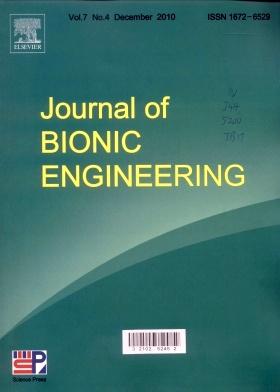
The Journal of Bionic Engineering (JBE) is a peer-reviewed journal that publishes original research papers and reviews that apply the knowledge learned from nature and biological systems to solve concrete engineering problems. The topics that JBE covers include but are not limited to:
Mechanisms, kinematical mechanics and control of animal locomotion, development of mobile robots with walking (running and crawling), swimming or flying abilities inspired by animal locomotion.
Structures, morphologies, composition and physical properties of natural and biomaterials; fabrication of new materials mimicking the properties and functions of natural and biomaterials.
Biomedical materials, artificial organs and tissue engineering for medical applications; rehabilitation equipment and devices.
Development of bioinspired computation methods and artificial intelligence for engineering applications.

 求助内容:
 应助结果提醒方式:


 京公网安备 11010802042870号


