{"title":"仿人机器人面部表情分析、驱动控制设计与仿真再现","authors":"Manjia Su, Hongkai Chen, Haifei Zhu, Ruiwei Liu, Shichao Gu, Yisheng Guan","doi":"10.1007/s42235-026-00964-0","DOIUrl":null,"url":null,"abstract":"<div><p>Humanoid robots with realistic facial expression capabilities hold significant potential in medical therapy, education, and the arts by replicating human emotions, thereby enhancing adaptive Human–Robot Interaction (HRI). This work presents a systematic framework for developing a facial system for humanoid robots. Our contributions are fourfold: First, a data-driven method for facial skin drive point selection using the Cohn-Kanade dataset, analyzing landmark displacement patterns to differentiate static and dynamic facial regions. Second, a modular biomimetic facial system integrating six region-optimized actuation units (eyebrows, jaw, eyelids, nasal alar, eyes, mouth corners) with a total of 14 servo motors, a 3D-printed head-shell with static-dynamic partitioning, and anthropomorphic silicone skin fabricated using custom molds. Third, an expression imitation algorithm using 11 morphological geometric features and a neural inverse model (Multilayer Neural Network, MNN) trained on 3000 automatically collected servo-image pairs. Fourth, experimental validation demonstrating accurate expression replication through custom metrics (Mean Error Percentage of Command, MEPC; Mean Error Percentage of Discretization Command, MEPDC) and expression similarity quantification. Our system achieves MEPC of 0.107 and MEPDC of 0.114, outperforming Linear regression, Random Forest, and Support Vector Regression (SVR) models. This work establishes a foundational approach for developing expressive humanoid robot facial systems, enabling emotionally intelligent HRI.</p></div>","PeriodicalId":614,"journal":{"name":"Journal of Bionic Engineering","volume":"23 5","pages":"2971 - 2984"},"PeriodicalIF":4.4000,"publicationDate":"2026-07-31","publicationTypes":"Journal Article","fieldsOfStudy":null,"isOpenAccess":false,"openAccessPdf":"","citationCount":"0","resultStr":"{\"title\":\"Facial Expression Analysis, Drive Control Design, and Imitation Reproduction for Humanoid Robots\",\"authors\":\"Manjia Su, Hongkai Chen, Haifei Zhu, Ruiwei Liu, Shichao Gu, Yisheng Guan\",\"doi\":\"10.1007/s42235-026-00964-0\",\"DOIUrl\":null,\"url\":null,\"abstract\":\"<div><p>Humanoid robots with realistic facial expression capabilities hold significant potential in medical therapy, education, and the arts by replicating human emotions, thereby enhancing adaptive Human–Robot Interaction (HRI). This work presents a systematic framework for developing a facial system for humanoid robots. Our contributions are fourfold: First, a data-driven method for facial skin drive point selection using the Cohn-Kanade dataset, analyzing landmark displacement patterns to differentiate static and dynamic facial regions. Second, a modular biomimetic facial system integrating six region-optimized actuation units (eyebrows, jaw, eyelids, nasal alar, eyes, mouth corners) with a total of 14 servo motors, a 3D-printed head-shell with static-dynamic partitioning, and anthropomorphic silicone skin fabricated using custom molds. Third, an expression imitation algorithm using 11 morphological geometric features and a neural inverse model (Multilayer Neural Network, MNN) trained on 3000 automatically collected servo-image pairs. Fourth, experimental validation demonstrating accurate expression replication through custom metrics (Mean Error Percentage of Command, MEPC; Mean Error Percentage of Discretization Command, MEPDC) and expression similarity quantification. Our system achieves MEPC of 0.107 and MEPDC of 0.114, outperforming Linear regression, Random Forest, and Support Vector Regression (SVR) models. This work establishes a foundational approach for developing expressive humanoid robot facial systems, enabling emotionally intelligent HRI.</p></div>\",\"PeriodicalId\":614,\"journal\":{\"name\":\"Journal of Bionic Engineering\",\"volume\":\"23 5\",\"pages\":\"2971 - 2984\"},\"PeriodicalIF\":4.4000,\"publicationDate\":\"2026-07-31\",\"publicationTypes\":\"Journal Article\",\"fieldsOfStudy\":null,\"isOpenAccess\":false,\"openAccessPdf\":\"\",\"citationCount\":\"0\",\"resultStr\":null,\"platform\":\"Semanticscholar\",\"paperid\":null,\"PeriodicalName\":\"Journal of Bionic Engineering\",\"FirstCategoryId\":\"94\",\"ListUrlMain\":\"https://link.springer.com/article/10.1007/s42235-026-00964-0\",\"RegionNum\":3,\"RegionCategory\":\"计算机科学\",\"ArticlePicture\":[],\"TitleCN\":null,\"AbstractTextCN\":null,\"PMCID\":null,\"EPubDate\":\"\",\"PubModel\":\"\",\"JCR\":\"Q1\",\"JCRName\":\"ENGINEERING, MULTIDISCIPLINARY\",\"Score\":null,\"Total\":0}","platform":"Semanticscholar","paperid":null,"PeriodicalName":"Journal of Bionic Engineering","FirstCategoryId":"94","ListUrlMain":"https://link.springer.com/article/10.1007/s42235-026-00964-0","RegionNum":3,"RegionCategory":"计算机科学","ArticlePicture":[],"TitleCN":null,"AbstractTextCN":null,"PMCID":null,"EPubDate":"","PubModel":"","JCR":"Q1","JCRName":"ENGINEERING, MULTIDISCIPLINARY","Score":null,"Total":0}
Facial Expression Analysis, Drive Control Design, and Imitation Reproduction for Humanoid Robots
Humanoid robots with realistic facial expression capabilities hold significant potential in medical therapy, education, and the arts by replicating human emotions, thereby enhancing adaptive Human–Robot Interaction (HRI). This work presents a systematic framework for developing a facial system for humanoid robots. Our contributions are fourfold: First, a data-driven method for facial skin drive point selection using the Cohn-Kanade dataset, analyzing landmark displacement patterns to differentiate static and dynamic facial regions. Second, a modular biomimetic facial system integrating six region-optimized actuation units (eyebrows, jaw, eyelids, nasal alar, eyes, mouth corners) with a total of 14 servo motors, a 3D-printed head-shell with static-dynamic partitioning, and anthropomorphic silicone skin fabricated using custom molds. Third, an expression imitation algorithm using 11 morphological geometric features and a neural inverse model (Multilayer Neural Network, MNN) trained on 3000 automatically collected servo-image pairs. Fourth, experimental validation demonstrating accurate expression replication through custom metrics (Mean Error Percentage of Command, MEPC; Mean Error Percentage of Discretization Command, MEPDC) and expression similarity quantification. Our system achieves MEPC of 0.107 and MEPDC of 0.114, outperforming Linear regression, Random Forest, and Support Vector Regression (SVR) models. This work establishes a foundational approach for developing expressive humanoid robot facial systems, enabling emotionally intelligent HRI.
期刊介绍:
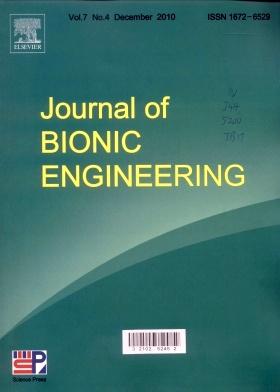
The Journal of Bionic Engineering (JBE) is a peer-reviewed journal that publishes original research papers and reviews that apply the knowledge learned from nature and biological systems to solve concrete engineering problems. The topics that JBE covers include but are not limited to:
Mechanisms, kinematical mechanics and control of animal locomotion, development of mobile robots with walking (running and crawling), swimming or flying abilities inspired by animal locomotion.
Structures, morphologies, composition and physical properties of natural and biomaterials; fabrication of new materials mimicking the properties and functions of natural and biomaterials.
Biomedical materials, artificial organs and tissue engineering for medical applications; rehabilitation equipment and devices.
Development of bioinspired computation methods and artificial intelligence for engineering applications.

 求助内容:
 应助结果提醒方式:


 京公网安备 11010802042870号


