Afnan Syifa’ Muhammad, Agustina Ari Murti Budi Hastuti
{"title":"傅里叶变换红外光谱结合主成分分析和偏最小二乘回归鉴别松节油中香茅油","authors":"Afnan Syifa’ Muhammad, Agustina Ari Murti Budi Hastuti","doi":"10.1134/S1061934825603196","DOIUrl":null,"url":null,"abstract":"<p>The adulteration of citronella (<i>Cymbopogon winterianus</i>) oil with a cheaper alternative, such as low-grade turpentine oil, is a recurring issue in the essential oil industry, posing risks to product quality and consumer safety. A rapid and non-destructive authentication method is therefore essential for quality control of this product. This study utilized Fourier-transform infrared spectroscopy followed by principal component analysis (<b>PCA</b>) and partial least squares (<b>PLS</b>) regression for qualitative and quantitative authentication of citronella oil mixed with turpentine oil, respectively. Samples were prepared with various adulteration concentrations of citronella oil in turpentine oil (0 to 100%). Additionally, several commercial products were analyzed. The PCA results showed that the best model was obtained using normal spectra without any pretreatment in the wavenumber range of 1200–900 cm<sup>–1</sup>. This model demonstrated high discrimination ability with eigenvalues of 95.65% for PC1 and 3.84% for PC2. For PLS analysis, the best model was developed using first-derivative pretreated spectra in the wavenumber range of 3600–1600 cm<sup>–1</sup>. The PLS calibration model produced the equation <i>y</i> = 0.99998<i>x</i> – 0.00001, with an <i>R</i><sup>2</sup> value of 1.0000 and a root mean square error of calibration of 0.00038, indicating excellent linearity. The PLS validation model resulted in the equation <i>y</i> = 1.0094<i>x</i> – 0.0007, with an <i>R</i><sup>2</sup> value of 0.9998 and a root mean square error of prediction of 0.0085, confirming the accuracy and precision of the model in detecting citronella oil adulterated with turpentine oil.</p>","PeriodicalId":606,"journal":{"name":"Journal of Analytical Chemistry","volume":"81 :","pages":"1244 - 1249"},"PeriodicalIF":1.5000,"publicationDate":"2026-08-02","publicationTypes":"Journal Article","fieldsOfStudy":null,"isOpenAccess":false,"openAccessPdf":"","citationCount":"0","resultStr":"{\"title\":\"Authentication of Citronella Oil from Turpentine Oil Using Fourier-Transform Infrared Spectroscopy Followed by Principal Component Analysis and Partial Least Squares Regression\",\"authors\":\"Afnan Syifa’ Muhammad, Agustina Ari Murti Budi Hastuti\",\"doi\":\"10.1134/S1061934825603196\",\"DOIUrl\":null,\"url\":null,\"abstract\":\"<p>The adulteration of citronella (<i>Cymbopogon winterianus</i>) oil with a cheaper alternative, such as low-grade turpentine oil, is a recurring issue in the essential oil industry, posing risks to product quality and consumer safety. A rapid and non-destructive authentication method is therefore essential for quality control of this product. This study utilized Fourier-transform infrared spectroscopy followed by principal component analysis (<b>PCA</b>) and partial least squares (<b>PLS</b>) regression for qualitative and quantitative authentication of citronella oil mixed with turpentine oil, respectively. Samples were prepared with various adulteration concentrations of citronella oil in turpentine oil (0 to 100%). Additionally, several commercial products were analyzed. The PCA results showed that the best model was obtained using normal spectra without any pretreatment in the wavenumber range of 1200–900 cm<sup>–1</sup>. This model demonstrated high discrimination ability with eigenvalues of 95.65% for PC1 and 3.84% for PC2. For PLS analysis, the best model was developed using first-derivative pretreated spectra in the wavenumber range of 3600–1600 cm<sup>–1</sup>. The PLS calibration model produced the equation <i>y</i> = 0.99998<i>x</i> – 0.00001, with an <i>R</i><sup>2</sup> value of 1.0000 and a root mean square error of calibration of 0.00038, indicating excellent linearity. The PLS validation model resulted in the equation <i>y</i> = 1.0094<i>x</i> – 0.0007, with an <i>R</i><sup>2</sup> value of 0.9998 and a root mean square error of prediction of 0.0085, confirming the accuracy and precision of the model in detecting citronella oil adulterated with turpentine oil.</p>\",\"PeriodicalId\":606,\"journal\":{\"name\":\"Journal of Analytical Chemistry\",\"volume\":\"81 :\",\"pages\":\"1244 - 1249\"},\"PeriodicalIF\":1.5000,\"publicationDate\":\"2026-08-02\",\"publicationTypes\":\"Journal Article\",\"fieldsOfStudy\":null,\"isOpenAccess\":false,\"openAccessPdf\":\"\",\"citationCount\":\"0\",\"resultStr\":null,\"platform\":\"Semanticscholar\",\"paperid\":null,\"PeriodicalName\":\"Journal of Analytical Chemistry\",\"FirstCategoryId\":\"92\",\"ListUrlMain\":\"https://link.springer.com/article/10.1134/S1061934825603196\",\"RegionNum\":4,\"RegionCategory\":\"化学\",\"ArticlePicture\":[],\"TitleCN\":null,\"AbstractTextCN\":null,\"PMCID\":null,\"EPubDate\":\"\",\"PubModel\":\"\",\"JCR\":\"Q4\",\"JCRName\":\"CHEMISTRY, ANALYTICAL\",\"Score\":null,\"Total\":0}","platform":"Semanticscholar","paperid":null,"PeriodicalName":"Journal of Analytical Chemistry","FirstCategoryId":"92","ListUrlMain":"https://link.springer.com/article/10.1134/S1061934825603196","RegionNum":4,"RegionCategory":"化学","ArticlePicture":[],"TitleCN":null,"AbstractTextCN":null,"PMCID":null,"EPubDate":"","PubModel":"","JCR":"Q4","JCRName":"CHEMISTRY, ANALYTICAL","Score":null,"Total":0}
Authentication of Citronella Oil from Turpentine Oil Using Fourier-Transform Infrared Spectroscopy Followed by Principal Component Analysis and Partial Least Squares Regression
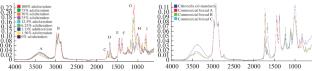
The adulteration of citronella (Cymbopogon winterianus) oil with a cheaper alternative, such as low-grade turpentine oil, is a recurring issue in the essential oil industry, posing risks to product quality and consumer safety. A rapid and non-destructive authentication method is therefore essential for quality control of this product. This study utilized Fourier-transform infrared spectroscopy followed by principal component analysis (PCA) and partial least squares (PLS) regression for qualitative and quantitative authentication of citronella oil mixed with turpentine oil, respectively. Samples were prepared with various adulteration concentrations of citronella oil in turpentine oil (0 to 100%). Additionally, several commercial products were analyzed. The PCA results showed that the best model was obtained using normal spectra without any pretreatment in the wavenumber range of 1200–900 cm–1. This model demonstrated high discrimination ability with eigenvalues of 95.65% for PC1 and 3.84% for PC2. For PLS analysis, the best model was developed using first-derivative pretreated spectra in the wavenumber range of 3600–1600 cm–1. The PLS calibration model produced the equation y = 0.99998x – 0.00001, with an R2 value of 1.0000 and a root mean square error of calibration of 0.00038, indicating excellent linearity. The PLS validation model resulted in the equation y = 1.0094x – 0.0007, with an R2 value of 0.9998 and a root mean square error of prediction of 0.0085, confirming the accuracy and precision of the model in detecting citronella oil adulterated with turpentine oil.
期刊介绍:
The Journal of Analytical Chemistry is an international peer reviewed journal that covers theoretical and applied aspects of analytical chemistry; it informs the reader about new achievements in analytical methods, instruments and reagents. Ample space is devoted to problems arising in the analysis of vital media such as water and air. Consideration is given to the detection and determination of metal ions, anions, and various organic substances. The journal welcomes manuscripts from all countries in the English or Russian language.

 求助内容:
求助内容: 应助结果提醒方式:

 京公网安备 11010802042870号


