{"title":"大角度双极化双宽带电磁窗的选择性色散抑制超表面","authors":"Tiefu Li,Jinwei Chen,Cunqian Feng,Jian Liu,Yuxiang Jia,Chang Ding,Yajuan Han,Xinmin Fu,Jie Yang,Zhenxu Wang,Song Zhao,Zhaotang Liu,Zhihui Zhang,Jiafu Wang","doi":"10.1002/nap2.70166","DOIUrl":null,"url":null,"abstract":"In this manuscript, we propose to suppress the metasurface's undesired dispersion to widen its working range, while preserving the desired one to preserve the function. As shown in the figure, through a method of reversed superimposition (RS), we have implemented the idea on a metasurface for the dual-band EM window at large angles (≥ 60°). The metasurface is originally only for transverse electric (TE) polarization and has a narrow effective band (EB). However, through selective dispersion suppression, it can work for dual polarization and dual broadband after the RS.","PeriodicalId":19027,"journal":{"name":"Nanophotonics","volume":"19 1","pages":""},"PeriodicalIF":6.8000,"publicationDate":"2026-07-20","publicationTypes":"Journal Article","fieldsOfStudy":null,"isOpenAccess":false,"openAccessPdf":"","citationCount":"0","resultStr":"{\"title\":\"A Selective Dispersion–Suppressed Metasurface for Dual-Polarization and Dual-Broadband Electromagnetic Window at Large Angles\",\"authors\":\"Tiefu Li,Jinwei Chen,Cunqian Feng,Jian Liu,Yuxiang Jia,Chang Ding,Yajuan Han,Xinmin Fu,Jie Yang,Zhenxu Wang,Song Zhao,Zhaotang Liu,Zhihui Zhang,Jiafu Wang\",\"doi\":\"10.1002/nap2.70166\",\"DOIUrl\":null,\"url\":null,\"abstract\":\"In this manuscript, we propose to suppress the metasurface's undesired dispersion to widen its working range, while preserving the desired one to preserve the function. As shown in the figure, through a method of reversed superimposition (RS), we have implemented the idea on a metasurface for the dual-band EM window at large angles (≥ 60°). The metasurface is originally only for transverse electric (TE) polarization and has a narrow effective band (EB). However, through selective dispersion suppression, it can work for dual polarization and dual broadband after the RS.\",\"PeriodicalId\":19027,\"journal\":{\"name\":\"Nanophotonics\",\"volume\":\"19 1\",\"pages\":\"\"},\"PeriodicalIF\":6.8000,\"publicationDate\":\"2026-07-20\",\"publicationTypes\":\"Journal Article\",\"fieldsOfStudy\":null,\"isOpenAccess\":false,\"openAccessPdf\":\"\",\"citationCount\":\"0\",\"resultStr\":null,\"platform\":\"Semanticscholar\",\"paperid\":null,\"PeriodicalName\":\"Nanophotonics\",\"FirstCategoryId\":\"101\",\"ListUrlMain\":\"https://doi.org/10.1002/nap2.70166\",\"RegionNum\":2,\"RegionCategory\":\"物理与天体物理\",\"ArticlePicture\":[],\"TitleCN\":null,\"AbstractTextCN\":null,\"PMCID\":null,\"EPubDate\":\"\",\"PubModel\":\"\",\"JCR\":\"Q1\",\"JCRName\":\"MATERIALS SCIENCE, MULTIDISCIPLINARY\",\"Score\":null,\"Total\":0}","platform":"Semanticscholar","paperid":null,"PeriodicalName":"Nanophotonics","FirstCategoryId":"101","ListUrlMain":"https://doi.org/10.1002/nap2.70166","RegionNum":2,"RegionCategory":"物理与天体物理","ArticlePicture":[],"TitleCN":null,"AbstractTextCN":null,"PMCID":null,"EPubDate":"","PubModel":"","JCR":"Q1","JCRName":"MATERIALS SCIENCE, MULTIDISCIPLINARY","Score":null,"Total":0}
A Selective Dispersion–Suppressed Metasurface for Dual-Polarization and Dual-Broadband Electromagnetic Window at Large Angles
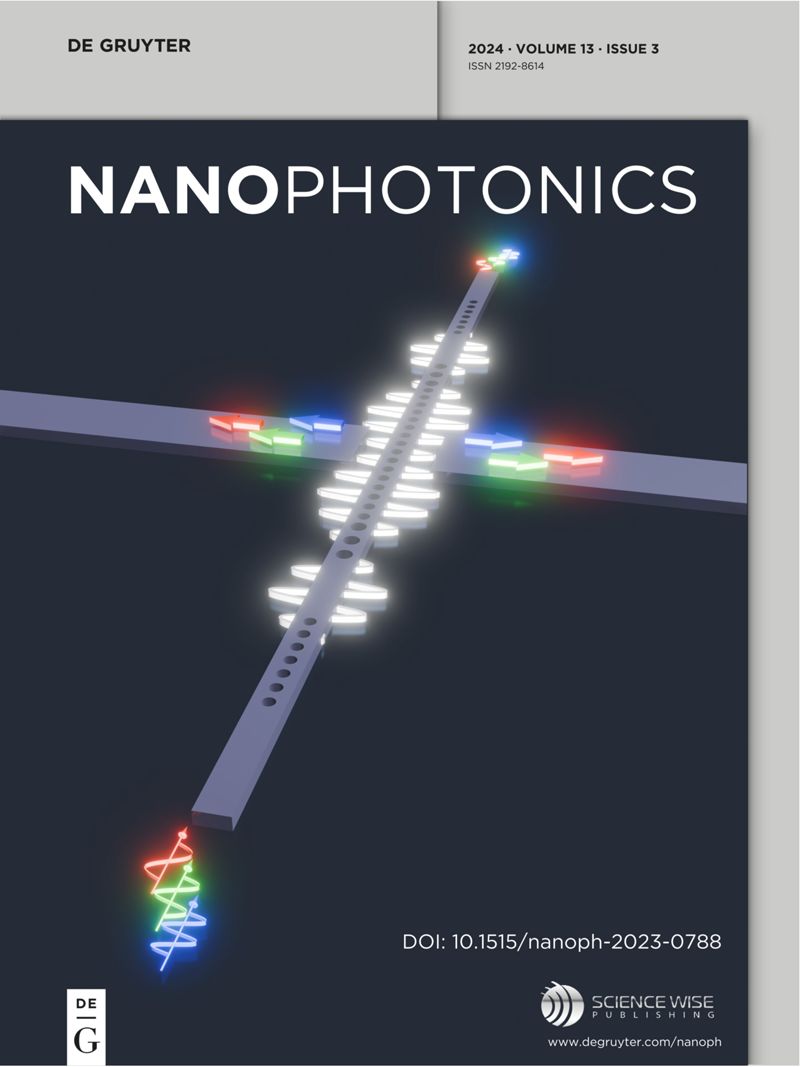
In this manuscript, we propose to suppress the metasurface's undesired dispersion to widen its working range, while preserving the desired one to preserve the function. As shown in the figure, through a method of reversed superimposition (RS), we have implemented the idea on a metasurface for the dual-band EM window at large angles (≥ 60°). The metasurface is originally only for transverse electric (TE) polarization and has a narrow effective band (EB). However, through selective dispersion suppression, it can work for dual polarization and dual broadband after the RS.
期刊介绍:
Nanophotonics, published in collaboration with Sciencewise, is a prestigious journal that showcases recent international research results, notable advancements in the field, and innovative applications. It is regarded as one of the leading publications in the realm of nanophotonics and encompasses a range of article types including research articles, selectively invited reviews, letters, and perspectives.
The journal specifically delves into the study of photon interaction with nano-structures, such as carbon nano-tubes, nano metal particles, nano crystals, semiconductor nano dots, photonic crystals, tissue, and DNA. It offers comprehensive coverage of the most up-to-date discoveries, making it an essential resource for physicists, engineers, and material scientists.