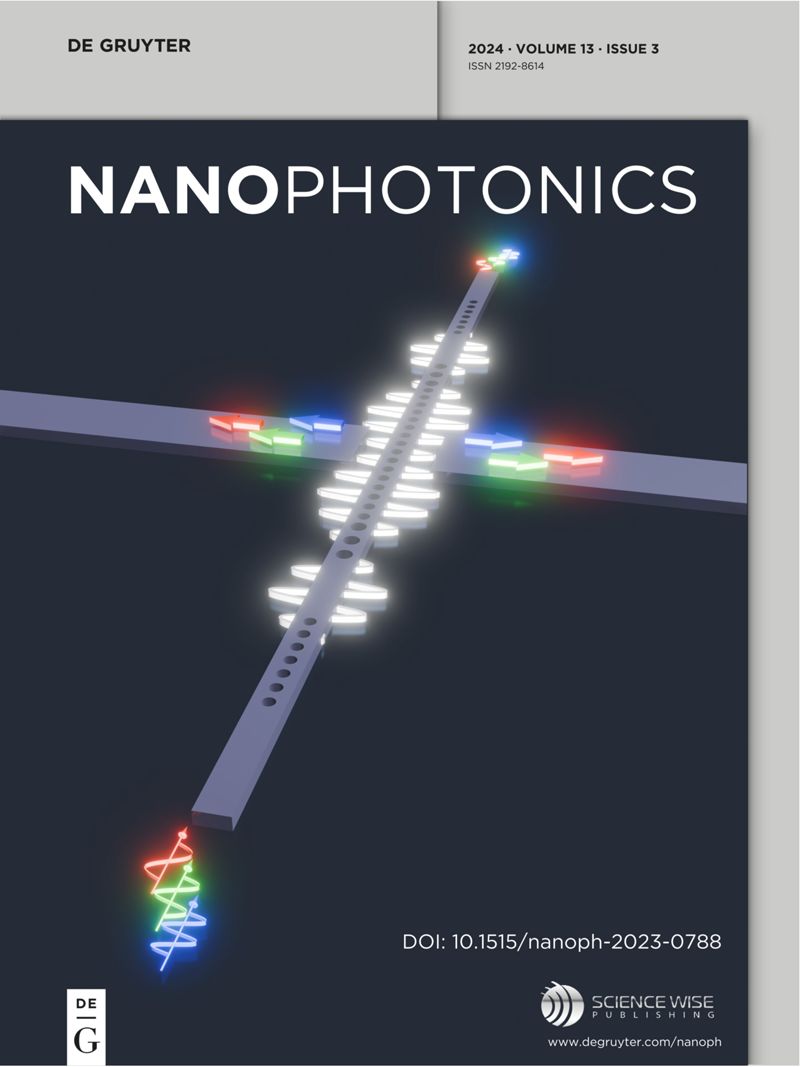
{"title":"硅纳米片中纵向Mie共振增强的对映选择性光捕获","authors":"Guillermo Serrera,Pablo Albella","doi":"10.1002/nap2.70207","DOIUrl":null,"url":null,"abstract":"Longitudinal Mie resonances in silicon nanodisks, excited by an azimuthally–radially polarized beam, generate strong optical chirality gradients with minimal achiral background. Magnetic quadrupole modes enable selective enantiomer trapping, achieving predicted selectivities over 100 for and robust performance even for weakly chiral nanoparticles, offering a noninvasive route to optical enantioseparation.","PeriodicalId":19027,"journal":{"name":"Nanophotonics","volume":"264 1","pages":""},"PeriodicalIF":6.8000,"publicationDate":"2026-07-18","publicationTypes":"Journal Article","fieldsOfStudy":null,"isOpenAccess":false,"openAccessPdf":"","citationCount":"0","resultStr":"{\"title\":\"Enhanced Enantioselective Optical Trapping Enabled by Longitudinal Mie Resonances in Silicon Nanodisks\",\"authors\":\"Guillermo Serrera,Pablo Albella\",\"doi\":\"10.1002/nap2.70207\",\"DOIUrl\":null,\"url\":null,\"abstract\":\"Longitudinal Mie resonances in silicon nanodisks, excited by an azimuthally–radially polarized beam, generate strong optical chirality gradients with minimal achiral background. Magnetic quadrupole modes enable selective enantiomer trapping, achieving predicted selectivities over 100 for and robust performance even for weakly chiral nanoparticles, offering a noninvasive route to optical enantioseparation.\",\"PeriodicalId\":19027,\"journal\":{\"name\":\"Nanophotonics\",\"volume\":\"264 1\",\"pages\":\"\"},\"PeriodicalIF\":6.8000,\"publicationDate\":\"2026-07-18\",\"publicationTypes\":\"Journal Article\",\"fieldsOfStudy\":null,\"isOpenAccess\":false,\"openAccessPdf\":\"\",\"citationCount\":\"0\",\"resultStr\":null,\"platform\":\"Semanticscholar\",\"paperid\":null,\"PeriodicalName\":\"Nanophotonics\",\"FirstCategoryId\":\"101\",\"ListUrlMain\":\"https://doi.org/10.1002/nap2.70207\",\"RegionNum\":2,\"RegionCategory\":\"物理与天体物理\",\"ArticlePicture\":[],\"TitleCN\":null,\"AbstractTextCN\":null,\"PMCID\":null,\"EPubDate\":\"\",\"PubModel\":\"\",\"JCR\":\"Q1\",\"JCRName\":\"MATERIALS SCIENCE, MULTIDISCIPLINARY\",\"Score\":null,\"Total\":0}","platform":"Semanticscholar","paperid":null,"PeriodicalName":"Nanophotonics","FirstCategoryId":"101","ListUrlMain":"https://doi.org/10.1002/nap2.70207","RegionNum":2,"RegionCategory":"物理与天体物理","ArticlePicture":[],"TitleCN":null,"AbstractTextCN":null,"PMCID":null,"EPubDate":"","PubModel":"","JCR":"Q1","JCRName":"MATERIALS SCIENCE, MULTIDISCIPLINARY","Score":null,"Total":0}
Enhanced Enantioselective Optical Trapping Enabled by Longitudinal Mie Resonances in Silicon Nanodisks
Longitudinal Mie resonances in silicon nanodisks, excited by an azimuthally–radially polarized beam, generate strong optical chirality gradients with minimal achiral background. Magnetic quadrupole modes enable selective enantiomer trapping, achieving predicted selectivities over 100 for and robust performance even for weakly chiral nanoparticles, offering a noninvasive route to optical enantioseparation.
期刊介绍:
Nanophotonics, published in collaboration with Sciencewise, is a prestigious journal that showcases recent international research results, notable advancements in the field, and innovative applications. It is regarded as one of the leading publications in the realm of nanophotonics and encompasses a range of article types including research articles, selectively invited reviews, letters, and perspectives.
The journal specifically delves into the study of photon interaction with nano-structures, such as carbon nano-tubes, nano metal particles, nano crystals, semiconductor nano dots, photonic crystals, tissue, and DNA. It offers comprehensive coverage of the most up-to-date discoveries, making it an essential resource for physicists, engineers, and material scientists.