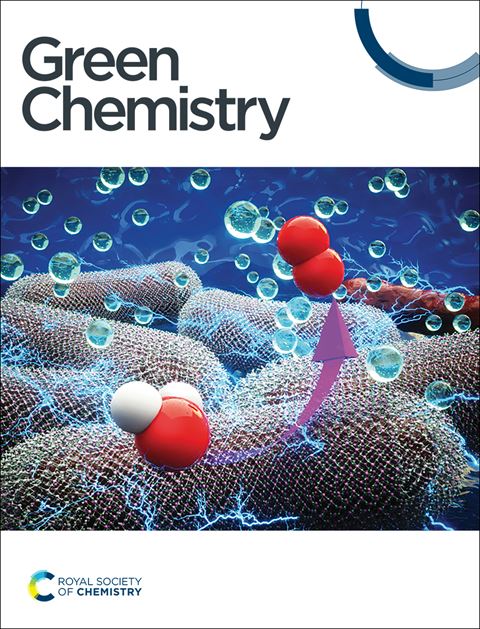
Lian Xue , Boyu Zhu , Peng Zheng , Xinyao Li , Kaiyu Geng , Jiao Geng , Xingbang Hu
{"title":"界面臭氧化学使微滴中的芳香氧化成为可能","authors":"Lian Xue , Boyu Zhu , Peng Zheng , Xinyao Li , Kaiyu Geng , Jiao Geng , Xingbang Hu","doi":"10.1039/d6gc00973e","DOIUrl":null,"url":null,"abstract":"<div><div>Developing safer and more sustainable oxidation strategies for aromatic hydrocarbons remains a key challenge in green chemistry due to the reliance on hazardous oxidants and metal catalysts. Here, we demonstrate that ozone (O<sub>3</sub>) can be generated <em>in situ</em> at aqueous microdroplet air–water interfaces and directly utilized for the selective oxidation of naphthalene (NA) under mild, catalyst-free conditions. In an ultrasonic microdroplet system, NA is converted into dimethyl phthalate (DMP) with an isolable yield of 11.6%. Ozone formation and reaction occur concurrently within the confined droplet environment, eliminating the need for external ozone generation. Experimental and theoretical studies support an interfacial O<sub>3</sub>-mediated pathway initiated by transient discharge events. These results demonstrate the potential of microdroplet interfaces as a platform for inherently safer ozone-mediated oxidation.</div></div>","PeriodicalId":78,"journal":{"name":"Green Chemistry","volume":"28 24","pages":"Pages 10050-10056"},"PeriodicalIF":10.6000,"publicationDate":"2026-06-22","publicationTypes":"Journal Article","fieldsOfStudy":null,"isOpenAccess":false,"openAccessPdf":"","citationCount":"0","resultStr":"{\"title\":\"Interfacial ozone chemistry enables aromatic oxidation in microdroplets\",\"authors\":\"Lian Xue , Boyu Zhu , Peng Zheng , Xinyao Li , Kaiyu Geng , Jiao Geng , Xingbang Hu\",\"doi\":\"10.1039/d6gc00973e\",\"DOIUrl\":null,\"url\":null,\"abstract\":\"<div><div>Developing safer and more sustainable oxidation strategies for aromatic hydrocarbons remains a key challenge in green chemistry due to the reliance on hazardous oxidants and metal catalysts. Here, we demonstrate that ozone (O<sub>3</sub>) can be generated <em>in situ</em> at aqueous microdroplet air–water interfaces and directly utilized for the selective oxidation of naphthalene (NA) under mild, catalyst-free conditions. In an ultrasonic microdroplet system, NA is converted into dimethyl phthalate (DMP) with an isolable yield of 11.6%. Ozone formation and reaction occur concurrently within the confined droplet environment, eliminating the need for external ozone generation. Experimental and theoretical studies support an interfacial O<sub>3</sub>-mediated pathway initiated by transient discharge events. These results demonstrate the potential of microdroplet interfaces as a platform for inherently safer ozone-mediated oxidation.</div></div>\",\"PeriodicalId\":78,\"journal\":{\"name\":\"Green Chemistry\",\"volume\":\"28 24\",\"pages\":\"Pages 10050-10056\"},\"PeriodicalIF\":10.6000,\"publicationDate\":\"2026-06-22\",\"publicationTypes\":\"Journal Article\",\"fieldsOfStudy\":null,\"isOpenAccess\":false,\"openAccessPdf\":\"\",\"citationCount\":\"0\",\"resultStr\":null,\"platform\":\"Semanticscholar\",\"paperid\":null,\"PeriodicalName\":\"Green Chemistry\",\"FirstCategoryId\":\"92\",\"ListUrlMain\":\"https://www.sciencedirect.com/org/science/article/pii/S1463926226005339\",\"RegionNum\":1,\"RegionCategory\":\"化学\",\"ArticlePicture\":[],\"TitleCN\":null,\"AbstractTextCN\":null,\"PMCID\":null,\"EPubDate\":\"2026/6/2 0:00:00\",\"PubModel\":\"Epub\",\"JCR\":\"Q1\",\"JCRName\":\"CHEMISTRY, MULTIDISCIPLINARY\",\"Score\":null,\"Total\":0}","platform":"Semanticscholar","paperid":null,"PeriodicalName":"Green Chemistry","FirstCategoryId":"92","ListUrlMain":"https://www.sciencedirect.com/org/science/article/pii/S1463926226005339","RegionNum":1,"RegionCategory":"化学","ArticlePicture":[],"TitleCN":null,"AbstractTextCN":null,"PMCID":null,"EPubDate":"2026/6/2 0:00:00","PubModel":"Epub","JCR":"Q1","JCRName":"CHEMISTRY, MULTIDISCIPLINARY","Score":null,"Total":0}
Interfacial ozone chemistry enables aromatic oxidation in microdroplets
Developing safer and more sustainable oxidation strategies for aromatic hydrocarbons remains a key challenge in green chemistry due to the reliance on hazardous oxidants and metal catalysts. Here, we demonstrate that ozone (O3) can be generated in situ at aqueous microdroplet air–water interfaces and directly utilized for the selective oxidation of naphthalene (NA) under mild, catalyst-free conditions. In an ultrasonic microdroplet system, NA is converted into dimethyl phthalate (DMP) with an isolable yield of 11.6%. Ozone formation and reaction occur concurrently within the confined droplet environment, eliminating the need for external ozone generation. Experimental and theoretical studies support an interfacial O3-mediated pathway initiated by transient discharge events. These results demonstrate the potential of microdroplet interfaces as a platform for inherently safer ozone-mediated oxidation.
期刊介绍:
Green Chemistry is a journal that provides a unique forum for the publication of innovative research on the development of alternative green and sustainable technologies. The scope of Green Chemistry is based on the definition proposed by Anastas and Warner (Green Chemistry: Theory and Practice, P T Anastas and J C Warner, Oxford University Press, Oxford, 1998), which defines green chemistry as the utilisation of a set of principles that reduces or eliminates the use or generation of hazardous substances in the design, manufacture and application of chemical products. Green Chemistry aims to reduce the environmental impact of the chemical enterprise by developing a technology base that is inherently non-toxic to living things and the environment. The journal welcomes submissions on all aspects of research relating to this endeavor and publishes original and significant cutting-edge research that is likely to be of wide general appeal. For a work to be published, it must present a significant advance in green chemistry, including a comparison with existing methods and a demonstration of advantages over those methods.