{"title":"基于元素映射的FESEM-EDS和MA-XRF对纸质文档中褪色笔迹的重建","authors":"Qinwen Wang, Jingqi Wang and Xiaoshuang Guo","doi":"10.1039/D6JA00165C","DOIUrl":null,"url":null,"abstract":"<p >Fading of handwritten text in archival paper documents poses a significant challenge for information preservation and document analysis. Conventional restoration methods, particularly chemical treatments, may cause irreversible damage to both ink and paper substrates. In this study, a nondestructive elemental analysis strategy was developed to reconstruct faded handwriting by mapping the spatial distribution of inorganic elements remaining in ink traces. Field-emission scanning electron microscopy coupled with energy-dispersive spectroscopy (FESEM-EDS) and macro X-ray fluorescence spectroscopy (MA-XRF) were employed to obtain elemental distribution maps of faded scripts. Artificially aged ink samples were prepared through ultraviolet irradiation to simulate different degrees of fading. The results demonstrate that both FESEM-EDS mapping and MA-XRF can effectively identify elemental distributions in moderately faded handwriting and enable visual reconstruction of the original script morphology. However, when the elemental concentration decreases to approximately 0.211%, FESEM-EDS mapping shows limited capability for handwriting restoration. In contrast, MA-XRF maintains higher detection sensitivity and enables successful reconstruction under nondestructive conditions. The proposed elemental mapping strategy provides a practical analytical approach for the identification and visualization of severely faded handwriting in paper-based cultural heritage materials.</p>","PeriodicalId":81,"journal":{"name":"Journal of Analytical Atomic Spectrometry","volume":" 6","pages":" 2243-2253"},"PeriodicalIF":3.3000,"publicationDate":"2026-05-21","publicationTypes":"Journal Article","fieldsOfStudy":null,"isOpenAccess":false,"openAccessPdf":"","citationCount":"0","resultStr":"{\"title\":\"Elemental mapping-based reconstruction of faded handwriting in paper documents using FESEM-EDS and MA-XRF\",\"authors\":\"Qinwen Wang, Jingqi Wang and Xiaoshuang Guo\",\"doi\":\"10.1039/D6JA00165C\",\"DOIUrl\":null,\"url\":null,\"abstract\":\"<p >Fading of handwritten text in archival paper documents poses a significant challenge for information preservation and document analysis. Conventional restoration methods, particularly chemical treatments, may cause irreversible damage to both ink and paper substrates. In this study, a nondestructive elemental analysis strategy was developed to reconstruct faded handwriting by mapping the spatial distribution of inorganic elements remaining in ink traces. Field-emission scanning electron microscopy coupled with energy-dispersive spectroscopy (FESEM-EDS) and macro X-ray fluorescence spectroscopy (MA-XRF) were employed to obtain elemental distribution maps of faded scripts. Artificially aged ink samples were prepared through ultraviolet irradiation to simulate different degrees of fading. The results demonstrate that both FESEM-EDS mapping and MA-XRF can effectively identify elemental distributions in moderately faded handwriting and enable visual reconstruction of the original script morphology. However, when the elemental concentration decreases to approximately 0.211%, FESEM-EDS mapping shows limited capability for handwriting restoration. In contrast, MA-XRF maintains higher detection sensitivity and enables successful reconstruction under nondestructive conditions. The proposed elemental mapping strategy provides a practical analytical approach for the identification and visualization of severely faded handwriting in paper-based cultural heritage materials.</p>\",\"PeriodicalId\":81,\"journal\":{\"name\":\"Journal of Analytical Atomic Spectrometry\",\"volume\":\" 6\",\"pages\":\" 2243-2253\"},\"PeriodicalIF\":3.3000,\"publicationDate\":\"2026-05-21\",\"publicationTypes\":\"Journal Article\",\"fieldsOfStudy\":null,\"isOpenAccess\":false,\"openAccessPdf\":\"\",\"citationCount\":\"0\",\"resultStr\":null,\"platform\":\"Semanticscholar\",\"paperid\":null,\"PeriodicalName\":\"Journal of Analytical Atomic Spectrometry\",\"FirstCategoryId\":\"92\",\"ListUrlMain\":\"https://pubs.rsc.org/en/content/articlelanding/2026/ja/d6ja00165c\",\"RegionNum\":2,\"RegionCategory\":\"化学\",\"ArticlePicture\":[],\"TitleCN\":null,\"AbstractTextCN\":null,\"PMCID\":null,\"EPubDate\":\"\",\"PubModel\":\"\",\"JCR\":\"Q2\",\"JCRName\":\"CHEMISTRY, ANALYTICAL\",\"Score\":null,\"Total\":0}","platform":"Semanticscholar","paperid":null,"PeriodicalName":"Journal of Analytical Atomic Spectrometry","FirstCategoryId":"92","ListUrlMain":"https://pubs.rsc.org/en/content/articlelanding/2026/ja/d6ja00165c","RegionNum":2,"RegionCategory":"化学","ArticlePicture":[],"TitleCN":null,"AbstractTextCN":null,"PMCID":null,"EPubDate":"","PubModel":"","JCR":"Q2","JCRName":"CHEMISTRY, ANALYTICAL","Score":null,"Total":0}
Elemental mapping-based reconstruction of faded handwriting in paper documents using FESEM-EDS and MA-XRF
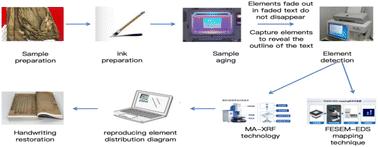
Fading of handwritten text in archival paper documents poses a significant challenge for information preservation and document analysis. Conventional restoration methods, particularly chemical treatments, may cause irreversible damage to both ink and paper substrates. In this study, a nondestructive elemental analysis strategy was developed to reconstruct faded handwriting by mapping the spatial distribution of inorganic elements remaining in ink traces. Field-emission scanning electron microscopy coupled with energy-dispersive spectroscopy (FESEM-EDS) and macro X-ray fluorescence spectroscopy (MA-XRF) were employed to obtain elemental distribution maps of faded scripts. Artificially aged ink samples were prepared through ultraviolet irradiation to simulate different degrees of fading. The results demonstrate that both FESEM-EDS mapping and MA-XRF can effectively identify elemental distributions in moderately faded handwriting and enable visual reconstruction of the original script morphology. However, when the elemental concentration decreases to approximately 0.211%, FESEM-EDS mapping shows limited capability for handwriting restoration. In contrast, MA-XRF maintains higher detection sensitivity and enables successful reconstruction under nondestructive conditions. The proposed elemental mapping strategy provides a practical analytical approach for the identification and visualization of severely faded handwriting in paper-based cultural heritage materials.

 求助内容:
 应助结果提醒方式:


 京公网安备 11010802042870号


