{"title":"针对麻疹病毒F蛋白的最小融合抑制剂的鉴定及构效关系分析。","authors":"Kazuya Kobayashi, Yuki Yamaguchi, Mizuki Itahara, Kazushige Hirata, Keisuke Aoki, Naoya Iwamoto, Hironori Hayashi, Eiichi Kodama and Shinya Oishi","doi":"10.1039/D6MD00211K","DOIUrl":null,"url":null,"abstract":"<p >Although measles has been effectively controlled by vaccination, sporadic outbreaks still occur worldwide, highlighting the need for antiviral agents as complementary measures to achieve sustained elimination. Previously, we reported an anti-measles virus (MV) peptide derived from the HR2 region of MV fusion (F) protein that inhibits viral membrane fusion by disrupting the interaction between HR1 and HR2 regions. Here, we aimed to optimize this peptide by minimizing its sequence and interaction characteristics, thereby identifying a short derivative that retains potent antiviral activity. Structure–activity relationship analyses revealed that both hydrophobic and polar residues in HR2-derived peptides are crucial for efficient interaction with HR1. Thermal stability analysis of potential six-helical bundles using HR1-40, a 40-residue peptide of the HR1 region, showed no clear correlation with antiviral activity. To address this, we designed HR1Y, a C-terminally extended HR1 variant, which allowed a more accurate assessment of complex stability. Furthermore, molecular modeling of the HR2-derived peptide–HR1Y complex reproduced several experimental trends and provided structural insight into the HR1–HR2 interface. These findings clarify the structural determinants of fusion inhibitors against MV and support the rational optimization of HR2-derived antiviral peptides.</p>","PeriodicalId":88,"journal":{"name":"MedChemComm","volume":" 6","pages":" 3100-3114"},"PeriodicalIF":3.5970,"publicationDate":"2026-05-13","publicationTypes":"Journal Article","fieldsOfStudy":null,"isOpenAccess":false,"openAccessPdf":"https://www.ncbi.nlm.nih.gov/pmc/articles/PMC13227976/pdf/","citationCount":"0","resultStr":"{\"title\":\"Identification and structure–activity relationship analysis of minimal fusion inhibitors targeting measles virus F protein\",\"authors\":\"Kazuya Kobayashi, Yuki Yamaguchi, Mizuki Itahara, Kazushige Hirata, Keisuke Aoki, Naoya Iwamoto, Hironori Hayashi, Eiichi Kodama and Shinya Oishi\",\"doi\":\"10.1039/D6MD00211K\",\"DOIUrl\":null,\"url\":null,\"abstract\":\"<p >Although measles has been effectively controlled by vaccination, sporadic outbreaks still occur worldwide, highlighting the need for antiviral agents as complementary measures to achieve sustained elimination. Previously, we reported an anti-measles virus (MV) peptide derived from the HR2 region of MV fusion (F) protein that inhibits viral membrane fusion by disrupting the interaction between HR1 and HR2 regions. Here, we aimed to optimize this peptide by minimizing its sequence and interaction characteristics, thereby identifying a short derivative that retains potent antiviral activity. Structure–activity relationship analyses revealed that both hydrophobic and polar residues in HR2-derived peptides are crucial for efficient interaction with HR1. Thermal stability analysis of potential six-helical bundles using HR1-40, a 40-residue peptide of the HR1 region, showed no clear correlation with antiviral activity. To address this, we designed HR1Y, a C-terminally extended HR1 variant, which allowed a more accurate assessment of complex stability. Furthermore, molecular modeling of the HR2-derived peptide–HR1Y complex reproduced several experimental trends and provided structural insight into the HR1–HR2 interface. These findings clarify the structural determinants of fusion inhibitors against MV and support the rational optimization of HR2-derived antiviral peptides.</p>\",\"PeriodicalId\":88,\"journal\":{\"name\":\"MedChemComm\",\"volume\":\" 6\",\"pages\":\" 3100-3114\"},\"PeriodicalIF\":3.5970,\"publicationDate\":\"2026-05-13\",\"publicationTypes\":\"Journal Article\",\"fieldsOfStudy\":null,\"isOpenAccess\":false,\"openAccessPdf\":\"https://www.ncbi.nlm.nih.gov/pmc/articles/PMC13227976/pdf/\",\"citationCount\":\"0\",\"resultStr\":null,\"platform\":\"Semanticscholar\",\"paperid\":null,\"PeriodicalName\":\"MedChemComm\",\"FirstCategoryId\":\"1085\",\"ListUrlMain\":\"https://pubs.rsc.org/en/content/articlelanding/2026/md/d6md00211k\",\"RegionNum\":0,\"RegionCategory\":null,\"ArticlePicture\":[],\"TitleCN\":null,\"AbstractTextCN\":null,\"PMCID\":null,\"EPubDate\":\"\",\"PubModel\":\"\",\"JCR\":\"Q2\",\"JCRName\":\"Pharmacology, Toxicology and Pharmaceutics\",\"Score\":null,\"Total\":0}","platform":"Semanticscholar","paperid":null,"PeriodicalName":"MedChemComm","FirstCategoryId":"1085","ListUrlMain":"https://pubs.rsc.org/en/content/articlelanding/2026/md/d6md00211k","RegionNum":0,"RegionCategory":null,"ArticlePicture":[],"TitleCN":null,"AbstractTextCN":null,"PMCID":null,"EPubDate":"","PubModel":"","JCR":"Q2","JCRName":"Pharmacology, Toxicology and Pharmaceutics","Score":null,"Total":0}
Identification and structure–activity relationship analysis of minimal fusion inhibitors targeting measles virus F protein
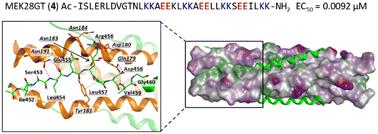
Although measles has been effectively controlled by vaccination, sporadic outbreaks still occur worldwide, highlighting the need for antiviral agents as complementary measures to achieve sustained elimination. Previously, we reported an anti-measles virus (MV) peptide derived from the HR2 region of MV fusion (F) protein that inhibits viral membrane fusion by disrupting the interaction between HR1 and HR2 regions. Here, we aimed to optimize this peptide by minimizing its sequence and interaction characteristics, thereby identifying a short derivative that retains potent antiviral activity. Structure–activity relationship analyses revealed that both hydrophobic and polar residues in HR2-derived peptides are crucial for efficient interaction with HR1. Thermal stability analysis of potential six-helical bundles using HR1-40, a 40-residue peptide of the HR1 region, showed no clear correlation with antiviral activity. To address this, we designed HR1Y, a C-terminally extended HR1 variant, which allowed a more accurate assessment of complex stability. Furthermore, molecular modeling of the HR2-derived peptide–HR1Y complex reproduced several experimental trends and provided structural insight into the HR1–HR2 interface. These findings clarify the structural determinants of fusion inhibitors against MV and support the rational optimization of HR2-derived antiviral peptides.
期刊介绍:
Research and review articles in medicinal chemistry and related drug discovery science; the official journal of the European Federation for Medicinal Chemistry.
In 2020, MedChemComm will change its name to RSC Medicinal Chemistry. Issue 12, 2019 will be the last issue as MedChemComm.


 求助内容:
 应助结果提醒方式:


 京公网安备 11010802042870号


