Ting Wang, Yuchen Wang, Fuping Pan and Kai-Jie Chen
{"title":"通过配体修饰将镍基催化剂上的二氧化碳深度还原为C3+碳氢化合物","authors":"Ting Wang, Yuchen Wang, Fuping Pan and Kai-Jie Chen","doi":"10.1039/D6SE00029K","DOIUrl":null,"url":null,"abstract":"<p >Electrochemical CO<small><sub>2</sub></small> reduction is a promising approach to produce synthetic fuels and chemicals. Nickel-based catalysts have been shown to reduce CO<small><sub>2</sub></small> toward long-chain hydrocarbons, whereas selectivity remains limited due to inefficient C–C coupling. We report a ligand-engineering strategy to modulate the electronic properties of a nickel hydroxide catalyst by surface cysteamine modification (Ni-OH-c) to boost the generation of C<small><sub>3+</sub></small> hydrocarbons. Structural and compositional characterization showed that carbon-supported amorphous Ni(OH)<small><sub>2</sub></small> nanosheets were reconstructed <em>in situ</em> into ultrasmall crystalline Ni(OH)<small><sub>2</sub></small> nanoparticles. More importantly, surface cysteamine donates an electron to Ni(OH)<small><sub>2</sub></small>, thus increasing the surface electron density of Ni(OH)<small><sub>2</sub></small> and creating interfacial Ni<small><sup>δ+</sup></small>/Ni<small><sup>2+</sup></small> sites. Electrochemical measurements showed that, compared with pristine Ni(OH)<small><sub>2</sub></small>, Ni-OH-c significantly promoted deep CO<small><sub>2</sub></small> reduction and C–C coupling, presenting a C<small><sub>3+</sub></small> hydrocarbons faradaic efficiency of 1.88% and a partial current density of 0.31 mA cm<small><sup>−2</sup></small>. We demonstrated stable C<small><sub>3+</sub></small> hydrocarbon generation for over 13 h. <em>In situ</em> spectroscopic investigation revealed that cysteamine modification facilitated the adsorption of bridge-bonded *CO, which promoted *CO hydrogenation and enabled facile asymmetric *CO–COH coupling, thereby enabling the preferential generation of C<small><sub>3+</sub></small> hydrocarbons. These findings offer an effective platform toward rational design of high-performance Ni-based non-Cu catalysts for selective synthesis of valuable long-chain feedstocks from direct CO<small><sub>2</sub></small> reduction.</p>","PeriodicalId":104,"journal":{"name":"Sustainable Energy & Fuels","volume":" 10","pages":" 2590-2597"},"PeriodicalIF":4.6000,"publicationDate":"2026-05-01","publicationTypes":"Journal Article","fieldsOfStudy":null,"isOpenAccess":false,"openAccessPdf":"","citationCount":"0","resultStr":"{\"title\":\"Steering deep CO2 reduction to C3+ hydrocarbons on nickel-based catalysts via ligand modification\",\"authors\":\"Ting Wang, Yuchen Wang, Fuping Pan and Kai-Jie Chen\",\"doi\":\"10.1039/D6SE00029K\",\"DOIUrl\":null,\"url\":null,\"abstract\":\"<p >Electrochemical CO<small><sub>2</sub></small> reduction is a promising approach to produce synthetic fuels and chemicals. Nickel-based catalysts have been shown to reduce CO<small><sub>2</sub></small> toward long-chain hydrocarbons, whereas selectivity remains limited due to inefficient C–C coupling. We report a ligand-engineering strategy to modulate the electronic properties of a nickel hydroxide catalyst by surface cysteamine modification (Ni-OH-c) to boost the generation of C<small><sub>3+</sub></small> hydrocarbons. Structural and compositional characterization showed that carbon-supported amorphous Ni(OH)<small><sub>2</sub></small> nanosheets were reconstructed <em>in situ</em> into ultrasmall crystalline Ni(OH)<small><sub>2</sub></small> nanoparticles. More importantly, surface cysteamine donates an electron to Ni(OH)<small><sub>2</sub></small>, thus increasing the surface electron density of Ni(OH)<small><sub>2</sub></small> and creating interfacial Ni<small><sup>δ+</sup></small>/Ni<small><sup>2+</sup></small> sites. Electrochemical measurements showed that, compared with pristine Ni(OH)<small><sub>2</sub></small>, Ni-OH-c significantly promoted deep CO<small><sub>2</sub></small> reduction and C–C coupling, presenting a C<small><sub>3+</sub></small> hydrocarbons faradaic efficiency of 1.88% and a partial current density of 0.31 mA cm<small><sup>−2</sup></small>. We demonstrated stable C<small><sub>3+</sub></small> hydrocarbon generation for over 13 h. <em>In situ</em> spectroscopic investigation revealed that cysteamine modification facilitated the adsorption of bridge-bonded *CO, which promoted *CO hydrogenation and enabled facile asymmetric *CO–COH coupling, thereby enabling the preferential generation of C<small><sub>3+</sub></small> hydrocarbons. These findings offer an effective platform toward rational design of high-performance Ni-based non-Cu catalysts for selective synthesis of valuable long-chain feedstocks from direct CO<small><sub>2</sub></small> reduction.</p>\",\"PeriodicalId\":104,\"journal\":{\"name\":\"Sustainable Energy & Fuels\",\"volume\":\" 10\",\"pages\":\" 2590-2597\"},\"PeriodicalIF\":4.6000,\"publicationDate\":\"2026-05-01\",\"publicationTypes\":\"Journal Article\",\"fieldsOfStudy\":null,\"isOpenAccess\":false,\"openAccessPdf\":\"\",\"citationCount\":\"0\",\"resultStr\":null,\"platform\":\"Semanticscholar\",\"paperid\":null,\"PeriodicalName\":\"Sustainable Energy & Fuels\",\"FirstCategoryId\":\"88\",\"ListUrlMain\":\"https://pubs.rsc.org/en/content/articlelanding/2026/se/d6se00029k\",\"RegionNum\":3,\"RegionCategory\":\"材料科学\",\"ArticlePicture\":[],\"TitleCN\":null,\"AbstractTextCN\":null,\"PMCID\":null,\"EPubDate\":\"\",\"PubModel\":\"\",\"JCR\":\"Q2\",\"JCRName\":\"CHEMISTRY, PHYSICAL\",\"Score\":null,\"Total\":0}","platform":"Semanticscholar","paperid":null,"PeriodicalName":"Sustainable Energy & Fuels","FirstCategoryId":"88","ListUrlMain":"https://pubs.rsc.org/en/content/articlelanding/2026/se/d6se00029k","RegionNum":3,"RegionCategory":"材料科学","ArticlePicture":[],"TitleCN":null,"AbstractTextCN":null,"PMCID":null,"EPubDate":"","PubModel":"","JCR":"Q2","JCRName":"CHEMISTRY, PHYSICAL","Score":null,"Total":0}
引用次数: 0
摘要
电化学CO2还原是生产合成燃料和化学品的一种很有前途的方法。镍基催化剂已被证明可以将CO2还原为长链烃,但由于碳-碳耦合效率低,选择性仍然有限。我们报道了一种配体工程策略,通过表面半胱胺修饰(Ni-OH-c)来调节氢氧化镍催化剂的电子性质,以促进C3+碳氢化合物的生成。结构和组成表征表明,碳负载的非晶态Ni(OH)2纳米片被原位重构为超小晶体Ni(OH)2纳米颗粒。更重要的是,表面半胱胺给Ni(OH)2提供了一个电子,从而增加了Ni(OH)2的表面电子密度,并形成了Ni(OH)2 +/Ni2+的界面位。电化学测量结果表明,与原始Ni(OH)2相比,Ni-OH-c显著促进了CO2深度还原和C-C耦合,C3+碳氢化合物的法拉第效率为1.88%,分电流密度为0.31 mA cm−2。原位光谱研究表明,半胱胺修饰促进了桥键*CO的吸附,从而促进了*CO的氢化,使*CO - coh容易发生不对称偶联,从而使C3+碳氢化合物优先生成。这些发现为合理设计高性能镍基非铜催化剂提供了有效的平台,用于从直接CO2还原中选择性合成有价值的长链原料。
Steering deep CO2 reduction to C3+ hydrocarbons on nickel-based catalysts via ligand modification
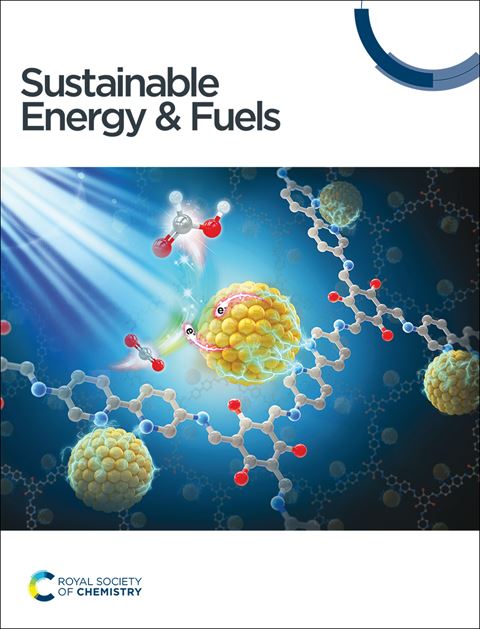
Electrochemical CO2 reduction is a promising approach to produce synthetic fuels and chemicals. Nickel-based catalysts have been shown to reduce CO2 toward long-chain hydrocarbons, whereas selectivity remains limited due to inefficient C–C coupling. We report a ligand-engineering strategy to modulate the electronic properties of a nickel hydroxide catalyst by surface cysteamine modification (Ni-OH-c) to boost the generation of C3+ hydrocarbons. Structural and compositional characterization showed that carbon-supported amorphous Ni(OH)2 nanosheets were reconstructed in situ into ultrasmall crystalline Ni(OH)2 nanoparticles. More importantly, surface cysteamine donates an electron to Ni(OH)2, thus increasing the surface electron density of Ni(OH)2 and creating interfacial Niδ+/Ni2+ sites. Electrochemical measurements showed that, compared with pristine Ni(OH)2, Ni-OH-c significantly promoted deep CO2 reduction and C–C coupling, presenting a C3+ hydrocarbons faradaic efficiency of 1.88% and a partial current density of 0.31 mA cm−2. We demonstrated stable C3+ hydrocarbon generation for over 13 h. In situ spectroscopic investigation revealed that cysteamine modification facilitated the adsorption of bridge-bonded *CO, which promoted *CO hydrogenation and enabled facile asymmetric *CO–COH coupling, thereby enabling the preferential generation of C3+ hydrocarbons. These findings offer an effective platform toward rational design of high-performance Ni-based non-Cu catalysts for selective synthesis of valuable long-chain feedstocks from direct CO2 reduction.
期刊介绍:
Sustainable Energy & Fuels will publish research that contributes to the development of sustainable energy technologies with a particular emphasis on new and next-generation technologies.


 求助内容:
 应助结果提醒方式:


 京公网安备 11010802042870号


