{"title":"具有抗增殖活性的吖啶衍生物的研究进展。","authors":"Mahdi Gallala, Najeh Tka and Sonia Aroui","doi":"10.1039/D6MD00023A","DOIUrl":null,"url":null,"abstract":"<p >Cancer remains a leading cause of mortality worldwide, with the limitations of conventional single-target therapies, such as severe side effects and drug resistance, driving the need for innovative treatment strategies. Molecular hybridization has emerged as a powerful rational drug design approach to develop multi-target agents capable of simultaneously modulating various oncogenic pathways. Among the diverse scaffolds explored, the acridine core, a tricyclic, planar heteroaromatic structure, stands out due to its inherent DNA-intercalating ability and potent antiproliferative activity through mechanisms like topoisomerase inhibition. This review provides a comprehensive overview of recent advances (2019–2025) in the design, synthesis, evaluation, and perspectives of acridine-based hybrids as antiproliferative agents. It systematically surveys a vast array of hybrids, classifying them by their dominant secondary pharmacophores to offer a structured and practical overview of the field. Particular attention is given to structure–activity relationships (SARs), illustrating how strategic modifications can affect cytotoxicity, selectivity, and underlying mechanistic pathways. The biological evaluation of these hybrids encompasses a range of <em>in vitro</em> assays, including cytotoxicity against diverse human cancer cell lines, enzyme inhibition studies, antiangiogenic assays, and preliminary <em>in vivo</em> experiments, reflecting their multifaceted pharmacological profiles. Computational approaches, such as molecular docking, molecular dynamics, and quantitative SAR (QSAR), have further contributed mechanistic insights and informed rational optimization of pharmacokinetic and pharmacodynamic properties. The review concludes by addressing current challenges and future directions, emphasizing the transformative potential of integrating artificial intelligence (AI) with computer-aided drug design (CADD) and advanced delivery systems. By compiling these developments, this work aims to serve as a useful reference to assist researchers in the design of new, more effective acridine-based anticancer agents.</p>","PeriodicalId":88,"journal":{"name":"MedChemComm","volume":" 6","pages":" 2768-2849"},"PeriodicalIF":3.5970,"publicationDate":"2026-04-14","publicationTypes":"Journal Article","fieldsOfStudy":null,"isOpenAccess":false,"openAccessPdf":"","citationCount":"0","resultStr":"{\"title\":\"Recent advances in the development of acridine-based hybrids with antiproliferative activity\",\"authors\":\"Mahdi Gallala, Najeh Tka and Sonia Aroui\",\"doi\":\"10.1039/D6MD00023A\",\"DOIUrl\":null,\"url\":null,\"abstract\":\"<p >Cancer remains a leading cause of mortality worldwide, with the limitations of conventional single-target therapies, such as severe side effects and drug resistance, driving the need for innovative treatment strategies. Molecular hybridization has emerged as a powerful rational drug design approach to develop multi-target agents capable of simultaneously modulating various oncogenic pathways. Among the diverse scaffolds explored, the acridine core, a tricyclic, planar heteroaromatic structure, stands out due to its inherent DNA-intercalating ability and potent antiproliferative activity through mechanisms like topoisomerase inhibition. This review provides a comprehensive overview of recent advances (2019–2025) in the design, synthesis, evaluation, and perspectives of acridine-based hybrids as antiproliferative agents. It systematically surveys a vast array of hybrids, classifying them by their dominant secondary pharmacophores to offer a structured and practical overview of the field. Particular attention is given to structure–activity relationships (SARs), illustrating how strategic modifications can affect cytotoxicity, selectivity, and underlying mechanistic pathways. The biological evaluation of these hybrids encompasses a range of <em>in vitro</em> assays, including cytotoxicity against diverse human cancer cell lines, enzyme inhibition studies, antiangiogenic assays, and preliminary <em>in vivo</em> experiments, reflecting their multifaceted pharmacological profiles. Computational approaches, such as molecular docking, molecular dynamics, and quantitative SAR (QSAR), have further contributed mechanistic insights and informed rational optimization of pharmacokinetic and pharmacodynamic properties. The review concludes by addressing current challenges and future directions, emphasizing the transformative potential of integrating artificial intelligence (AI) with computer-aided drug design (CADD) and advanced delivery systems. By compiling these developments, this work aims to serve as a useful reference to assist researchers in the design of new, more effective acridine-based anticancer agents.</p>\",\"PeriodicalId\":88,\"journal\":{\"name\":\"MedChemComm\",\"volume\":\" 6\",\"pages\":\" 2768-2849\"},\"PeriodicalIF\":3.5970,\"publicationDate\":\"2026-04-14\",\"publicationTypes\":\"Journal Article\",\"fieldsOfStudy\":null,\"isOpenAccess\":false,\"openAccessPdf\":\"\",\"citationCount\":\"0\",\"resultStr\":null,\"platform\":\"Semanticscholar\",\"paperid\":null,\"PeriodicalName\":\"MedChemComm\",\"FirstCategoryId\":\"1085\",\"ListUrlMain\":\"https://pubs.rsc.org/en/content/articlelanding/2026/md/d6md00023a\",\"RegionNum\":0,\"RegionCategory\":null,\"ArticlePicture\":[],\"TitleCN\":null,\"AbstractTextCN\":null,\"PMCID\":null,\"EPubDate\":\"\",\"PubModel\":\"\",\"JCR\":\"Q2\",\"JCRName\":\"Pharmacology, Toxicology and Pharmaceutics\",\"Score\":null,\"Total\":0}","platform":"Semanticscholar","paperid":null,"PeriodicalName":"MedChemComm","FirstCategoryId":"1085","ListUrlMain":"https://pubs.rsc.org/en/content/articlelanding/2026/md/d6md00023a","RegionNum":0,"RegionCategory":null,"ArticlePicture":[],"TitleCN":null,"AbstractTextCN":null,"PMCID":null,"EPubDate":"","PubModel":"","JCR":"Q2","JCRName":"Pharmacology, Toxicology and Pharmaceutics","Score":null,"Total":0}
Recent advances in the development of acridine-based hybrids with antiproliferative activity
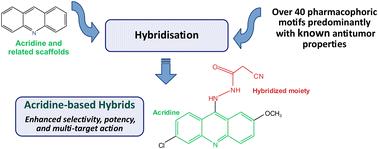
Cancer remains a leading cause of mortality worldwide, with the limitations of conventional single-target therapies, such as severe side effects and drug resistance, driving the need for innovative treatment strategies. Molecular hybridization has emerged as a powerful rational drug design approach to develop multi-target agents capable of simultaneously modulating various oncogenic pathways. Among the diverse scaffolds explored, the acridine core, a tricyclic, planar heteroaromatic structure, stands out due to its inherent DNA-intercalating ability and potent antiproliferative activity through mechanisms like topoisomerase inhibition. This review provides a comprehensive overview of recent advances (2019–2025) in the design, synthesis, evaluation, and perspectives of acridine-based hybrids as antiproliferative agents. It systematically surveys a vast array of hybrids, classifying them by their dominant secondary pharmacophores to offer a structured and practical overview of the field. Particular attention is given to structure–activity relationships (SARs), illustrating how strategic modifications can affect cytotoxicity, selectivity, and underlying mechanistic pathways. The biological evaluation of these hybrids encompasses a range of in vitro assays, including cytotoxicity against diverse human cancer cell lines, enzyme inhibition studies, antiangiogenic assays, and preliminary in vivo experiments, reflecting their multifaceted pharmacological profiles. Computational approaches, such as molecular docking, molecular dynamics, and quantitative SAR (QSAR), have further contributed mechanistic insights and informed rational optimization of pharmacokinetic and pharmacodynamic properties. The review concludes by addressing current challenges and future directions, emphasizing the transformative potential of integrating artificial intelligence (AI) with computer-aided drug design (CADD) and advanced delivery systems. By compiling these developments, this work aims to serve as a useful reference to assist researchers in the design of new, more effective acridine-based anticancer agents.
期刊介绍:
Research and review articles in medicinal chemistry and related drug discovery science; the official journal of the European Federation for Medicinal Chemistry.
In 2020, MedChemComm will change its name to RSC Medicinal Chemistry. Issue 12, 2019 will be the last issue as MedChemComm.

 求助内容:
 应助结果提醒方式:


 京公网安备 11010802042870号


