{"title":"新兴的bRo5 protac细胞摄取机制。","authors":"Toshihiko Tashima","doi":"10.1039/D6MD00243A","DOIUrl":null,"url":null,"abstract":"<p >Proteolysis-targeting chimeras (PROTACs) predominantly occupy beyond-rule-of-5 (bRo5) chemical space, where the mechanisms governing their cellular uptake remain incompletely understood and are not captured by classical models of passive membrane diffusion. Considerable progress has been made in rationalizing the permeability of bRo5 compounds, including the contributions of chameleonic conformational behavior, intramolecular hydrogen bonding, and lipophilicity-driven membrane partitioning. However, these factors do not fully explain the intracellular activity observed for certain large and polar PROTACs, suggesting that additional uptake mechanisms may be involved. Recent studies have proposed that receptor-mediated processes may contribute to the cellular uptake of selected PROTACs. Among these, CD36-mediated endocytosis has emerged as one potential pathway for certain bRo5 PROTACs, including SIM1-Me and MZ1, although the current evidence remains limited and its broader applicability across PROTAC chemical space is unclear and likely context-dependent. In this review, I critically examine emerging uptake mechanisms for bRo5 PROTACs within the broader framework of established permeability models. Experimentally supported observations are clearly distinguished from mechanistic hypotheses, and I evaluate the biological plausibility of receptor-mediated contributions, with particular focus on CD36 in the context of its established roles in lipid and lipoprotein uptake. Within this framework, CD36-mediated endocytosis is considered as a complementary, context-dependent pathway that may operate alongside passive diffusion and other permeability mechanisms, particularly for subsets of PROTACs with structural features that enable receptor engagement. Finally, I outline key structural and biological determinants that may influence uptake pathway selection and highlight critical experimental questions required to assess the generality and design relevance of these mechanisms for PROTAC development.</p>","PeriodicalId":88,"journal":{"name":"MedChemComm","volume":" 6","pages":" 2850-2859"},"PeriodicalIF":3.5970,"publicationDate":"2026-04-23","publicationTypes":"Journal Article","fieldsOfStudy":null,"isOpenAccess":false,"openAccessPdf":"","citationCount":"0","resultStr":"{\"title\":\"Emerging cellular uptake mechanisms of bRo5 PROTACs\",\"authors\":\"Toshihiko Tashima\",\"doi\":\"10.1039/D6MD00243A\",\"DOIUrl\":null,\"url\":null,\"abstract\":\"<p >Proteolysis-targeting chimeras (PROTACs) predominantly occupy beyond-rule-of-5 (bRo5) chemical space, where the mechanisms governing their cellular uptake remain incompletely understood and are not captured by classical models of passive membrane diffusion. Considerable progress has been made in rationalizing the permeability of bRo5 compounds, including the contributions of chameleonic conformational behavior, intramolecular hydrogen bonding, and lipophilicity-driven membrane partitioning. However, these factors do not fully explain the intracellular activity observed for certain large and polar PROTACs, suggesting that additional uptake mechanisms may be involved. Recent studies have proposed that receptor-mediated processes may contribute to the cellular uptake of selected PROTACs. Among these, CD36-mediated endocytosis has emerged as one potential pathway for certain bRo5 PROTACs, including SIM1-Me and MZ1, although the current evidence remains limited and its broader applicability across PROTAC chemical space is unclear and likely context-dependent. In this review, I critically examine emerging uptake mechanisms for bRo5 PROTACs within the broader framework of established permeability models. Experimentally supported observations are clearly distinguished from mechanistic hypotheses, and I evaluate the biological plausibility of receptor-mediated contributions, with particular focus on CD36 in the context of its established roles in lipid and lipoprotein uptake. Within this framework, CD36-mediated endocytosis is considered as a complementary, context-dependent pathway that may operate alongside passive diffusion and other permeability mechanisms, particularly for subsets of PROTACs with structural features that enable receptor engagement. Finally, I outline key structural and biological determinants that may influence uptake pathway selection and highlight critical experimental questions required to assess the generality and design relevance of these mechanisms for PROTAC development.</p>\",\"PeriodicalId\":88,\"journal\":{\"name\":\"MedChemComm\",\"volume\":\" 6\",\"pages\":\" 2850-2859\"},\"PeriodicalIF\":3.5970,\"publicationDate\":\"2026-04-23\",\"publicationTypes\":\"Journal Article\",\"fieldsOfStudy\":null,\"isOpenAccess\":false,\"openAccessPdf\":\"\",\"citationCount\":\"0\",\"resultStr\":null,\"platform\":\"Semanticscholar\",\"paperid\":null,\"PeriodicalName\":\"MedChemComm\",\"FirstCategoryId\":\"1085\",\"ListUrlMain\":\"https://pubs.rsc.org/en/content/articlelanding/2026/md/d6md00243a\",\"RegionNum\":0,\"RegionCategory\":null,\"ArticlePicture\":[],\"TitleCN\":null,\"AbstractTextCN\":null,\"PMCID\":null,\"EPubDate\":\"\",\"PubModel\":\"\",\"JCR\":\"Q2\",\"JCRName\":\"Pharmacology, Toxicology and Pharmaceutics\",\"Score\":null,\"Total\":0}","platform":"Semanticscholar","paperid":null,"PeriodicalName":"MedChemComm","FirstCategoryId":"1085","ListUrlMain":"https://pubs.rsc.org/en/content/articlelanding/2026/md/d6md00243a","RegionNum":0,"RegionCategory":null,"ArticlePicture":[],"TitleCN":null,"AbstractTextCN":null,"PMCID":null,"EPubDate":"","PubModel":"","JCR":"Q2","JCRName":"Pharmacology, Toxicology and Pharmaceutics","Score":null,"Total":0}
Emerging cellular uptake mechanisms of bRo5 PROTACs
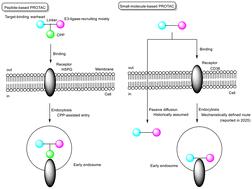
Proteolysis-targeting chimeras (PROTACs) predominantly occupy beyond-rule-of-5 (bRo5) chemical space, where the mechanisms governing their cellular uptake remain incompletely understood and are not captured by classical models of passive membrane diffusion. Considerable progress has been made in rationalizing the permeability of bRo5 compounds, including the contributions of chameleonic conformational behavior, intramolecular hydrogen bonding, and lipophilicity-driven membrane partitioning. However, these factors do not fully explain the intracellular activity observed for certain large and polar PROTACs, suggesting that additional uptake mechanisms may be involved. Recent studies have proposed that receptor-mediated processes may contribute to the cellular uptake of selected PROTACs. Among these, CD36-mediated endocytosis has emerged as one potential pathway for certain bRo5 PROTACs, including SIM1-Me and MZ1, although the current evidence remains limited and its broader applicability across PROTAC chemical space is unclear and likely context-dependent. In this review, I critically examine emerging uptake mechanisms for bRo5 PROTACs within the broader framework of established permeability models. Experimentally supported observations are clearly distinguished from mechanistic hypotheses, and I evaluate the biological plausibility of receptor-mediated contributions, with particular focus on CD36 in the context of its established roles in lipid and lipoprotein uptake. Within this framework, CD36-mediated endocytosis is considered as a complementary, context-dependent pathway that may operate alongside passive diffusion and other permeability mechanisms, particularly for subsets of PROTACs with structural features that enable receptor engagement. Finally, I outline key structural and biological determinants that may influence uptake pathway selection and highlight critical experimental questions required to assess the generality and design relevance of these mechanisms for PROTAC development.
期刊介绍:
Research and review articles in medicinal chemistry and related drug discovery science; the official journal of the European Federation for Medicinal Chemistry.
In 2020, MedChemComm will change its name to RSC Medicinal Chemistry. Issue 12, 2019 will be the last issue as MedChemComm.

 求助内容:
 应助结果提醒方式:


 京公网安备 11010802042870号


