{"title":"基于黑洞优化的GaN高电子迁移率晶体管建模方法","authors":"Anwar Jarndal","doi":"10.1007/s10825-026-02550-3","DOIUrl":null,"url":null,"abstract":"<div><p>This paper presents a black-hole optimization (BHO) based parameters extraction method. The developed method was applied on distributed small-signal equivalent circuit models of GaN HEMT. The BHO as a global technique generates initial values for the model elements that can be tuned in a later step using gradient or simplex local optimization. The reliability of extraction was improved by using measurement-based boundaries for the initially generated candidate solutions. Physics-based restriction conditions were implemented through the optimization process to avoid any nonrealistic values. The developed procedure was demonstrated by modeling different sizes devices on SiC, Diamond and Si substrates at different bias conditions. The modeling accuracy was validated by means of S-premasters simulations, which show a very good fitting to measured data. The extracted values of the models’ elements are consistent with the devices physics and scaling well with the device size. In general, the results obtained prove the applicability of the proposed approach for small-modeling and liner circuit design and providing an accurate and physically consistent framework within the operating conditions considered.</p></div>","PeriodicalId":620,"journal":{"name":"Journal of Computational Electronics","volume":"25 3","pages":""},"PeriodicalIF":2.5000,"publicationDate":"2026-05-08","publicationTypes":"Journal Article","fieldsOfStudy":null,"isOpenAccess":false,"openAccessPdf":"","citationCount":"0","resultStr":"{\"title\":\"A reliable black-hole optimization-based approach for modeling of GaN high electron mobility transistors\",\"authors\":\"Anwar Jarndal\",\"doi\":\"10.1007/s10825-026-02550-3\",\"DOIUrl\":null,\"url\":null,\"abstract\":\"<div><p>This paper presents a black-hole optimization (BHO) based parameters extraction method. The developed method was applied on distributed small-signal equivalent circuit models of GaN HEMT. The BHO as a global technique generates initial values for the model elements that can be tuned in a later step using gradient or simplex local optimization. The reliability of extraction was improved by using measurement-based boundaries for the initially generated candidate solutions. Physics-based restriction conditions were implemented through the optimization process to avoid any nonrealistic values. The developed procedure was demonstrated by modeling different sizes devices on SiC, Diamond and Si substrates at different bias conditions. The modeling accuracy was validated by means of S-premasters simulations, which show a very good fitting to measured data. The extracted values of the models’ elements are consistent with the devices physics and scaling well with the device size. In general, the results obtained prove the applicability of the proposed approach for small-modeling and liner circuit design and providing an accurate and physically consistent framework within the operating conditions considered.</p></div>\",\"PeriodicalId\":620,\"journal\":{\"name\":\"Journal of Computational Electronics\",\"volume\":\"25 3\",\"pages\":\"\"},\"PeriodicalIF\":2.5000,\"publicationDate\":\"2026-05-08\",\"publicationTypes\":\"Journal Article\",\"fieldsOfStudy\":null,\"isOpenAccess\":false,\"openAccessPdf\":\"\",\"citationCount\":\"0\",\"resultStr\":null,\"platform\":\"Semanticscholar\",\"paperid\":null,\"PeriodicalName\":\"Journal of Computational Electronics\",\"FirstCategoryId\":\"5\",\"ListUrlMain\":\"https://link.springer.com/article/10.1007/s10825-026-02550-3\",\"RegionNum\":4,\"RegionCategory\":\"工程技术\",\"ArticlePicture\":[],\"TitleCN\":null,\"AbstractTextCN\":null,\"PMCID\":null,\"EPubDate\":\"\",\"PubModel\":\"\",\"JCR\":\"Q3\",\"JCRName\":\"ENGINEERING, ELECTRICAL & ELECTRONIC\",\"Score\":null,\"Total\":0}","platform":"Semanticscholar","paperid":null,"PeriodicalName":"Journal of Computational Electronics","FirstCategoryId":"5","ListUrlMain":"https://link.springer.com/article/10.1007/s10825-026-02550-3","RegionNum":4,"RegionCategory":"工程技术","ArticlePicture":[],"TitleCN":null,"AbstractTextCN":null,"PMCID":null,"EPubDate":"","PubModel":"","JCR":"Q3","JCRName":"ENGINEERING, ELECTRICAL & ELECTRONIC","Score":null,"Total":0}
A reliable black-hole optimization-based approach for modeling of GaN high electron mobility transistors
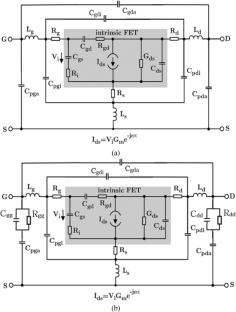
This paper presents a black-hole optimization (BHO) based parameters extraction method. The developed method was applied on distributed small-signal equivalent circuit models of GaN HEMT. The BHO as a global technique generates initial values for the model elements that can be tuned in a later step using gradient or simplex local optimization. The reliability of extraction was improved by using measurement-based boundaries for the initially generated candidate solutions. Physics-based restriction conditions were implemented through the optimization process to avoid any nonrealistic values. The developed procedure was demonstrated by modeling different sizes devices on SiC, Diamond and Si substrates at different bias conditions. The modeling accuracy was validated by means of S-premasters simulations, which show a very good fitting to measured data. The extracted values of the models’ elements are consistent with the devices physics and scaling well with the device size. In general, the results obtained prove the applicability of the proposed approach for small-modeling and liner circuit design and providing an accurate and physically consistent framework within the operating conditions considered.
期刊介绍:
he Journal of Computational Electronics brings together research on all aspects of modeling and simulation of modern electronics. This includes optical, electronic, mechanical, and quantum mechanical aspects, as well as research on the underlying mathematical algorithms and computational details. The related areas of energy conversion/storage and of molecular and biological systems, in which the thrust is on the charge transport, electronic, mechanical, and optical properties, are also covered.
In particular, we encourage manuscripts dealing with device simulation; with optical and optoelectronic systems and photonics; with energy storage (e.g. batteries, fuel cells) and harvesting (e.g. photovoltaic), with simulation of circuits, VLSI layout, logic and architecture (based on, for example, CMOS devices, quantum-cellular automata, QBITs, or single-electron transistors); with electromagnetic simulations (such as microwave electronics and components); or with molecular and biological systems. However, in all these cases, the submitted manuscripts should explicitly address the electronic properties of the relevant systems, materials, or devices and/or present novel contributions to the physical models, computational strategies, or numerical algorithms.

 求助内容:
求助内容: 应助结果提醒方式:

 京公网安备 11010802042870号


