XueYan Cui, ZeMin Sheng, Wei Song, Dengke Zhao, YiJing Yan and JianHua Wei
{"title":"不同激子哈密顿量对PE555配合物激发动力学过程影响的理论研究","authors":"XueYan Cui, ZeMin Sheng, Wei Song, Dengke Zhao, YiJing Yan and JianHua Wei","doi":"10.1039/D5RA09996J","DOIUrl":null,"url":null,"abstract":"<p >Photosynthesis initiates at the light harvesting stage, where specific pigment–protein complexes can convert absorbed light energy into electronic excited states. These excited states are transferred to the reaction center, initiating charge separation. Existing studies have confirmed that quantum coherence between electronic excited states plays a pivotal role in excitation energy transfer. In this paper, we employ the dissipation equation of motion (DEOM) method from quantum dissipation theory to investigate the influence of the structure of the PE555 complex on its exciton dynamics, while also exploring the quantum coherence characteristics during the excitation energy transfer process of the complex. The research focuses on examining the effects of exciton-type Hamiltonians obtained by two different methods (the point dipole approximation (PDA) method and the transition charge from electrostatic potential (TrEsp) method) on the aforementioned processes. The results demonstrate that, under both low temperature and room temperature conditions, when the Hamiltonian obtained by the PDA method is combined with the DEOM method for calculations, the excitation energy transfer in the PE555 complex is faster, and more energy is transferred to the DBV50/61B molecule. The analysis reveals that the open structure of the PE555 complex results in larger exciton coupling values obtained by the PDA method, with a wider coupling distribution compared to that from the TrEsp method, which directly facilitates the efficient transfer of excitation energy. This study provides a theoretical basis for understanding the regulatory mechanisms of quantum coherence effects and structural characteristics on energy transfer in light harvesting systems.</p>","PeriodicalId":102,"journal":{"name":"RSC Advances","volume":" 26","pages":" 23870-23883"},"PeriodicalIF":4.6000,"publicationDate":"2026-05-07","publicationTypes":"Journal Article","fieldsOfStudy":null,"isOpenAccess":false,"openAccessPdf":"https://pubs.rsc.org/en/content/articlepdf/2026/ra/d5ra09996j?page=search","citationCount":"0","resultStr":"{\"title\":\"Theoretical study on the influence of different exciton Hamiltonians on the excitation dynamic process of the PE555 complex\",\"authors\":\"XueYan Cui, ZeMin Sheng, Wei Song, Dengke Zhao, YiJing Yan and JianHua Wei\",\"doi\":\"10.1039/D5RA09996J\",\"DOIUrl\":null,\"url\":null,\"abstract\":\"<p >Photosynthesis initiates at the light harvesting stage, where specific pigment–protein complexes can convert absorbed light energy into electronic excited states. These excited states are transferred to the reaction center, initiating charge separation. Existing studies have confirmed that quantum coherence between electronic excited states plays a pivotal role in excitation energy transfer. In this paper, we employ the dissipation equation of motion (DEOM) method from quantum dissipation theory to investigate the influence of the structure of the PE555 complex on its exciton dynamics, while also exploring the quantum coherence characteristics during the excitation energy transfer process of the complex. The research focuses on examining the effects of exciton-type Hamiltonians obtained by two different methods (the point dipole approximation (PDA) method and the transition charge from electrostatic potential (TrEsp) method) on the aforementioned processes. The results demonstrate that, under both low temperature and room temperature conditions, when the Hamiltonian obtained by the PDA method is combined with the DEOM method for calculations, the excitation energy transfer in the PE555 complex is faster, and more energy is transferred to the DBV50/61B molecule. The analysis reveals that the open structure of the PE555 complex results in larger exciton coupling values obtained by the PDA method, with a wider coupling distribution compared to that from the TrEsp method, which directly facilitates the efficient transfer of excitation energy. This study provides a theoretical basis for understanding the regulatory mechanisms of quantum coherence effects and structural characteristics on energy transfer in light harvesting systems.</p>\",\"PeriodicalId\":102,\"journal\":{\"name\":\"RSC Advances\",\"volume\":\" 26\",\"pages\":\" 23870-23883\"},\"PeriodicalIF\":4.6000,\"publicationDate\":\"2026-05-07\",\"publicationTypes\":\"Journal Article\",\"fieldsOfStudy\":null,\"isOpenAccess\":false,\"openAccessPdf\":\"https://pubs.rsc.org/en/content/articlepdf/2026/ra/d5ra09996j?page=search\",\"citationCount\":\"0\",\"resultStr\":null,\"platform\":\"Semanticscholar\",\"paperid\":null,\"PeriodicalName\":\"RSC Advances\",\"FirstCategoryId\":\"92\",\"ListUrlMain\":\"https://pubs.rsc.org/en/content/articlelanding/2026/ra/d5ra09996j\",\"RegionNum\":3,\"RegionCategory\":\"化学\",\"ArticlePicture\":[],\"TitleCN\":null,\"AbstractTextCN\":null,\"PMCID\":null,\"EPubDate\":\"\",\"PubModel\":\"\",\"JCR\":\"Q2\",\"JCRName\":\"CHEMISTRY, MULTIDISCIPLINARY\",\"Score\":null,\"Total\":0}","platform":"Semanticscholar","paperid":null,"PeriodicalName":"RSC Advances","FirstCategoryId":"92","ListUrlMain":"https://pubs.rsc.org/en/content/articlelanding/2026/ra/d5ra09996j","RegionNum":3,"RegionCategory":"化学","ArticlePicture":[],"TitleCN":null,"AbstractTextCN":null,"PMCID":null,"EPubDate":"","PubModel":"","JCR":"Q2","JCRName":"CHEMISTRY, MULTIDISCIPLINARY","Score":null,"Total":0}
Theoretical study on the influence of different exciton Hamiltonians on the excitation dynamic process of the PE555 complex
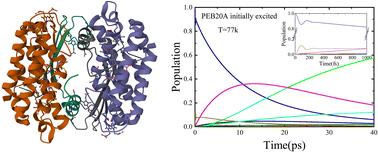
Photosynthesis initiates at the light harvesting stage, where specific pigment–protein complexes can convert absorbed light energy into electronic excited states. These excited states are transferred to the reaction center, initiating charge separation. Existing studies have confirmed that quantum coherence between electronic excited states plays a pivotal role in excitation energy transfer. In this paper, we employ the dissipation equation of motion (DEOM) method from quantum dissipation theory to investigate the influence of the structure of the PE555 complex on its exciton dynamics, while also exploring the quantum coherence characteristics during the excitation energy transfer process of the complex. The research focuses on examining the effects of exciton-type Hamiltonians obtained by two different methods (the point dipole approximation (PDA) method and the transition charge from electrostatic potential (TrEsp) method) on the aforementioned processes. The results demonstrate that, under both low temperature and room temperature conditions, when the Hamiltonian obtained by the PDA method is combined with the DEOM method for calculations, the excitation energy transfer in the PE555 complex is faster, and more energy is transferred to the DBV50/61B molecule. The analysis reveals that the open structure of the PE555 complex results in larger exciton coupling values obtained by the PDA method, with a wider coupling distribution compared to that from the TrEsp method, which directly facilitates the efficient transfer of excitation energy. This study provides a theoretical basis for understanding the regulatory mechanisms of quantum coherence effects and structural characteristics on energy transfer in light harvesting systems.
期刊介绍:
An international, peer-reviewed journal covering all of the chemical sciences, including multidisciplinary and emerging areas. RSC Advances is a gold open access journal allowing researchers free access to research articles, and offering an affordable open access publishing option for authors around the world.


 求助内容:
求助内容: 应助结果提醒方式:

 京公网安备 11010802042870号


