{"title":"La-Al共掺杂ZnO薄膜中线性和非线性光学特性的厚度驱动调制及其光学限制应用","authors":"Preethika and Raghavendra Bairy","doi":"10.1039/D6RA00168H","DOIUrl":null,"url":null,"abstract":"<p >The influence of film thickness on the structural, surface, optical, and nonlinear optical properties of Al–La co-doped ZnO thin films was systematically examined. By adjusting the number of deposition cycles, film thicknesses in the ranges of 200–300 nm, 400–500 nm, and 700–800 nm were obtained. Powder X-ray diffraction (PXRD) analysis confirmed a hexagonal wurtzite crystal structure. Slight shifts in the (002) peak position with increasing film thickness indicated lattice parameter changes, and the decrease in peak width suggested improved crystallinity. Field emission scanning electron microscopy (FESEM) micrographs revealed that larger grain sizes developed as the films became thicker. Correspondingly, the surface roughness increased from 2.61 nm to 3.91 nm. The optical band gap exhibited a shift from 3.21 eV to 3.34 eV with increasing thickness. Z scan technique demonstrated that La–ZnO films possess self-defocusing characteristics, a positive nonlinear refractive index, and reverse saturable absorption (RSA). The third-order nonlinear optical susceptibility of the film increased from 200–300 nm to 400–500 nm thickness and decreased at 700–800 nm thickness due to the increased scattering and saturation effects associated with larger grain sizes and surface roughness at greater thicknesses, which can limit the efficiency of nonlinear interactions. Among the studied thicknesses, the 486 nm film exhibited the highest third-order nonlinear optical susceptibility, indicating that this thickness offers an optimal balance of crystallinity, grain size, and surface morphology for enhanced nonlinear optical performance.</p>","PeriodicalId":102,"journal":{"name":"RSC Advances","volume":" 27","pages":" 24280-24295"},"PeriodicalIF":4.6000,"publicationDate":"2026-05-08","publicationTypes":"Journal Article","fieldsOfStudy":null,"isOpenAccess":false,"openAccessPdf":"https://pubs.rsc.org/en/content/articlepdf/2026/ra/d6ra00168h?page=search","citationCount":"0","resultStr":"{\"title\":\"Thickness-driven modulation of linear and nonlinear optical properties in La–Al co-doped ZnO thin films for optical limiting applications\",\"authors\":\"Preethika and Raghavendra Bairy\",\"doi\":\"10.1039/D6RA00168H\",\"DOIUrl\":null,\"url\":null,\"abstract\":\"<p >The influence of film thickness on the structural, surface, optical, and nonlinear optical properties of Al–La co-doped ZnO thin films was systematically examined. By adjusting the number of deposition cycles, film thicknesses in the ranges of 200–300 nm, 400–500 nm, and 700–800 nm were obtained. Powder X-ray diffraction (PXRD) analysis confirmed a hexagonal wurtzite crystal structure. Slight shifts in the (002) peak position with increasing film thickness indicated lattice parameter changes, and the decrease in peak width suggested improved crystallinity. Field emission scanning electron microscopy (FESEM) micrographs revealed that larger grain sizes developed as the films became thicker. Correspondingly, the surface roughness increased from 2.61 nm to 3.91 nm. The optical band gap exhibited a shift from 3.21 eV to 3.34 eV with increasing thickness. Z scan technique demonstrated that La–ZnO films possess self-defocusing characteristics, a positive nonlinear refractive index, and reverse saturable absorption (RSA). The third-order nonlinear optical susceptibility of the film increased from 200–300 nm to 400–500 nm thickness and decreased at 700–800 nm thickness due to the increased scattering and saturation effects associated with larger grain sizes and surface roughness at greater thicknesses, which can limit the efficiency of nonlinear interactions. Among the studied thicknesses, the 486 nm film exhibited the highest third-order nonlinear optical susceptibility, indicating that this thickness offers an optimal balance of crystallinity, grain size, and surface morphology for enhanced nonlinear optical performance.</p>\",\"PeriodicalId\":102,\"journal\":{\"name\":\"RSC Advances\",\"volume\":\" 27\",\"pages\":\" 24280-24295\"},\"PeriodicalIF\":4.6000,\"publicationDate\":\"2026-05-08\",\"publicationTypes\":\"Journal Article\",\"fieldsOfStudy\":null,\"isOpenAccess\":false,\"openAccessPdf\":\"https://pubs.rsc.org/en/content/articlepdf/2026/ra/d6ra00168h?page=search\",\"citationCount\":\"0\",\"resultStr\":null,\"platform\":\"Semanticscholar\",\"paperid\":null,\"PeriodicalName\":\"RSC Advances\",\"FirstCategoryId\":\"92\",\"ListUrlMain\":\"https://pubs.rsc.org/en/content/articlelanding/2026/ra/d6ra00168h\",\"RegionNum\":3,\"RegionCategory\":\"化学\",\"ArticlePicture\":[],\"TitleCN\":null,\"AbstractTextCN\":null,\"PMCID\":null,\"EPubDate\":\"\",\"PubModel\":\"\",\"JCR\":\"Q2\",\"JCRName\":\"CHEMISTRY, MULTIDISCIPLINARY\",\"Score\":null,\"Total\":0}","platform":"Semanticscholar","paperid":null,"PeriodicalName":"RSC Advances","FirstCategoryId":"92","ListUrlMain":"https://pubs.rsc.org/en/content/articlelanding/2026/ra/d6ra00168h","RegionNum":3,"RegionCategory":"化学","ArticlePicture":[],"TitleCN":null,"AbstractTextCN":null,"PMCID":null,"EPubDate":"","PubModel":"","JCR":"Q2","JCRName":"CHEMISTRY, MULTIDISCIPLINARY","Score":null,"Total":0}
Thickness-driven modulation of linear and nonlinear optical properties in La–Al co-doped ZnO thin films for optical limiting applications
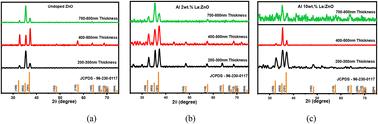
The influence of film thickness on the structural, surface, optical, and nonlinear optical properties of Al–La co-doped ZnO thin films was systematically examined. By adjusting the number of deposition cycles, film thicknesses in the ranges of 200–300 nm, 400–500 nm, and 700–800 nm were obtained. Powder X-ray diffraction (PXRD) analysis confirmed a hexagonal wurtzite crystal structure. Slight shifts in the (002) peak position with increasing film thickness indicated lattice parameter changes, and the decrease in peak width suggested improved crystallinity. Field emission scanning electron microscopy (FESEM) micrographs revealed that larger grain sizes developed as the films became thicker. Correspondingly, the surface roughness increased from 2.61 nm to 3.91 nm. The optical band gap exhibited a shift from 3.21 eV to 3.34 eV with increasing thickness. Z scan technique demonstrated that La–ZnO films possess self-defocusing characteristics, a positive nonlinear refractive index, and reverse saturable absorption (RSA). The third-order nonlinear optical susceptibility of the film increased from 200–300 nm to 400–500 nm thickness and decreased at 700–800 nm thickness due to the increased scattering and saturation effects associated with larger grain sizes and surface roughness at greater thicknesses, which can limit the efficiency of nonlinear interactions. Among the studied thicknesses, the 486 nm film exhibited the highest third-order nonlinear optical susceptibility, indicating that this thickness offers an optimal balance of crystallinity, grain size, and surface morphology for enhanced nonlinear optical performance.
期刊介绍:
An international, peer-reviewed journal covering all of the chemical sciences, including multidisciplinary and emerging areas. RSC Advances is a gold open access journal allowing researchers free access to research articles, and offering an affordable open access publishing option for authors around the world.

 求助内容:
求助内容: 应助结果提醒方式:

 京公网安备 11010802042870号


