Chenyu Zhao, Song Lu, Shuqi Cao, Zhenghao Wu, Linhua Wang, Xuan Tang, Bin Liu, Meihua Gao and Huifang Xu
{"title":"芳香盐对阳离子gemini表面活性剂在水溶液中的相行为和粘弹性的影响","authors":"Chenyu Zhao, Song Lu, Shuqi Cao, Zhenghao Wu, Linhua Wang, Xuan Tang, Bin Liu, Meihua Gao and Huifang Xu","doi":"10.1039/D6RA01652A","DOIUrl":null,"url":null,"abstract":"<p >Gemini surfactants, composed of two linked surfactant monomers, are capable of forming viscoelastic fluids in aqueous solution even at low concentrations. In this paper, two types of additives, benzoate and cinnamate derivatives, were introduced into aqueous solutions of the gemini surfactant 2-hydroxyltrimethylene-1,3-bis(tetradecyldimethylammonium chloride) (G<small><sub>14</sub></small>) at varying molar ratios. The phase behavior, viscoelastic properties, and morphological transitions of the resulting systems were systematically investigated using rheology, dynamic light scattering, and cryogenic/negative-staining transmission electron microscopy. We demonstrate that structural features of the aromatic hydrotropes, such as hydroxyl, methyl, or methoxy substitutions and positional isomerism, critically regulate micellar growth and network entanglement. With increasing the hydrotrope-to-G<small><sub>14</sub></small> molar ratio (<em>R</em>), the morphology transitions successively from spherical micelles to wormlike micelles and finally to vesicles. At an optimal <em>R</em> value of approximately 0.5, synergistic interactions between G<small><sub>14</sub></small> and the hydrotrope promote maximal micellar elongation, yielding a highly entangled network and a corresponding maximum increase in zero-shear viscosity. The viscosity enhancement arises from the combined effects of electrostatic interactions, hydrogen bonding, and steric hindrance. This work establishes substituent-dependent structure–activity relationships for aromatic hydrotropes in gemini surfactant systems and provides a rational design strategy for tailoring wormlike micellar networks with potential applications in oil recovery, drug delivery, and specialized formulations.</p>","PeriodicalId":102,"journal":{"name":"RSC Advances","volume":" 27","pages":" 24418-24426"},"PeriodicalIF":4.6000,"publicationDate":"2026-05-08","publicationTypes":"Journal Article","fieldsOfStudy":null,"isOpenAccess":false,"openAccessPdf":"https://pubs.rsc.org/en/content/articlepdf/2026/ra/d6ra01652a?page=search","citationCount":"0","resultStr":"{\"title\":\"Effects of aromatic salts on the phase behavior and viscoelastic properties of a cationic gemini surfactant in aqueous solutions\",\"authors\":\"Chenyu Zhao, Song Lu, Shuqi Cao, Zhenghao Wu, Linhua Wang, Xuan Tang, Bin Liu, Meihua Gao and Huifang Xu\",\"doi\":\"10.1039/D6RA01652A\",\"DOIUrl\":null,\"url\":null,\"abstract\":\"<p >Gemini surfactants, composed of two linked surfactant monomers, are capable of forming viscoelastic fluids in aqueous solution even at low concentrations. In this paper, two types of additives, benzoate and cinnamate derivatives, were introduced into aqueous solutions of the gemini surfactant 2-hydroxyltrimethylene-1,3-bis(tetradecyldimethylammonium chloride) (G<small><sub>14</sub></small>) at varying molar ratios. The phase behavior, viscoelastic properties, and morphological transitions of the resulting systems were systematically investigated using rheology, dynamic light scattering, and cryogenic/negative-staining transmission electron microscopy. We demonstrate that structural features of the aromatic hydrotropes, such as hydroxyl, methyl, or methoxy substitutions and positional isomerism, critically regulate micellar growth and network entanglement. With increasing the hydrotrope-to-G<small><sub>14</sub></small> molar ratio (<em>R</em>), the morphology transitions successively from spherical micelles to wormlike micelles and finally to vesicles. At an optimal <em>R</em> value of approximately 0.5, synergistic interactions between G<small><sub>14</sub></small> and the hydrotrope promote maximal micellar elongation, yielding a highly entangled network and a corresponding maximum increase in zero-shear viscosity. The viscosity enhancement arises from the combined effects of electrostatic interactions, hydrogen bonding, and steric hindrance. This work establishes substituent-dependent structure–activity relationships for aromatic hydrotropes in gemini surfactant systems and provides a rational design strategy for tailoring wormlike micellar networks with potential applications in oil recovery, drug delivery, and specialized formulations.</p>\",\"PeriodicalId\":102,\"journal\":{\"name\":\"RSC Advances\",\"volume\":\" 27\",\"pages\":\" 24418-24426\"},\"PeriodicalIF\":4.6000,\"publicationDate\":\"2026-05-08\",\"publicationTypes\":\"Journal Article\",\"fieldsOfStudy\":null,\"isOpenAccess\":false,\"openAccessPdf\":\"https://pubs.rsc.org/en/content/articlepdf/2026/ra/d6ra01652a?page=search\",\"citationCount\":\"0\",\"resultStr\":null,\"platform\":\"Semanticscholar\",\"paperid\":null,\"PeriodicalName\":\"RSC Advances\",\"FirstCategoryId\":\"92\",\"ListUrlMain\":\"https://pubs.rsc.org/en/content/articlelanding/2026/ra/d6ra01652a\",\"RegionNum\":3,\"RegionCategory\":\"化学\",\"ArticlePicture\":[],\"TitleCN\":null,\"AbstractTextCN\":null,\"PMCID\":null,\"EPubDate\":\"\",\"PubModel\":\"\",\"JCR\":\"Q2\",\"JCRName\":\"CHEMISTRY, MULTIDISCIPLINARY\",\"Score\":null,\"Total\":0}","platform":"Semanticscholar","paperid":null,"PeriodicalName":"RSC Advances","FirstCategoryId":"92","ListUrlMain":"https://pubs.rsc.org/en/content/articlelanding/2026/ra/d6ra01652a","RegionNum":3,"RegionCategory":"化学","ArticlePicture":[],"TitleCN":null,"AbstractTextCN":null,"PMCID":null,"EPubDate":"","PubModel":"","JCR":"Q2","JCRName":"CHEMISTRY, MULTIDISCIPLINARY","Score":null,"Total":0}
Effects of aromatic salts on the phase behavior and viscoelastic properties of a cationic gemini surfactant in aqueous solutions
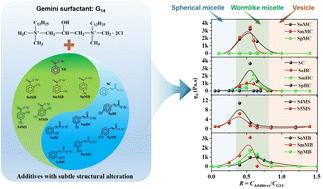
Gemini surfactants, composed of two linked surfactant monomers, are capable of forming viscoelastic fluids in aqueous solution even at low concentrations. In this paper, two types of additives, benzoate and cinnamate derivatives, were introduced into aqueous solutions of the gemini surfactant 2-hydroxyltrimethylene-1,3-bis(tetradecyldimethylammonium chloride) (G14) at varying molar ratios. The phase behavior, viscoelastic properties, and morphological transitions of the resulting systems were systematically investigated using rheology, dynamic light scattering, and cryogenic/negative-staining transmission electron microscopy. We demonstrate that structural features of the aromatic hydrotropes, such as hydroxyl, methyl, or methoxy substitutions and positional isomerism, critically regulate micellar growth and network entanglement. With increasing the hydrotrope-to-G14 molar ratio (R), the morphology transitions successively from spherical micelles to wormlike micelles and finally to vesicles. At an optimal R value of approximately 0.5, synergistic interactions between G14 and the hydrotrope promote maximal micellar elongation, yielding a highly entangled network and a corresponding maximum increase in zero-shear viscosity. The viscosity enhancement arises from the combined effects of electrostatic interactions, hydrogen bonding, and steric hindrance. This work establishes substituent-dependent structure–activity relationships for aromatic hydrotropes in gemini surfactant systems and provides a rational design strategy for tailoring wormlike micellar networks with potential applications in oil recovery, drug delivery, and specialized formulations.
期刊介绍:
An international, peer-reviewed journal covering all of the chemical sciences, including multidisciplinary and emerging areas. RSC Advances is a gold open access journal allowing researchers free access to research articles, and offering an affordable open access publishing option for authors around the world.

 求助内容:
求助内容: 应助结果提醒方式:

 京公网安备 11010802042870号


