干旱区内陆河流域景观破碎化如何影响生态系统服务流?

IF 2.5 3区 环境科学与生态学 Q2 ECOLOGY
Jia Liang, Jinghu Pan, Dan Men
{"title":"干旱区内陆河流域景观破碎化如何影响生态系统服务流?","authors":"Jia Liang,&nbsp;Jinghu Pan,&nbsp;Dan Men","doi":"10.1016/j.jaridenv.2026.105630","DOIUrl":null,"url":null,"abstract":"<div><div>Landscape fragmentation in arid inland river basins, driven by intensifying human-environment conflicts, severely compromises ecosystem service (ES) functionality and stability, hindering regional sustainable development. Traditional static assessments map ES supply-demand patterns but overlook the spatio-temporal ecosystem service flows (ESFs), which determine actual ES realization in fragmented landscapes. This study introduced a spatio-temporal ESFs framework to address this gap. Supply and demand for two ESs in the Shiyang River Basin (SRB) were assessed using InVEST and Carnegie-Ames-Stanford Approach (CASA) models. Network models were then constructed to simulate the changes of ESFs under landscape fragmentation, which was calculated through landscape pattern indices and moving window analysis. Results revealed that high-supply areas for both services concentrated in vegetation-rich upstream regions, while high-demand areas predominated in desert and urban zones. The carbon sequestration ESF network remained largely intact, whereas soil conservation ES flows from upstream failed to meet midstream and downstream demand. Moderate fragmentation, comprising over 30% of the study area, represented the dominant landscape type. Critically, landscape fragmentation exerted predominantly negative effects on ESF connectivity, though impacts varied by transmission medium. Water-mediated soil conservation flows proved highly sensitive to structural disruption, while wind-mediated carbon sequestration flows showed greater resilience. These findings underscore that ESF quantification must account for service-specific transport mechanisms and that fragmentation thresholds differ between water and wind driven processes. The network-based approach provides decision-makers with spatially explicit insights for sustainable landscape management, enabling targeted interventions to restore biophysical connectivity and enhance ES provision in vulnerable arid inland river basins.</div></div>","PeriodicalId":51080,"journal":{"name":"Journal of Arid Environments","volume":"235 ","pages":"Article 105630"},"PeriodicalIF":2.5000,"publicationDate":"2026-05-01","publicationTypes":"Journal Article","fieldsOfStudy":null,"isOpenAccess":false,"openAccessPdf":"","citationCount":"0","resultStr":"{\"title\":\"How does landscape fragmentation in arid inland river basins affect ecosystem service flow?\",\"authors\":\"Jia Liang,&nbsp;Jinghu Pan,&nbsp;Dan Men\",\"doi\":\"10.1016/j.jaridenv.2026.105630\",\"DOIUrl\":null,\"url\":null,\"abstract\":\"<div><div>Landscape fragmentation in arid inland river basins, driven by intensifying human-environment conflicts, severely compromises ecosystem service (ES) functionality and stability, hindering regional sustainable development. Traditional static assessments map ES supply-demand patterns but overlook the spatio-temporal ecosystem service flows (ESFs), which determine actual ES realization in fragmented landscapes. This study introduced a spatio-temporal ESFs framework to address this gap. Supply and demand for two ESs in the Shiyang River Basin (SRB) were assessed using InVEST and Carnegie-Ames-Stanford Approach (CASA) models. Network models were then constructed to simulate the changes of ESFs under landscape fragmentation, which was calculated through landscape pattern indices and moving window analysis. Results revealed that high-supply areas for both services concentrated in vegetation-rich upstream regions, while high-demand areas predominated in desert and urban zones. The carbon sequestration ESF network remained largely intact, whereas soil conservation ES flows from upstream failed to meet midstream and downstream demand. Moderate fragmentation, comprising over 30% of the study area, represented the dominant landscape type. Critically, landscape fragmentation exerted predominantly negative effects on ESF connectivity, though impacts varied by transmission medium. Water-mediated soil conservation flows proved highly sensitive to structural disruption, while wind-mediated carbon sequestration flows showed greater resilience. These findings underscore that ESF quantification must account for service-specific transport mechanisms and that fragmentation thresholds differ between water and wind driven processes. The network-based approach provides decision-makers with spatially explicit insights for sustainable landscape management, enabling targeted interventions to restore biophysical connectivity and enhance ES provision in vulnerable arid inland river basins.</div></div>\",\"PeriodicalId\":51080,\"journal\":{\"name\":\"Journal of Arid Environments\",\"volume\":\"235 \",\"pages\":\"Article 105630\"},\"PeriodicalIF\":2.5000,\"publicationDate\":\"2026-05-01\",\"publicationTypes\":\"Journal Article\",\"fieldsOfStudy\":null,\"isOpenAccess\":false,\"openAccessPdf\":\"\",\"citationCount\":\"0\",\"resultStr\":null,\"platform\":\"Semanticscholar\",\"paperid\":null,\"PeriodicalName\":\"Journal of Arid Environments\",\"FirstCategoryId\":\"93\",\"ListUrlMain\":\"https://www.sciencedirect.com/science/article/pii/S0140196326000820\",\"RegionNum\":3,\"RegionCategory\":\"环境科学与生态学\",\"ArticlePicture\":[],\"TitleCN\":null,\"AbstractTextCN\":null,\"PMCID\":null,\"EPubDate\":\"\",\"PubModel\":\"\",\"JCR\":\"Q2\",\"JCRName\":\"ECOLOGY\",\"Score\":null,\"Total\":0}","platform":"Semanticscholar","paperid":null,"PeriodicalName":"Journal of Arid Environments","FirstCategoryId":"93","ListUrlMain":"https://www.sciencedirect.com/science/article/pii/S0140196326000820","RegionNum":3,"RegionCategory":"环境科学与生态学","ArticlePicture":[],"TitleCN":null,"AbstractTextCN":null,"PMCID":null,"EPubDate":"","PubModel":"","JCR":"Q2","JCRName":"ECOLOGY","Score":null,"Total":0}
引用次数: 0

摘要

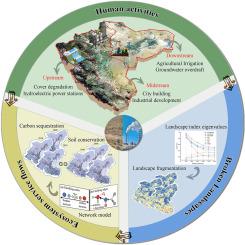
在人与环境冲突加剧的驱动下,干旱区内陆河流域景观破碎化严重损害了生态系统服务功能和稳定性,阻碍了区域可持续发展。传统的静态评估绘制了生态系统供需格局,但忽略了时空生态系统服务流(ESFs),而时空生态系统服务流决定了破碎景观中生态系统的实际实现。本研究引入了一个时空ESFs框架来解决这一差距。采用InVEST模型和Carnegie-Ames-Stanford方法(CASA)对石羊河流域(SRB)两种ESs的供需进行了评估。在此基础上,通过景观格局指数和移动窗分析,构建景观破碎化条件下的生态稳定因子变化网络模型。结果表明,这两种服务的高供给区集中在植被丰富的上游地区,而高需求区主要在沙漠和城市地区。固碳ESF网络基本保持完整,而上游土壤保持ESF流量未能满足中下游需求。中等破碎化占研究区面积的30%以上,为优势景观类型。重要的是,景观破碎化主要对ESF连通性产生负面影响,尽管影响因传播媒介而异。水介导的土壤保持流对结构破坏高度敏感,而风介导的碳固存流表现出更大的弹性。这些发现强调,ESF量化必须考虑特定服务的输送机制,以及水和风驱动过程之间的碎片化阈值不同。基于网络的方法为决策者提供了可持续景观管理的空间明确见解,使有针对性的干预措施能够恢复脆弱干旱内陆河流域的生物物理连通性并增强ES供应。
本文章由计算机程序翻译,如有差异,请以英文原文为准。

How does landscape fragmentation in arid inland river basins affect ecosystem service flow?

How does landscape fragmentation in arid inland river basins affect ecosystem service flow?
Landscape fragmentation in arid inland river basins, driven by intensifying human-environment conflicts, severely compromises ecosystem service (ES) functionality and stability, hindering regional sustainable development. Traditional static assessments map ES supply-demand patterns but overlook the spatio-temporal ecosystem service flows (ESFs), which determine actual ES realization in fragmented landscapes. This study introduced a spatio-temporal ESFs framework to address this gap. Supply and demand for two ESs in the Shiyang River Basin (SRB) were assessed using InVEST and Carnegie-Ames-Stanford Approach (CASA) models. Network models were then constructed to simulate the changes of ESFs under landscape fragmentation, which was calculated through landscape pattern indices and moving window analysis. Results revealed that high-supply areas for both services concentrated in vegetation-rich upstream regions, while high-demand areas predominated in desert and urban zones. The carbon sequestration ESF network remained largely intact, whereas soil conservation ES flows from upstream failed to meet midstream and downstream demand. Moderate fragmentation, comprising over 30% of the study area, represented the dominant landscape type. Critically, landscape fragmentation exerted predominantly negative effects on ESF connectivity, though impacts varied by transmission medium. Water-mediated soil conservation flows proved highly sensitive to structural disruption, while wind-mediated carbon sequestration flows showed greater resilience. These findings underscore that ESF quantification must account for service-specific transport mechanisms and that fragmentation thresholds differ between water and wind driven processes. The network-based approach provides decision-makers with spatially explicit insights for sustainable landscape management, enabling targeted interventions to restore biophysical connectivity and enhance ES provision in vulnerable arid inland river basins.
求助全文
通过发布文献求助,成功后即可免费获取论文全文。 去求助
来源期刊
Journal of Arid Environments
Journal of Arid Environments 环境科学-环境科学
CiteScore
5.70
自引率
3.70%
发文量
144
审稿时长
55 days
期刊介绍: The Journal of Arid Environments is an international journal publishing original scientific and technical research articles on physical, biological and cultural aspects of arid, semi-arid, and desert environments. As a forum of multi-disciplinary and interdisciplinary dialogue it addresses research on all aspects of arid environments and their past, present and future use.

×
引用
GB/T 7714-2015
复制
MLA
复制
APA
复制
导出至
BibTeX EndNote RefMan NoteFirst NoteExpress
×
提示
您的信息不完整,为了账户安全,请先补充。
现在去补充
×
提示
您因"违规操作"
具体请查看互助需知
我知道了
×
提示
确定
请完成安全验证×
copy
已复制链接
快去分享给好友吧!
我知道了
右上角分享
点击右上角分享
0
联系我们:info@booksci.cn Book学术提供免费学术资源搜索服务,方便国内外学者检索中英文文献。致力于提供最便捷和优质的服务体验。 Copyright © 2023 布克学术 All rights reserved.
京ICP备2023020795号-1
ghs 京公网安备 11010802042870号
Book学术文献互助
Book学术文献互助群
群 号:604180095
Book学术官方微信
小红书