{"title":"从预测到行动:利用可观测的空间约束重新定义干旱区适应干旱的土地能力","authors":"Vahid Rahdari , Saeideh Maleki , Ali Shahriari","doi":"10.1016/j.jaridenv.2026.105607","DOIUrl":null,"url":null,"abstract":"<div><div>This study investigates the effectiveness of land use planning as a spatial adaptation strategy to enhance climate change resilience in the Sistan Plain, Iran. We applied the Multi-Criteria Evaluation (MCE) method and the Weighted Linear Combination (WLC) model to assess land suitability for agriculture, ecotourism, and residential areas under two distinct scenarios: normal conditions (intrinsic suitability) and drought-consequence constraints (integrated with climate change impacts). Abandoned agricultural areas, dust-storm corridors, and desiccated wetlands were considered as indicators of drought effects. The results quantify a dramatic spatial impact: agricultural suitability, which covers over 70% of the Sistan Plain under normal conditions, collapses to less than 10% under drought-consequence constraints. Ecotourism potential, while quantitatively similar between the two scenarios (30% vs. 20%), undergoes a qualitative shift from water-dependent sites to sustainable desert ecotourism centers. Residential suitability also drops from 45% to 10% of the study area, highlighting the need for highly centralized development focused on resilient zones. Given the impact of dust storms on the suitability of the Sistan Plain, taking urgent action for soil stabilization is essential. This study demonstrates that utilizing the spatial legacy of climate change impacts within MCE provides a necessary and immediate action plan for guiding resource reallocation and protecting communities in severely stressed arid environments.</div></div>","PeriodicalId":51080,"journal":{"name":"Journal of Arid Environments","volume":"235 ","pages":"Article 105607"},"PeriodicalIF":2.5000,"publicationDate":"2026-05-01","publicationTypes":"Journal Article","fieldsOfStudy":null,"isOpenAccess":false,"openAccessPdf":"","citationCount":"0","resultStr":"{\"title\":\"From prediction to action: Using observable spatial constraints to redefine land capability for drought adaptation in arid regions\",\"authors\":\"Vahid Rahdari , Saeideh Maleki , Ali Shahriari\",\"doi\":\"10.1016/j.jaridenv.2026.105607\",\"DOIUrl\":null,\"url\":null,\"abstract\":\"<div><div>This study investigates the effectiveness of land use planning as a spatial adaptation strategy to enhance climate change resilience in the Sistan Plain, Iran. We applied the Multi-Criteria Evaluation (MCE) method and the Weighted Linear Combination (WLC) model to assess land suitability for agriculture, ecotourism, and residential areas under two distinct scenarios: normal conditions (intrinsic suitability) and drought-consequence constraints (integrated with climate change impacts). Abandoned agricultural areas, dust-storm corridors, and desiccated wetlands were considered as indicators of drought effects. The results quantify a dramatic spatial impact: agricultural suitability, which covers over 70% of the Sistan Plain under normal conditions, collapses to less than 10% under drought-consequence constraints. Ecotourism potential, while quantitatively similar between the two scenarios (30% vs. 20%), undergoes a qualitative shift from water-dependent sites to sustainable desert ecotourism centers. Residential suitability also drops from 45% to 10% of the study area, highlighting the need for highly centralized development focused on resilient zones. Given the impact of dust storms on the suitability of the Sistan Plain, taking urgent action for soil stabilization is essential. This study demonstrates that utilizing the spatial legacy of climate change impacts within MCE provides a necessary and immediate action plan for guiding resource reallocation and protecting communities in severely stressed arid environments.</div></div>\",\"PeriodicalId\":51080,\"journal\":{\"name\":\"Journal of Arid Environments\",\"volume\":\"235 \",\"pages\":\"Article 105607\"},\"PeriodicalIF\":2.5000,\"publicationDate\":\"2026-05-01\",\"publicationTypes\":\"Journal Article\",\"fieldsOfStudy\":null,\"isOpenAccess\":false,\"openAccessPdf\":\"\",\"citationCount\":\"0\",\"resultStr\":null,\"platform\":\"Semanticscholar\",\"paperid\":null,\"PeriodicalName\":\"Journal of Arid Environments\",\"FirstCategoryId\":\"93\",\"ListUrlMain\":\"https://www.sciencedirect.com/science/article/pii/S0140196326000595\",\"RegionNum\":3,\"RegionCategory\":\"环境科学与生态学\",\"ArticlePicture\":[],\"TitleCN\":null,\"AbstractTextCN\":null,\"PMCID\":null,\"EPubDate\":\"2026/4/28 0:00:00\",\"PubModel\":\"Epub\",\"JCR\":\"Q2\",\"JCRName\":\"ECOLOGY\",\"Score\":null,\"Total\":0}","platform":"Semanticscholar","paperid":null,"PeriodicalName":"Journal of Arid Environments","FirstCategoryId":"93","ListUrlMain":"https://www.sciencedirect.com/science/article/pii/S0140196326000595","RegionNum":3,"RegionCategory":"环境科学与生态学","ArticlePicture":[],"TitleCN":null,"AbstractTextCN":null,"PMCID":null,"EPubDate":"2026/4/28 0:00:00","PubModel":"Epub","JCR":"Q2","JCRName":"ECOLOGY","Score":null,"Total":0}
引用次数: 0
摘要
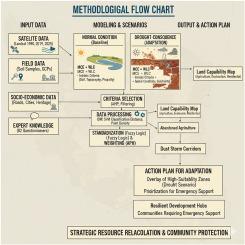
本研究探讨了伊朗锡斯坦平原土地利用规划作为空间适应策略增强气候变化抵御力的有效性。采用多准则评价(MCE)方法和加权线性组合(WLC)模型,在正常条件(内在适宜性)和干旱后果约束(综合气候变化影响)两种不同情景下,对农业、生态旅游和居住区的土地适宜性进行了评估。废弃农业区、沙尘暴走廊和干涸的湿地被认为是干旱影响的指标。结果量化了一个巨大的空间影响:在正常条件下覆盖超过70%的锡斯坦平原的农业适宜性,在干旱后果的限制下下降到不足10%。虽然两种情景的生态旅游潜力在数量上相似(30% vs. 20%),但经历了从依赖水的地点到可持续的沙漠生态旅游中心的质的转变。住宅适宜性也从研究区域的45%下降到10%,突出了高度集中开发弹性区域的必要性。考虑到沙尘暴对锡斯坦平原适宜性的影响,采取紧急行动稳定土壤至关重要。研究表明,利用气候变化影响的空间遗产为指导资源再分配和保护严重干旱环境下的社区提供了必要和直接的行动计划。
From prediction to action: Using observable spatial constraints to redefine land capability for drought adaptation in arid regions
This study investigates the effectiveness of land use planning as a spatial adaptation strategy to enhance climate change resilience in the Sistan Plain, Iran. We applied the Multi-Criteria Evaluation (MCE) method and the Weighted Linear Combination (WLC) model to assess land suitability for agriculture, ecotourism, and residential areas under two distinct scenarios: normal conditions (intrinsic suitability) and drought-consequence constraints (integrated with climate change impacts). Abandoned agricultural areas, dust-storm corridors, and desiccated wetlands were considered as indicators of drought effects. The results quantify a dramatic spatial impact: agricultural suitability, which covers over 70% of the Sistan Plain under normal conditions, collapses to less than 10% under drought-consequence constraints. Ecotourism potential, while quantitatively similar between the two scenarios (30% vs. 20%), undergoes a qualitative shift from water-dependent sites to sustainable desert ecotourism centers. Residential suitability also drops from 45% to 10% of the study area, highlighting the need for highly centralized development focused on resilient zones. Given the impact of dust storms on the suitability of the Sistan Plain, taking urgent action for soil stabilization is essential. This study demonstrates that utilizing the spatial legacy of climate change impacts within MCE provides a necessary and immediate action plan for guiding resource reallocation and protecting communities in severely stressed arid environments.
期刊介绍:
The Journal of Arid Environments is an international journal publishing original scientific and technical research articles on physical, biological and cultural aspects of arid, semi-arid, and desert environments. As a forum of multi-disciplinary and interdisciplinary dialogue it addresses research on all aspects of arid environments and their past, present and future use.