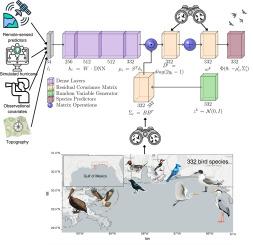
深度学习物种分布模型揭示了飓风驱动鸟类迁移

IF 7.3 2区 环境科学与生态学 Q1 ECOLOGY
Ecological Informatics Pub Date : 2026-05-01 Epub Date: 2026-04-24 DOI:10.1016/j.ecoinf.2026.103785
Liying Li , Marcos Zuzuarregui , Junwen Bai , Shoukun Sun , Yangkang Chen , Zhe Wang
{"title":"深度学习物种分布模型揭示了飓风驱动鸟类迁移","authors":"Liying Li ,&nbsp;Marcos Zuzuarregui ,&nbsp;Junwen Bai ,&nbsp;Shoukun Sun ,&nbsp;Yangkang Chen ,&nbsp;Zhe Wang","doi":"10.1016/j.ecoinf.2026.103785","DOIUrl":null,"url":null,"abstract":"<div><div>Hurricanes are increasing in frequency and intensity under climate change, driving rapid and cascading transformations in coastal ecosystems. In affected regions, storm-driven flooding can restructure habitats and facilitate the spread of invasive species, with impacts propagating across trophic levels. Because birds link terrestrial and aquatic systems, understanding hurricane-driven displacement is critical for biodiversity monitoring and adaptive conservation planning. We develop an adaptive stratified deep learning framework to analyze citizen-science observations and quantify hurricane impacts on 332 bird species. The model achieves high predictive performance while jointly capturing abiotic and biotic niche structure, enabling the generation of fine-scale maps of post-hurricane habitat suitability and species redistribution. Our results suggest that projected bird displacement is contingent on long-term trajectories of climate change and sea-level rise, reflecting the interaction of acute disturbance and chronic environmental change. Vulnerability varies systematically across functional morphology groups and hurricane seasons: medium-sized, medium-long-winged, and granivorous species exhibit greater resilience, whereas winter emerges as a critical bottleneck for maintaining structural habitat complexity. Prioritizing winter habitat quality and protecting refugia adjacent to agricultural lands may therefore yield disproportionate conservation benefits as hurricane intensity increases. Sheltering and rebound patterns further demonstrate that scenario contrasts are critical for coastal conservation, supporting a shift from static protection toward dynamic, surge-aware strategies. Collectively, this work provides a scalable analytical framework for proactive, climate-adaptive decision-making under intensifying extreme events.</div></div>","PeriodicalId":51024,"journal":{"name":"Ecological Informatics","volume":"95 ","pages":"Article 103785"},"PeriodicalIF":7.3000,"publicationDate":"2026-05-01","publicationTypes":"Journal Article","fieldsOfStudy":null,"isOpenAccess":false,"openAccessPdf":"","citationCount":"0","resultStr":"{\"title\":\"Hurricanes drive bird displacement revealed by deep learning species distribution models\",\"authors\":\"Liying Li ,&nbsp;Marcos Zuzuarregui ,&nbsp;Junwen Bai ,&nbsp;Shoukun Sun ,&nbsp;Yangkang Chen ,&nbsp;Zhe Wang\",\"doi\":\"10.1016/j.ecoinf.2026.103785\",\"DOIUrl\":null,\"url\":null,\"abstract\":\"<div><div>Hurricanes are increasing in frequency and intensity under climate change, driving rapid and cascading transformations in coastal ecosystems. In affected regions, storm-driven flooding can restructure habitats and facilitate the spread of invasive species, with impacts propagating across trophic levels. Because birds link terrestrial and aquatic systems, understanding hurricane-driven displacement is critical for biodiversity monitoring and adaptive conservation planning. We develop an adaptive stratified deep learning framework to analyze citizen-science observations and quantify hurricane impacts on 332 bird species. The model achieves high predictive performance while jointly capturing abiotic and biotic niche structure, enabling the generation of fine-scale maps of post-hurricane habitat suitability and species redistribution. Our results suggest that projected bird displacement is contingent on long-term trajectories of climate change and sea-level rise, reflecting the interaction of acute disturbance and chronic environmental change. Vulnerability varies systematically across functional morphology groups and hurricane seasons: medium-sized, medium-long-winged, and granivorous species exhibit greater resilience, whereas winter emerges as a critical bottleneck for maintaining structural habitat complexity. Prioritizing winter habitat quality and protecting refugia adjacent to agricultural lands may therefore yield disproportionate conservation benefits as hurricane intensity increases. Sheltering and rebound patterns further demonstrate that scenario contrasts are critical for coastal conservation, supporting a shift from static protection toward dynamic, surge-aware strategies. Collectively, this work provides a scalable analytical framework for proactive, climate-adaptive decision-making under intensifying extreme events.</div></div>\",\"PeriodicalId\":51024,\"journal\":{\"name\":\"Ecological Informatics\",\"volume\":\"95 \",\"pages\":\"Article 103785\"},\"PeriodicalIF\":7.3000,\"publicationDate\":\"2026-05-01\",\"publicationTypes\":\"Journal Article\",\"fieldsOfStudy\":null,\"isOpenAccess\":false,\"openAccessPdf\":\"\",\"citationCount\":\"0\",\"resultStr\":null,\"platform\":\"Semanticscholar\",\"paperid\":null,\"PeriodicalName\":\"Ecological Informatics\",\"FirstCategoryId\":\"93\",\"ListUrlMain\":\"https://www.sciencedirect.com/science/article/pii/S1574954126001913\",\"RegionNum\":2,\"RegionCategory\":\"环境科学与生态学\",\"ArticlePicture\":[],\"TitleCN\":null,\"AbstractTextCN\":null,\"PMCID\":null,\"EPubDate\":\"2026/4/24 0:00:00\",\"PubModel\":\"Epub\",\"JCR\":\"Q1\",\"JCRName\":\"ECOLOGY\",\"Score\":null,\"Total\":0}","platform":"Semanticscholar","paperid":null,"PeriodicalName":"Ecological Informatics","FirstCategoryId":"93","ListUrlMain":"https://www.sciencedirect.com/science/article/pii/S1574954126001913","RegionNum":2,"RegionCategory":"环境科学与生态学","ArticlePicture":[],"TitleCN":null,"AbstractTextCN":null,"PMCID":null,"EPubDate":"2026/4/24 0:00:00","PubModel":"Epub","JCR":"Q1","JCRName":"ECOLOGY","Score":null,"Total":0}
引用次数: 0

摘要

在气候变化的影响下,飓风的频率和强度都在增加,推动了沿海生态系统的快速和级联转变。在受影响的地区,风暴驱动的洪水可以重建栖息地,促进入侵物种的传播,其影响在整个营养水平上传播。由于鸟类连接陆地和水生系统,因此了解飓风导致的流离失所对生物多样性监测和适应性保护规划至关重要。我们开发了一个自适应分层深度学习框架来分析公民科学观测并量化飓风对332种鸟类的影响。该模型在捕获非生物和生物生态位结构的同时,实现了较高的预测性能,能够生成飓风后栖息地适宜性和物种再分配的精细地图。我们的研究结果表明,预测的鸟类迁移取决于气候变化和海平面上升的长期轨迹,反映了急性干扰和慢性环境变化的相互作用。脆弱性在不同的功能形态组和飓风季节有系统的变化:中型、中等长翼和花岗岩物种表现出更强的恢复能力,而冬季成为维持结构栖息地复杂性的关键瓶颈。因此,随着飓风强度的增加,优先考虑冬季栖息地的质量和保护毗邻农业用地的避难所可能会产生不成比例的保护效益。庇护和反弹模式进一步表明,情景对比对沿海保护至关重要,支持从静态保护向动态、波浪感知策略的转变。总的来说,这项工作提供了一个可扩展的分析框架,用于在日益加剧的极端事件下进行主动的气候适应性决策。
本文章由计算机程序翻译,如有差异,请以英文原文为准。

Hurricanes drive bird displacement revealed by deep learning species distribution models

Hurricanes drive bird displacement revealed by deep learning species distribution models
Hurricanes are increasing in frequency and intensity under climate change, driving rapid and cascading transformations in coastal ecosystems. In affected regions, storm-driven flooding can restructure habitats and facilitate the spread of invasive species, with impacts propagating across trophic levels. Because birds link terrestrial and aquatic systems, understanding hurricane-driven displacement is critical for biodiversity monitoring and adaptive conservation planning. We develop an adaptive stratified deep learning framework to analyze citizen-science observations and quantify hurricane impacts on 332 bird species. The model achieves high predictive performance while jointly capturing abiotic and biotic niche structure, enabling the generation of fine-scale maps of post-hurricane habitat suitability and species redistribution. Our results suggest that projected bird displacement is contingent on long-term trajectories of climate change and sea-level rise, reflecting the interaction of acute disturbance and chronic environmental change. Vulnerability varies systematically across functional morphology groups and hurricane seasons: medium-sized, medium-long-winged, and granivorous species exhibit greater resilience, whereas winter emerges as a critical bottleneck for maintaining structural habitat complexity. Prioritizing winter habitat quality and protecting refugia adjacent to agricultural lands may therefore yield disproportionate conservation benefits as hurricane intensity increases. Sheltering and rebound patterns further demonstrate that scenario contrasts are critical for coastal conservation, supporting a shift from static protection toward dynamic, surge-aware strategies. Collectively, this work provides a scalable analytical framework for proactive, climate-adaptive decision-making under intensifying extreme events.
求助全文
通过发布文献求助,成功后即可免费获取论文全文。 去求助
来源期刊
Ecological Informatics
Ecological Informatics 环境科学-生态学
CiteScore
8.30
自引率
11.80%
发文量
346
审稿时长
46 days
期刊介绍: The journal Ecological Informatics is devoted to the publication of high quality, peer-reviewed articles on all aspects of computational ecology, data science and biogeography. The scope of the journal takes into account the data-intensive nature of ecology, the growing capacity of information technology to access, harness and leverage complex data as well as the critical need for informing sustainable management in view of global environmental and climate change. The nature of the journal is interdisciplinary at the crossover between ecology and informatics. It focuses on novel concepts and techniques for image- and genome-based monitoring and interpretation, sensor- and multimedia-based data acquisition, internet-based data archiving and sharing, data assimilation, modelling and prediction of ecological data.

×
引用
GB/T 7714-2015
复制
MLA
复制
APA
复制
导出至
BibTeX EndNote RefMan NoteFirst NoteExpress
×
提示
您的信息不完整,为了账户安全,请先补充。
现在去补充
×
提示
您因"违规操作"
具体请查看互助需知
我知道了
×
提示
确定
请完成安全验证×
copy
已复制链接
快去分享给好友吧!
我知道了
右上角分享
点击右上角分享
0
联系我们:info@booksci.cn Book学术提供免费学术资源搜索服务,方便国内外学者检索中英文文献。致力于提供最便捷和优质的服务体验。 Copyright © 2023 布克学术 All rights reserved.
京ICP备2023020795号-1
ghs 京公网安备 11010802042870号
Book学术文献互助
Book学术文献互助群
群 号:604180095
Book学术官方微信
小红书