Xiaofan Shi, Qiong Peng, Taiming Bai, Zhihua Wang, Yanhui Tang, Ming Lei
{"title":"钴催化多取代α,β-不饱和羧酸的不对称加氢机理","authors":"Xiaofan Shi, Qiong Peng, Taiming Bai, Zhihua Wang, Yanhui Tang, Ming Lei","doi":"10.1016/j.jcat.2026.116920","DOIUrl":null,"url":null,"abstract":"Herein the reaction mechanisms and the origin of enantioselectivity of the Co-catalyzed asymmetric hydrogenation (AH) of multi-substituted <em>α,β</em>-unsaturated carboxylic acids involving Co(0)/Co(II) catalytic redox cycle and Co(II)/Co(II) non-redox one were investigated using density functional theory (DFT) method. For the AH reaction adopting Co(0)/Co(II) redox cycle by (<em>R</em>,<em>R</em>)-(<sup>Ph</sup>BPE)Co(0)(COD) system, it is revealed that the oxidative hydride transfer step is more favorable than the step-wise process including the oxidative addition step and the migratory insertion step in the hydrogenation process. The isomerization between Λ- and Δ-conformers along reaction pathway was proposed, interestingly, the AH pathway by Λ catalytic conformer is dominant to achieve <em>R</em>-product while that by Δ catalytic conformer is dominant to achieve <em>S</em>-product for tetra-substituted substrate. Unlike conventional models in which stereoselectivity is determined by a single step, the calculated results indicate that both the oxidative hydride transfer step and reductive elimination one cooperatively control the enantioselectivity of this reaction. Similarly, for that adopting Co(II)/Co(II) non-redox cycle by (<em>R</em>,<em>R</em>)-(<sup>Ph</sup>BPE)Co(II)-stearate system, the enantioselectivity is found to be cooperatively determined by the migratory insertion step and the σ‑bond metathesis one. In addition, the reversed enantioselectivity between tetra‑ and di-substituted substrates originates from steric bulk. Importantly, the Co(II)-monohydride species got involved instead of the Co(II)-dihydride species in either the Co(0)/Co(II) redox cycle or the Co(II)/Co(II) non‑redox cycle. This work not only agrees well with experimental observation, but also provides theoretical insights into the Co-catalyzed AH and establishes a valuable foundation for the development of efficient earth‑abundant metal catalysts","PeriodicalId":346,"journal":{"name":"Journal of Catalysis","volume":"9 1","pages":""},"PeriodicalIF":6.5000,"publicationDate":"2026-04-30","publicationTypes":"Journal Article","fieldsOfStudy":null,"isOpenAccess":false,"openAccessPdf":"","citationCount":"0","resultStr":"{\"title\":\"Mechanisms of cobalt-catalyzed asymmetric hydrogenation of multi-substituted α,β-unsaturated carboxylic acids\",\"authors\":\"Xiaofan Shi, Qiong Peng, Taiming Bai, Zhihua Wang, Yanhui Tang, Ming Lei\",\"doi\":\"10.1016/j.jcat.2026.116920\",\"DOIUrl\":null,\"url\":null,\"abstract\":\"Herein the reaction mechanisms and the origin of enantioselectivity of the Co-catalyzed asymmetric hydrogenation (AH) of multi-substituted <em>α,β</em>-unsaturated carboxylic acids involving Co(0)/Co(II) catalytic redox cycle and Co(II)/Co(II) non-redox one were investigated using density functional theory (DFT) method. For the AH reaction adopting Co(0)/Co(II) redox cycle by (<em>R</em>,<em>R</em>)-(<sup>Ph</sup>BPE)Co(0)(COD) system, it is revealed that the oxidative hydride transfer step is more favorable than the step-wise process including the oxidative addition step and the migratory insertion step in the hydrogenation process. The isomerization between Λ- and Δ-conformers along reaction pathway was proposed, interestingly, the AH pathway by Λ catalytic conformer is dominant to achieve <em>R</em>-product while that by Δ catalytic conformer is dominant to achieve <em>S</em>-product for tetra-substituted substrate. Unlike conventional models in which stereoselectivity is determined by a single step, the calculated results indicate that both the oxidative hydride transfer step and reductive elimination one cooperatively control the enantioselectivity of this reaction. Similarly, for that adopting Co(II)/Co(II) non-redox cycle by (<em>R</em>,<em>R</em>)-(<sup>Ph</sup>BPE)Co(II)-stearate system, the enantioselectivity is found to be cooperatively determined by the migratory insertion step and the σ‑bond metathesis one. In addition, the reversed enantioselectivity between tetra‑ and di-substituted substrates originates from steric bulk. Importantly, the Co(II)-monohydride species got involved instead of the Co(II)-dihydride species in either the Co(0)/Co(II) redox cycle or the Co(II)/Co(II) non‑redox cycle. This work not only agrees well with experimental observation, but also provides theoretical insights into the Co-catalyzed AH and establishes a valuable foundation for the development of efficient earth‑abundant metal catalysts\",\"PeriodicalId\":346,\"journal\":{\"name\":\"Journal of Catalysis\",\"volume\":\"9 1\",\"pages\":\"\"},\"PeriodicalIF\":6.5000,\"publicationDate\":\"2026-04-30\",\"publicationTypes\":\"Journal Article\",\"fieldsOfStudy\":null,\"isOpenAccess\":false,\"openAccessPdf\":\"\",\"citationCount\":\"0\",\"resultStr\":null,\"platform\":\"Semanticscholar\",\"paperid\":null,\"PeriodicalName\":\"Journal of Catalysis\",\"FirstCategoryId\":\"92\",\"ListUrlMain\":\"https://doi.org/10.1016/j.jcat.2026.116920\",\"RegionNum\":1,\"RegionCategory\":\"化学\",\"ArticlePicture\":[],\"TitleCN\":null,\"AbstractTextCN\":null,\"PMCID\":null,\"EPubDate\":\"\",\"PubModel\":\"\",\"JCR\":\"Q2\",\"JCRName\":\"CHEMISTRY, PHYSICAL\",\"Score\":null,\"Total\":0}","platform":"Semanticscholar","paperid":null,"PeriodicalName":"Journal of Catalysis","FirstCategoryId":"92","ListUrlMain":"https://doi.org/10.1016/j.jcat.2026.116920","RegionNum":1,"RegionCategory":"化学","ArticlePicture":[],"TitleCN":null,"AbstractTextCN":null,"PMCID":null,"EPubDate":"","PubModel":"","JCR":"Q2","JCRName":"CHEMISTRY, PHYSICAL","Score":null,"Total":0}
Mechanisms of cobalt-catalyzed asymmetric hydrogenation of multi-substituted α,β-unsaturated carboxylic acids
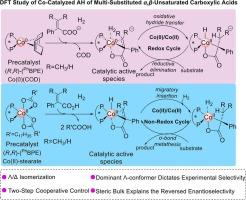
Herein the reaction mechanisms and the origin of enantioselectivity of the Co-catalyzed asymmetric hydrogenation (AH) of multi-substituted α,β-unsaturated carboxylic acids involving Co(0)/Co(II) catalytic redox cycle and Co(II)/Co(II) non-redox one were investigated using density functional theory (DFT) method. For the AH reaction adopting Co(0)/Co(II) redox cycle by (R,R)-(PhBPE)Co(0)(COD) system, it is revealed that the oxidative hydride transfer step is more favorable than the step-wise process including the oxidative addition step and the migratory insertion step in the hydrogenation process. The isomerization between Λ- and Δ-conformers along reaction pathway was proposed, interestingly, the AH pathway by Λ catalytic conformer is dominant to achieve R-product while that by Δ catalytic conformer is dominant to achieve S-product for tetra-substituted substrate. Unlike conventional models in which stereoselectivity is determined by a single step, the calculated results indicate that both the oxidative hydride transfer step and reductive elimination one cooperatively control the enantioselectivity of this reaction. Similarly, for that adopting Co(II)/Co(II) non-redox cycle by (R,R)-(PhBPE)Co(II)-stearate system, the enantioselectivity is found to be cooperatively determined by the migratory insertion step and the σ‑bond metathesis one. In addition, the reversed enantioselectivity between tetra‑ and di-substituted substrates originates from steric bulk. Importantly, the Co(II)-monohydride species got involved instead of the Co(II)-dihydride species in either the Co(0)/Co(II) redox cycle or the Co(II)/Co(II) non‑redox cycle. This work not only agrees well with experimental observation, but also provides theoretical insights into the Co-catalyzed AH and establishes a valuable foundation for the development of efficient earth‑abundant metal catalysts
期刊介绍:
The Journal of Catalysis publishes scholarly articles on both heterogeneous and homogeneous catalysis, covering a wide range of chemical transformations. These include various types of catalysis, such as those mediated by photons, plasmons, and electrons. The focus of the studies is to understand the relationship between catalytic function and the underlying chemical properties of surfaces and metal complexes.
The articles in the journal offer innovative concepts and explore the synthesis and kinetics of inorganic solids and homogeneous complexes. Furthermore, they discuss spectroscopic techniques for characterizing catalysts, investigate the interaction of probes and reacting species with catalysts, and employ theoretical methods.
The research presented in the journal should have direct relevance to the field of catalytic processes, addressing either fundamental aspects or applications of catalysis.