Ruijia Tian, Kexuan Sun, Yuanyuan Meng, Jiahan Xie, Yaohua Wang, Xiaoyi Lu, Jingnan Wang, Shujing Zhou, Ming Yang, Haibin Pan, Yang Bai, Zhenhua Song, Yingguo Yang, Quan Liu, Bin Han, Bencan Tang, Darren A. Walsh, Hainam Do, Chang Liu, Ziyi Ge
{"title":"化学硬度工程同步钙钛矿串联结晶","authors":"Ruijia Tian, Kexuan Sun, Yuanyuan Meng, Jiahan Xie, Yaohua Wang, Xiaoyi Lu, Jingnan Wang, Shujing Zhou, Ming Yang, Haibin Pan, Yang Bai, Zhenhua Song, Yingguo Yang, Quan Liu, Bin Han, Bencan Tang, Darren A. Walsh, Hainam Do, Chang Liu, Ziyi Ge","doi":"10.1038/s41565-026-02165-6","DOIUrl":null,"url":null,"abstract":"All-perovskite tandem solar cells are constrained by asynchronous crystallization in multicomponent perovskites, which produces vertical compositional gradients, structural inhomogeneity and excessive non-radiative recombination. These effects arise from mismatched coordination and crystallization kinetics among mixed halides and Pb2+/Sn2+ cations. Here we establish a generalizable additive design strategy guided by hard–soft acid–base principles to synchronize nucleation and crystal growth in both wide- and narrow-bandgap perovskites. Borderline-base difluoro(oxalato)borate and hard-base tetrafluoroborate selectively coordinate wide- and narrow-bandgap perovskite precursors, respectively, balancing the crystallization kinetics of PbI2/PbBr2 and PbI2/SnI2 and producing vertically uniform perovskite films with reduced defect densities and suppressed ion migration. In situ optical and structural characterization reveals homogeneous nucleation and direct crystal growth without intermediate halide redistribution. Monolithic two-terminal tandems achieve an efficiency of 30.3% (certified, 30.3%) with improved open-circuit voltage (2.16 V) and fill factor (85.2%), retaining 92% efficiency after 1,000 h of maximum power point tracking. Flexible tandems reach an efficiency of 28.2% (certified, 28.0%). These results establish chemical hardness matching as a universal principle for controlling crystallization in different perovskite systems.","PeriodicalId":18915,"journal":{"name":"Nature nanotechnology","volume":"25 1","pages":""},"PeriodicalIF":34.9000,"publicationDate":"2026-04-27","publicationTypes":"Journal Article","fieldsOfStudy":null,"isOpenAccess":false,"openAccessPdf":"","citationCount":"0","resultStr":"{\"title\":\"Chemical hardness engineering synchronizes crystallization in perovskite tandems\",\"authors\":\"Ruijia Tian, Kexuan Sun, Yuanyuan Meng, Jiahan Xie, Yaohua Wang, Xiaoyi Lu, Jingnan Wang, Shujing Zhou, Ming Yang, Haibin Pan, Yang Bai, Zhenhua Song, Yingguo Yang, Quan Liu, Bin Han, Bencan Tang, Darren A. Walsh, Hainam Do, Chang Liu, Ziyi Ge\",\"doi\":\"10.1038/s41565-026-02165-6\",\"DOIUrl\":null,\"url\":null,\"abstract\":\"All-perovskite tandem solar cells are constrained by asynchronous crystallization in multicomponent perovskites, which produces vertical compositional gradients, structural inhomogeneity and excessive non-radiative recombination. These effects arise from mismatched coordination and crystallization kinetics among mixed halides and Pb2+/Sn2+ cations. Here we establish a generalizable additive design strategy guided by hard–soft acid–base principles to synchronize nucleation and crystal growth in both wide- and narrow-bandgap perovskites. Borderline-base difluoro(oxalato)borate and hard-base tetrafluoroborate selectively coordinate wide- and narrow-bandgap perovskite precursors, respectively, balancing the crystallization kinetics of PbI2/PbBr2 and PbI2/SnI2 and producing vertically uniform perovskite films with reduced defect densities and suppressed ion migration. In situ optical and structural characterization reveals homogeneous nucleation and direct crystal growth without intermediate halide redistribution. Monolithic two-terminal tandems achieve an efficiency of 30.3% (certified, 30.3%) with improved open-circuit voltage (2.16 V) and fill factor (85.2%), retaining 92% efficiency after 1,000 h of maximum power point tracking. Flexible tandems reach an efficiency of 28.2% (certified, 28.0%). These results establish chemical hardness matching as a universal principle for controlling crystallization in different perovskite systems.\",\"PeriodicalId\":18915,\"journal\":{\"name\":\"Nature nanotechnology\",\"volume\":\"25 1\",\"pages\":\"\"},\"PeriodicalIF\":34.9000,\"publicationDate\":\"2026-04-27\",\"publicationTypes\":\"Journal Article\",\"fieldsOfStudy\":null,\"isOpenAccess\":false,\"openAccessPdf\":\"\",\"citationCount\":\"0\",\"resultStr\":null,\"platform\":\"Semanticscholar\",\"paperid\":null,\"PeriodicalName\":\"Nature nanotechnology\",\"FirstCategoryId\":\"88\",\"ListUrlMain\":\"https://doi.org/10.1038/s41565-026-02165-6\",\"RegionNum\":1,\"RegionCategory\":\"材料科学\",\"ArticlePicture\":[],\"TitleCN\":null,\"AbstractTextCN\":null,\"PMCID\":null,\"EPubDate\":\"\",\"PubModel\":\"\",\"JCR\":\"Q1\",\"JCRName\":\"MATERIALS SCIENCE, MULTIDISCIPLINARY\",\"Score\":null,\"Total\":0}","platform":"Semanticscholar","paperid":null,"PeriodicalName":"Nature nanotechnology","FirstCategoryId":"88","ListUrlMain":"https://doi.org/10.1038/s41565-026-02165-6","RegionNum":1,"RegionCategory":"材料科学","ArticlePicture":[],"TitleCN":null,"AbstractTextCN":null,"PMCID":null,"EPubDate":"","PubModel":"","JCR":"Q1","JCRName":"MATERIALS SCIENCE, MULTIDISCIPLINARY","Score":null,"Total":0}
Chemical hardness engineering synchronizes crystallization in perovskite tandems
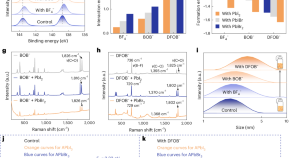
All-perovskite tandem solar cells are constrained by asynchronous crystallization in multicomponent perovskites, which produces vertical compositional gradients, structural inhomogeneity and excessive non-radiative recombination. These effects arise from mismatched coordination and crystallization kinetics among mixed halides and Pb2+/Sn2+ cations. Here we establish a generalizable additive design strategy guided by hard–soft acid–base principles to synchronize nucleation and crystal growth in both wide- and narrow-bandgap perovskites. Borderline-base difluoro(oxalato)borate and hard-base tetrafluoroborate selectively coordinate wide- and narrow-bandgap perovskite precursors, respectively, balancing the crystallization kinetics of PbI2/PbBr2 and PbI2/SnI2 and producing vertically uniform perovskite films with reduced defect densities and suppressed ion migration. In situ optical and structural characterization reveals homogeneous nucleation and direct crystal growth without intermediate halide redistribution. Monolithic two-terminal tandems achieve an efficiency of 30.3% (certified, 30.3%) with improved open-circuit voltage (2.16 V) and fill factor (85.2%), retaining 92% efficiency after 1,000 h of maximum power point tracking. Flexible tandems reach an efficiency of 28.2% (certified, 28.0%). These results establish chemical hardness matching as a universal principle for controlling crystallization in different perovskite systems.
期刊介绍:
Nature Nanotechnology is a prestigious journal that publishes high-quality papers in various areas of nanoscience and nanotechnology. The journal focuses on the design, characterization, and production of structures, devices, and systems that manipulate and control materials at atomic, molecular, and macromolecular scales. It encompasses both bottom-up and top-down approaches, as well as their combinations.
Furthermore, Nature Nanotechnology fosters the exchange of ideas among researchers from diverse disciplines such as chemistry, physics, material science, biomedical research, engineering, and more. It promotes collaboration at the forefront of this multidisciplinary field. The journal covers a wide range of topics, from fundamental research in physics, chemistry, and biology, including computational work and simulations, to the development of innovative devices and technologies for various industrial sectors such as information technology, medicine, manufacturing, high-performance materials, energy, and environmental technologies. It includes coverage of organic, inorganic, and hybrid materials.