{"title":"模块化双链DNA识别定义了cGAS-STING控制中外切酶TREX1的特异性","authors":"Jiali Zhu, Lei Wang, Changjie Lin, Shuchen Bian, Xiaohan Luan, Yingying Sui, Luhang Piao, Wen Zhou","doi":"10.1016/j.immuni.2026.03.025","DOIUrl":null,"url":null,"abstract":"TREX1, but not other DEDDh exonucleases, restrains cyclic GMP-AMP synthase- stimulator of interferon genes (cGAS-STING) activation by cytosolic DNA. Here, we examined the mechanisms underlying this specificity. Biochemical comparison of TREX1 and TREX2 mapped TREX1’s ability to degrade dsDNA and suppress cGAS signaling to a single amino acid, R128. Metazoan TREX proteins containing an R128-equivalent functioned as double-stranded DNA (dsDNA) nucleases, often alongside cGAS-like receptors, defining an evolutionarily conserved family. Structurally, TREX1-R128 contacted the non-substrate strand to enable efficient dsDNA binding and cleavage. Examination of conserved structural features of the R128-containing TREX family further identified a substrate-sensing loop that inserted into the active-site cleft and stabilized the substrate strand. In human TREX1, a distinct auxiliary DNA-binding surface (B-site) strengthened DNA engagement and cGAS restraint independent of DNase activity, suggesting a competitive function. Autoimmune-associated TREX1 mutations mapped to TREX1-dsDNA interfaces, and mutations disrupting these interactions increased cGAS-STING signaling and antitumor immunity in murine models. Thus, a modular dsDNA-recognition architecture defines TREX1 specificity and regulation of the cGAS-STING pathway.","PeriodicalId":13269,"journal":{"name":"Immunity","volume":"6 1","pages":""},"PeriodicalIF":26.3000,"publicationDate":"2026-04-24","publicationTypes":"Journal Article","fieldsOfStudy":null,"isOpenAccess":false,"openAccessPdf":"","citationCount":"0","resultStr":"{\"title\":\"Modular double-stranded DNA recognition defines specificity of the exonuclease TREX1 in cGAS-STING control\",\"authors\":\"Jiali Zhu, Lei Wang, Changjie Lin, Shuchen Bian, Xiaohan Luan, Yingying Sui, Luhang Piao, Wen Zhou\",\"doi\":\"10.1016/j.immuni.2026.03.025\",\"DOIUrl\":null,\"url\":null,\"abstract\":\"TREX1, but not other DEDDh exonucleases, restrains cyclic GMP-AMP synthase- stimulator of interferon genes (cGAS-STING) activation by cytosolic DNA. Here, we examined the mechanisms underlying this specificity. Biochemical comparison of TREX1 and TREX2 mapped TREX1’s ability to degrade dsDNA and suppress cGAS signaling to a single amino acid, R128. Metazoan TREX proteins containing an R128-equivalent functioned as double-stranded DNA (dsDNA) nucleases, often alongside cGAS-like receptors, defining an evolutionarily conserved family. Structurally, TREX1-R128 contacted the non-substrate strand to enable efficient dsDNA binding and cleavage. Examination of conserved structural features of the R128-containing TREX family further identified a substrate-sensing loop that inserted into the active-site cleft and stabilized the substrate strand. In human TREX1, a distinct auxiliary DNA-binding surface (B-site) strengthened DNA engagement and cGAS restraint independent of DNase activity, suggesting a competitive function. Autoimmune-associated TREX1 mutations mapped to TREX1-dsDNA interfaces, and mutations disrupting these interactions increased cGAS-STING signaling and antitumor immunity in murine models. Thus, a modular dsDNA-recognition architecture defines TREX1 specificity and regulation of the cGAS-STING pathway.\",\"PeriodicalId\":13269,\"journal\":{\"name\":\"Immunity\",\"volume\":\"6 1\",\"pages\":\"\"},\"PeriodicalIF\":26.3000,\"publicationDate\":\"2026-04-24\",\"publicationTypes\":\"Journal Article\",\"fieldsOfStudy\":null,\"isOpenAccess\":false,\"openAccessPdf\":\"\",\"citationCount\":\"0\",\"resultStr\":null,\"platform\":\"Semanticscholar\",\"paperid\":null,\"PeriodicalName\":\"Immunity\",\"FirstCategoryId\":\"3\",\"ListUrlMain\":\"https://doi.org/10.1016/j.immuni.2026.03.025\",\"RegionNum\":1,\"RegionCategory\":\"医学\",\"ArticlePicture\":[],\"TitleCN\":null,\"AbstractTextCN\":null,\"PMCID\":null,\"EPubDate\":\"\",\"PubModel\":\"\",\"JCR\":\"Q1\",\"JCRName\":\"IMMUNOLOGY\",\"Score\":null,\"Total\":0}","platform":"Semanticscholar","paperid":null,"PeriodicalName":"Immunity","FirstCategoryId":"3","ListUrlMain":"https://doi.org/10.1016/j.immuni.2026.03.025","RegionNum":1,"RegionCategory":"医学","ArticlePicture":[],"TitleCN":null,"AbstractTextCN":null,"PMCID":null,"EPubDate":"","PubModel":"","JCR":"Q1","JCRName":"IMMUNOLOGY","Score":null,"Total":0}
Modular double-stranded DNA recognition defines specificity of the exonuclease TREX1 in cGAS-STING control
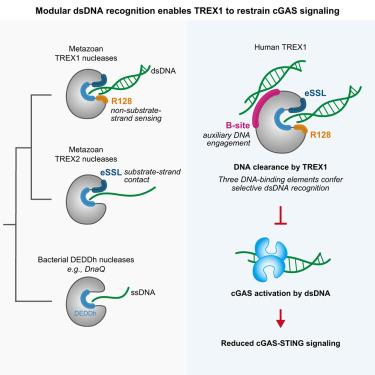
TREX1, but not other DEDDh exonucleases, restrains cyclic GMP-AMP synthase- stimulator of interferon genes (cGAS-STING) activation by cytosolic DNA. Here, we examined the mechanisms underlying this specificity. Biochemical comparison of TREX1 and TREX2 mapped TREX1’s ability to degrade dsDNA and suppress cGAS signaling to a single amino acid, R128. Metazoan TREX proteins containing an R128-equivalent functioned as double-stranded DNA (dsDNA) nucleases, often alongside cGAS-like receptors, defining an evolutionarily conserved family. Structurally, TREX1-R128 contacted the non-substrate strand to enable efficient dsDNA binding and cleavage. Examination of conserved structural features of the R128-containing TREX family further identified a substrate-sensing loop that inserted into the active-site cleft and stabilized the substrate strand. In human TREX1, a distinct auxiliary DNA-binding surface (B-site) strengthened DNA engagement and cGAS restraint independent of DNase activity, suggesting a competitive function. Autoimmune-associated TREX1 mutations mapped to TREX1-dsDNA interfaces, and mutations disrupting these interactions increased cGAS-STING signaling and antitumor immunity in murine models. Thus, a modular dsDNA-recognition architecture defines TREX1 specificity and regulation of the cGAS-STING pathway.
期刊介绍:
Immunity is a publication that focuses on publishing significant advancements in research related to immunology. We encourage the submission of studies that offer groundbreaking immunological discoveries, whether at the molecular, cellular, or whole organism level. Topics of interest encompass a wide range, such as cancer, infectious diseases, neuroimmunology, autoimmune diseases, allergies, mucosal immunity, metabolic diseases, and homeostasis.