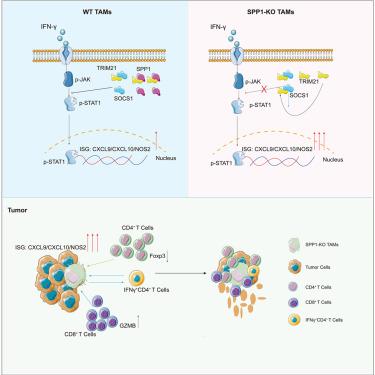
SPP1-SOCS1通路抑制肿瘤相关巨噬细胞中的干扰素反应并形成免疫抑制肿瘤微环境

IF 26.3 1区 医学 Q1 IMMUNOLOGY
Liangzhan Sun, Xiaojing Chu, Tingting Kong, Xirui Chen, Jianing Ru, Qianqian Gao, Wei Zhou, Xiliang Wang, Sijin Cheng, Linnan Zhu, Zemin Zhang
{"title":"SPP1-SOCS1通路抑制肿瘤相关巨噬细胞中的干扰素反应并形成免疫抑制肿瘤微环境","authors":"Liangzhan Sun, Xiaojing Chu, Tingting Kong, Xirui Chen, Jianing Ru, Qianqian Gao, Wei Zhou, Xiliang Wang, Sijin Cheng, Linnan Zhu, Zemin Zhang","doi":"10.1016/j.immuni.2026.04.001","DOIUrl":null,"url":null,"abstract":"Tumor-associated macrophages (TAMs) can suppress antitumor immunity and reduce responses to immune checkpoint blockade (ICB). Here, we asked how TAM programs contribute to ICB non-response. Integration of public single-cell RNA sequencing (scRNA-seq) datasets across 12 cancer types identified SPP1<sup>+</sup> TAMs as a tumor-enriched macrophage subset with immunosuppressive features. TAMs from ICB non-responders across multiple tumor types exhibited higher SPP1 expression. In murine models, macrophage Spp1 deletion suppressed tumor growth and prolonged survival and was associated with a remodeled tumor microenvironment featuring reduced T regulatory cell (Treg) frequencies, increased interferon (IFN)-γ<sup>+</sup> CD4<sup>+</sup> and GZMB<sup>+</sup> CD8<sup>+</sup> T cells, and augmented interferon-stimulated gene (ISG) expression across immune and malignant compartments. Mechanistically, intracellular SPP1 interacted with TRIM21 to limit SOCS1 ubiquitination, stabilizing SOCS1-mediated negative feedback and dampening IFN-γ-STAT1-ISG signaling in TAMs. Consistently, SPP1 targeting enhanced the efficacy of anti-PD-L1 therapy <em>in vivo</em>. Thus, remodeling the TME via targeting the TAM SPP1-IFN-γ axis presents a therapeutic avenue for enhancing responses to ICB.","PeriodicalId":13269,"journal":{"name":"Immunity","volume":"13 1","pages":""},"PeriodicalIF":26.3000,"publicationDate":"2026-04-27","publicationTypes":"Journal Article","fieldsOfStudy":null,"isOpenAccess":false,"openAccessPdf":"","citationCount":"0","resultStr":"{\"title\":\"An SPP1-SOCS1 pathway constrains interferon responses in tumor-associated macrophages and shapes an immunosuppressive tumor microenvironment\",\"authors\":\"Liangzhan Sun, Xiaojing Chu, Tingting Kong, Xirui Chen, Jianing Ru, Qianqian Gao, Wei Zhou, Xiliang Wang, Sijin Cheng, Linnan Zhu, Zemin Zhang\",\"doi\":\"10.1016/j.immuni.2026.04.001\",\"DOIUrl\":null,\"url\":null,\"abstract\":\"Tumor-associated macrophages (TAMs) can suppress antitumor immunity and reduce responses to immune checkpoint blockade (ICB). Here, we asked how TAM programs contribute to ICB non-response. Integration of public single-cell RNA sequencing (scRNA-seq) datasets across 12 cancer types identified SPP1<sup>+</sup> TAMs as a tumor-enriched macrophage subset with immunosuppressive features. TAMs from ICB non-responders across multiple tumor types exhibited higher SPP1 expression. In murine models, macrophage Spp1 deletion suppressed tumor growth and prolonged survival and was associated with a remodeled tumor microenvironment featuring reduced T regulatory cell (Treg) frequencies, increased interferon (IFN)-γ<sup>+</sup> CD4<sup>+</sup> and GZMB<sup>+</sup> CD8<sup>+</sup> T cells, and augmented interferon-stimulated gene (ISG) expression across immune and malignant compartments. Mechanistically, intracellular SPP1 interacted with TRIM21 to limit SOCS1 ubiquitination, stabilizing SOCS1-mediated negative feedback and dampening IFN-γ-STAT1-ISG signaling in TAMs. Consistently, SPP1 targeting enhanced the efficacy of anti-PD-L1 therapy <em>in vivo</em>. Thus, remodeling the TME via targeting the TAM SPP1-IFN-γ axis presents a therapeutic avenue for enhancing responses to ICB.\",\"PeriodicalId\":13269,\"journal\":{\"name\":\"Immunity\",\"volume\":\"13 1\",\"pages\":\"\"},\"PeriodicalIF\":26.3000,\"publicationDate\":\"2026-04-27\",\"publicationTypes\":\"Journal Article\",\"fieldsOfStudy\":null,\"isOpenAccess\":false,\"openAccessPdf\":\"\",\"citationCount\":\"0\",\"resultStr\":null,\"platform\":\"Semanticscholar\",\"paperid\":null,\"PeriodicalName\":\"Immunity\",\"FirstCategoryId\":\"3\",\"ListUrlMain\":\"https://doi.org/10.1016/j.immuni.2026.04.001\",\"RegionNum\":1,\"RegionCategory\":\"医学\",\"ArticlePicture\":[],\"TitleCN\":null,\"AbstractTextCN\":null,\"PMCID\":null,\"EPubDate\":\"\",\"PubModel\":\"\",\"JCR\":\"Q1\",\"JCRName\":\"IMMUNOLOGY\",\"Score\":null,\"Total\":0}","platform":"Semanticscholar","paperid":null,"PeriodicalName":"Immunity","FirstCategoryId":"3","ListUrlMain":"https://doi.org/10.1016/j.immuni.2026.04.001","RegionNum":1,"RegionCategory":"医学","ArticlePicture":[],"TitleCN":null,"AbstractTextCN":null,"PMCID":null,"EPubDate":"","PubModel":"","JCR":"Q1","JCRName":"IMMUNOLOGY","Score":null,"Total":0}
引用次数: 0

摘要

肿瘤相关巨噬细胞(tam)可以抑制抗肿瘤免疫并降低对免疫检查点阻断(ICB)的反应。在这里,我们询问TAM项目是如何导致ICB无响应的。对12种癌症类型的公共单细胞RNA测序(scRNA-seq)数据集进行整合,发现SPP1+ tam是一个具有免疫抑制特征的肿瘤富集巨噬细胞亚群。来自多种肿瘤类型的ICB无应答者的tam表现出更高的SPP1表达。在小鼠模型中,巨噬细胞Spp1缺失抑制肿瘤生长和延长存活时间,并与肿瘤微环境重塑相关,其特征是T调节细胞(Treg)频率降低,干扰素(IFN)-γ+ CD4+和GZMB+ CD8+ T细胞增加,干扰素刺激基因(ISG)在免疫和恶性区室中的表达增加。机制上,细胞内SPP1与TRIM21相互作用,限制SOCS1泛素化,稳定SOCS1介导的负反馈,抑制tam中IFN-γ-STAT1-ISG信号。与此一致的是,SPP1靶向增强了体内抗pd - l1治疗的疗效。因此,通过靶向TAM SPP1-IFN-γ轴来重塑TME,为增强对ICB的反应提供了一种治疗途径。
本文章由计算机程序翻译,如有差异,请以英文原文为准。

An SPP1-SOCS1 pathway constrains interferon responses in tumor-associated macrophages and shapes an immunosuppressive tumor microenvironment

An SPP1-SOCS1 pathway constrains interferon responses in tumor-associated macrophages and shapes an immunosuppressive tumor microenvironment
Tumor-associated macrophages (TAMs) can suppress antitumor immunity and reduce responses to immune checkpoint blockade (ICB). Here, we asked how TAM programs contribute to ICB non-response. Integration of public single-cell RNA sequencing (scRNA-seq) datasets across 12 cancer types identified SPP1+ TAMs as a tumor-enriched macrophage subset with immunosuppressive features. TAMs from ICB non-responders across multiple tumor types exhibited higher SPP1 expression. In murine models, macrophage Spp1 deletion suppressed tumor growth and prolonged survival and was associated with a remodeled tumor microenvironment featuring reduced T regulatory cell (Treg) frequencies, increased interferon (IFN)-γ+ CD4+ and GZMB+ CD8+ T cells, and augmented interferon-stimulated gene (ISG) expression across immune and malignant compartments. Mechanistically, intracellular SPP1 interacted with TRIM21 to limit SOCS1 ubiquitination, stabilizing SOCS1-mediated negative feedback and dampening IFN-γ-STAT1-ISG signaling in TAMs. Consistently, SPP1 targeting enhanced the efficacy of anti-PD-L1 therapy in vivo. Thus, remodeling the TME via targeting the TAM SPP1-IFN-γ axis presents a therapeutic avenue for enhancing responses to ICB.
求助全文
通过发布文献求助,成功后即可免费获取论文全文。 去求助
来源期刊
Immunity
Immunity 医学-免疫学
CiteScore
49.40
自引率
2.20%
发文量
205
审稿时长
6 months
期刊介绍: Immunity is a publication that focuses on publishing significant advancements in research related to immunology. We encourage the submission of studies that offer groundbreaking immunological discoveries, whether at the molecular, cellular, or whole organism level. Topics of interest encompass a wide range, such as cancer, infectious diseases, neuroimmunology, autoimmune diseases, allergies, mucosal immunity, metabolic diseases, and homeostasis.

×
引用
GB/T 7714-2015
复制
MLA
复制
APA
复制
导出至
BibTeX EndNote RefMan NoteFirst NoteExpress
×
提示
您的信息不完整,为了账户安全,请先补充。
现在去补充
×
提示
您因"违规操作"
具体请查看互助需知
我知道了
×
提示
确定
请完成安全验证×
copy
已复制链接
快去分享给好友吧!
我知道了
右上角分享
点击右上角分享
0
联系我们:info@booksci.cn Book学术提供免费学术资源搜索服务,方便国内外学者检索中英文文献。致力于提供最便捷和优质的服务体验。 Copyright © 2023 布克学术 All rights reserved.
京ICP备2023020795号-1
ghs 京公网安备 11010802042870号
Book学术文献互助
Book学术文献互助群
群 号:604180095
Book学术官方微信
小红书