{"title":"绘制拉沙病毒的科学景观:55年文献计量学研究(1970-2025)","authors":"Uwem Okon Edet , Clement Meseko , Md Zulfekar Ali , Edema Enogiomwan Imalele , Agusi Ebere Roseann , Aniekan-Augusta Okon Eyo , Bassey Edet , Olayinka Asala","doi":"10.1016/j.soh.2026.100156","DOIUrl":null,"url":null,"abstract":"<div><h3>Background</h3><div>Lassa fever is a zoonotic disease, caused by Lassa virus (LASV), that was first reported in 1965. After 55 years, its research landscape remains largely underexplored. Therefore, a bibliometric study is needed to identify LASV research landscape.</div></div><div><h3>Methods</h3><div>Scopus database was searched and the resulting data was analyzed using VOSviewer (version 1.6.15) for Windows, bibliometrix (version 3.0.0) with Biblioshiny, and R (version 4.5.2) to reveal trends in LASV publications, including keywords, authors’ productivity over time, and collaboration among research institutions and universities.</div></div><div><h3>Results</h3><div>From Scopus, 1566 studies were retrieved, and the trend analysis indicated three distinct phases: a low productivity phase (1970–2002), consistent increase phase (2003–2014), and high productivity phase (2015–2025). <em>The Journal of Virology</em> included the most LASV publications (132 articles). Original research articles dominated the LASV publications with 1270 (81.10%), followed by reviews 296 (18.90%). Keyword analysis revealed evolution over time, with terms used to describe LASV forming the most dominant network across clusters. Factorial analysis revealed keywords absence linked to health and environment role in LASV spread. Among the top 50 authors, 20% were from Africa (Guinea, Mali, Nigeria, and Sierra Leone), indicating minimal locally driven research. Country collaboration network analysis revealed the dominance of the United States, Germany, France, and China, while Nigeria was prominently represented in Africa. The findings further indicate few studies on vaccines and therapeutics, and less involvement of authors from LASV-endemic regions.</div></div><div><h3>Conclusion</h3><div>Despite significant growth in LASV research, critical gaps in vaccines, therapeutics, and endemic region representation highlight the urgent need for locally driven One Health studies and equitable research partnerships.</div></div>","PeriodicalId":101146,"journal":{"name":"Science in One Health","volume":"5 ","pages":"Article 100156"},"PeriodicalIF":0.0000,"publicationDate":"2026-01-01","publicationTypes":"Journal Article","fieldsOfStudy":null,"isOpenAccess":false,"openAccessPdf":"","citationCount":"0","resultStr":"{\"title\":\"Mapping the scientific landscape of Lassa virus: a 55-year bibliometric study (1970–2025)\",\"authors\":\"Uwem Okon Edet , Clement Meseko , Md Zulfekar Ali , Edema Enogiomwan Imalele , Agusi Ebere Roseann , Aniekan-Augusta Okon Eyo , Bassey Edet , Olayinka Asala\",\"doi\":\"10.1016/j.soh.2026.100156\",\"DOIUrl\":null,\"url\":null,\"abstract\":\"<div><h3>Background</h3><div>Lassa fever is a zoonotic disease, caused by Lassa virus (LASV), that was first reported in 1965. After 55 years, its research landscape remains largely underexplored. Therefore, a bibliometric study is needed to identify LASV research landscape.</div></div><div><h3>Methods</h3><div>Scopus database was searched and the resulting data was analyzed using VOSviewer (version 1.6.15) for Windows, bibliometrix (version 3.0.0) with Biblioshiny, and R (version 4.5.2) to reveal trends in LASV publications, including keywords, authors’ productivity over time, and collaboration among research institutions and universities.</div></div><div><h3>Results</h3><div>From Scopus, 1566 studies were retrieved, and the trend analysis indicated three distinct phases: a low productivity phase (1970–2002), consistent increase phase (2003–2014), and high productivity phase (2015–2025). <em>The Journal of Virology</em> included the most LASV publications (132 articles). Original research articles dominated the LASV publications with 1270 (81.10%), followed by reviews 296 (18.90%). Keyword analysis revealed evolution over time, with terms used to describe LASV forming the most dominant network across clusters. Factorial analysis revealed keywords absence linked to health and environment role in LASV spread. Among the top 50 authors, 20% were from Africa (Guinea, Mali, Nigeria, and Sierra Leone), indicating minimal locally driven research. Country collaboration network analysis revealed the dominance of the United States, Germany, France, and China, while Nigeria was prominently represented in Africa. The findings further indicate few studies on vaccines and therapeutics, and less involvement of authors from LASV-endemic regions.</div></div><div><h3>Conclusion</h3><div>Despite significant growth in LASV research, critical gaps in vaccines, therapeutics, and endemic region representation highlight the urgent need for locally driven One Health studies and equitable research partnerships.</div></div>\",\"PeriodicalId\":101146,\"journal\":{\"name\":\"Science in One Health\",\"volume\":\"5 \",\"pages\":\"Article 100156\"},\"PeriodicalIF\":0.0000,\"publicationDate\":\"2026-01-01\",\"publicationTypes\":\"Journal Article\",\"fieldsOfStudy\":null,\"isOpenAccess\":false,\"openAccessPdf\":\"\",\"citationCount\":\"0\",\"resultStr\":null,\"platform\":\"Semanticscholar\",\"paperid\":null,\"PeriodicalName\":\"Science in One Health\",\"FirstCategoryId\":\"1085\",\"ListUrlMain\":\"https://www.sciencedirect.com/science/article/pii/S2949704326000119\",\"RegionNum\":0,\"RegionCategory\":null,\"ArticlePicture\":[],\"TitleCN\":null,\"AbstractTextCN\":null,\"PMCID\":null,\"EPubDate\":\"2026/3/31 0:00:00\",\"PubModel\":\"Epub\",\"JCR\":\"\",\"JCRName\":\"\",\"Score\":null,\"Total\":0}","platform":"Semanticscholar","paperid":null,"PeriodicalName":"Science in One Health","FirstCategoryId":"1085","ListUrlMain":"https://www.sciencedirect.com/science/article/pii/S2949704326000119","RegionNum":0,"RegionCategory":null,"ArticlePicture":[],"TitleCN":null,"AbstractTextCN":null,"PMCID":null,"EPubDate":"2026/3/31 0:00:00","PubModel":"Epub","JCR":"","JCRName":"","Score":null,"Total":0}
Mapping the scientific landscape of Lassa virus: a 55-year bibliometric study (1970–2025)
Background
Lassa fever is a zoonotic disease, caused by Lassa virus (LASV), that was first reported in 1965. After 55 years, its research landscape remains largely underexplored. Therefore, a bibliometric study is needed to identify LASV research landscape.
Methods
Scopus database was searched and the resulting data was analyzed using VOSviewer (version 1.6.15) for Windows, bibliometrix (version 3.0.0) with Biblioshiny, and R (version 4.5.2) to reveal trends in LASV publications, including keywords, authors’ productivity over time, and collaboration among research institutions and universities.
Results
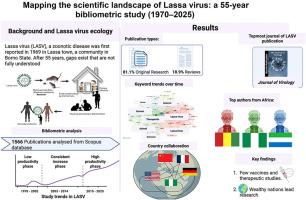
From Scopus, 1566 studies were retrieved, and the trend analysis indicated three distinct phases: a low productivity phase (1970–2002), consistent increase phase (2003–2014), and high productivity phase (2015–2025). The Journal of Virology included the most LASV publications (132 articles). Original research articles dominated the LASV publications with 1270 (81.10%), followed by reviews 296 (18.90%). Keyword analysis revealed evolution over time, with terms used to describe LASV forming the most dominant network across clusters. Factorial analysis revealed keywords absence linked to health and environment role in LASV spread. Among the top 50 authors, 20% were from Africa (Guinea, Mali, Nigeria, and Sierra Leone), indicating minimal locally driven research. Country collaboration network analysis revealed the dominance of the United States, Germany, France, and China, while Nigeria was prominently represented in Africa. The findings further indicate few studies on vaccines and therapeutics, and less involvement of authors from LASV-endemic regions.
Conclusion
Despite significant growth in LASV research, critical gaps in vaccines, therapeutics, and endemic region representation highlight the urgent need for locally driven One Health studies and equitable research partnerships.


 求助内容:
求助内容: 应助结果提醒方式:

 京公网安备 11010802042870号


