Fiorenza Sella , Christian Giommi , Damiano Carbonari , Marta Lombó , Oliana Carnevali
{"title":"PFOA对成骨细胞分化的影响:氧化应激和内源性大麻素受体的参与","authors":"Fiorenza Sella , Christian Giommi , Damiano Carbonari , Marta Lombó , Oliana Carnevali","doi":"10.1016/j.ygcen.2026.114932","DOIUrl":null,"url":null,"abstract":"<div><div>Perfluorooctanoic acid (PFOA), a persistent perfluoroalkyl substance (PFAS), has been implicated in bone mineral density loss and defective osteogenesis. In this study, by employing human fetal osteoblast (hFOB1.19), we investigated whether PFOA interferes with osteoblast differentiation by altering the transcription of genes involved in osteogenesis, and protein levels of oxidative stress defense and cannabinoid receptors (CBs). The hFOB 1.19 were exposed to increasing PFOA concentrations (1–100 µM) for seven days, representing supra-environmental concentration commonly used in mechanistic <em>in vitro</em> studies. Osteogenic markers were then evaluated at transcriptional level together with matrix deposition, and the results were compared to an untreated control group. Exposure to PFOA at 10 µM increased the expression of osteocalcin (<em>BGLAP</em>) encoding for a protein involved in calcium deposition. Catalase (CAT) protein levels were upregulated at 1 µM PFOA, while superoxide dismutase (SOD1) did not change, suggesting a selective antioxidant response to oxidative perturbation. Notably, this increase in CAT correlated with a trend toward <em>RUNX2</em> upregulation, possibly representing a compensatory mechanism to preserve differentiation under oxidative stress. In addition, the highest concentration of PFOA modulated the endocannabinoid system (ECS), reducing CB1 and CB2 protein levels. Despite these molecular changes, Alizarin Red staining revealed a borderline and not statistically significant enhanced calcium deposition only at 50 µM PFOA, suggesting potentially aberrant mineralization. Overall, our findings suggest that PFOA perturbs osteoblast differentiation through oxidative stress-linked mechanisms and CBs modulation, with catalase emerging as a key protective mediator of osteogenic competence under environmental contaminants. Furthermore, the observed dysregulation of CB1 and CB2 receptors indicates that the ECS itself may represent a direct target of PFOA action in osteoblasts.</div></div>","PeriodicalId":12582,"journal":{"name":"General and comparative endocrinology","volume":"380 ","pages":"Article 114932"},"PeriodicalIF":1.7000,"publicationDate":"2026-04-01","publicationTypes":"Journal Article","fieldsOfStudy":null,"isOpenAccess":false,"openAccessPdf":"","citationCount":"0","resultStr":"{\"title\":\"PFOA effects on osteoblast differentiation: Involvement of oxidative stress and endocannabinoid receptors\",\"authors\":\"Fiorenza Sella , Christian Giommi , Damiano Carbonari , Marta Lombó , Oliana Carnevali\",\"doi\":\"10.1016/j.ygcen.2026.114932\",\"DOIUrl\":null,\"url\":null,\"abstract\":\"<div><div>Perfluorooctanoic acid (PFOA), a persistent perfluoroalkyl substance (PFAS), has been implicated in bone mineral density loss and defective osteogenesis. In this study, by employing human fetal osteoblast (hFOB1.19), we investigated whether PFOA interferes with osteoblast differentiation by altering the transcription of genes involved in osteogenesis, and protein levels of oxidative stress defense and cannabinoid receptors (CBs). The hFOB 1.19 were exposed to increasing PFOA concentrations (1–100 µM) for seven days, representing supra-environmental concentration commonly used in mechanistic <em>in vitro</em> studies. Osteogenic markers were then evaluated at transcriptional level together with matrix deposition, and the results were compared to an untreated control group. Exposure to PFOA at 10 µM increased the expression of osteocalcin (<em>BGLAP</em>) encoding for a protein involved in calcium deposition. Catalase (CAT) protein levels were upregulated at 1 µM PFOA, while superoxide dismutase (SOD1) did not change, suggesting a selective antioxidant response to oxidative perturbation. Notably, this increase in CAT correlated with a trend toward <em>RUNX2</em> upregulation, possibly representing a compensatory mechanism to preserve differentiation under oxidative stress. In addition, the highest concentration of PFOA modulated the endocannabinoid system (ECS), reducing CB1 and CB2 protein levels. Despite these molecular changes, Alizarin Red staining revealed a borderline and not statistically significant enhanced calcium deposition only at 50 µM PFOA, suggesting potentially aberrant mineralization. Overall, our findings suggest that PFOA perturbs osteoblast differentiation through oxidative stress-linked mechanisms and CBs modulation, with catalase emerging as a key protective mediator of osteogenic competence under environmental contaminants. Furthermore, the observed dysregulation of CB1 and CB2 receptors indicates that the ECS itself may represent a direct target of PFOA action in osteoblasts.</div></div>\",\"PeriodicalId\":12582,\"journal\":{\"name\":\"General and comparative endocrinology\",\"volume\":\"380 \",\"pages\":\"Article 114932\"},\"PeriodicalIF\":1.7000,\"publicationDate\":\"2026-04-01\",\"publicationTypes\":\"Journal Article\",\"fieldsOfStudy\":null,\"isOpenAccess\":false,\"openAccessPdf\":\"\",\"citationCount\":\"0\",\"resultStr\":null,\"platform\":\"Semanticscholar\",\"paperid\":null,\"PeriodicalName\":\"General and comparative endocrinology\",\"FirstCategoryId\":\"3\",\"ListUrlMain\":\"https://www.sciencedirect.com/science/article/pii/S0016648026000596\",\"RegionNum\":3,\"RegionCategory\":\"医学\",\"ArticlePicture\":[],\"TitleCN\":null,\"AbstractTextCN\":null,\"PMCID\":null,\"EPubDate\":\"2026/4/15 0:00:00\",\"PubModel\":\"Epub\",\"JCR\":\"Q3\",\"JCRName\":\"ENDOCRINOLOGY & METABOLISM\",\"Score\":null,\"Total\":0}","platform":"Semanticscholar","paperid":null,"PeriodicalName":"General and comparative endocrinology","FirstCategoryId":"3","ListUrlMain":"https://www.sciencedirect.com/science/article/pii/S0016648026000596","RegionNum":3,"RegionCategory":"医学","ArticlePicture":[],"TitleCN":null,"AbstractTextCN":null,"PMCID":null,"EPubDate":"2026/4/15 0:00:00","PubModel":"Epub","JCR":"Q3","JCRName":"ENDOCRINOLOGY & METABOLISM","Score":null,"Total":0}
PFOA effects on osteoblast differentiation: Involvement of oxidative stress and endocannabinoid receptors
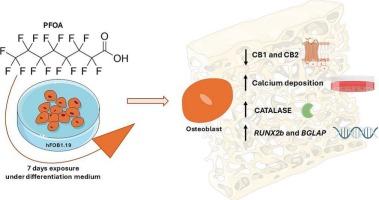
Perfluorooctanoic acid (PFOA), a persistent perfluoroalkyl substance (PFAS), has been implicated in bone mineral density loss and defective osteogenesis. In this study, by employing human fetal osteoblast (hFOB1.19), we investigated whether PFOA interferes with osteoblast differentiation by altering the transcription of genes involved in osteogenesis, and protein levels of oxidative stress defense and cannabinoid receptors (CBs). The hFOB 1.19 were exposed to increasing PFOA concentrations (1–100 µM) for seven days, representing supra-environmental concentration commonly used in mechanistic in vitro studies. Osteogenic markers were then evaluated at transcriptional level together with matrix deposition, and the results were compared to an untreated control group. Exposure to PFOA at 10 µM increased the expression of osteocalcin (BGLAP) encoding for a protein involved in calcium deposition. Catalase (CAT) protein levels were upregulated at 1 µM PFOA, while superoxide dismutase (SOD1) did not change, suggesting a selective antioxidant response to oxidative perturbation. Notably, this increase in CAT correlated with a trend toward RUNX2 upregulation, possibly representing a compensatory mechanism to preserve differentiation under oxidative stress. In addition, the highest concentration of PFOA modulated the endocannabinoid system (ECS), reducing CB1 and CB2 protein levels. Despite these molecular changes, Alizarin Red staining revealed a borderline and not statistically significant enhanced calcium deposition only at 50 µM PFOA, suggesting potentially aberrant mineralization. Overall, our findings suggest that PFOA perturbs osteoblast differentiation through oxidative stress-linked mechanisms and CBs modulation, with catalase emerging as a key protective mediator of osteogenic competence under environmental contaminants. Furthermore, the observed dysregulation of CB1 and CB2 receptors indicates that the ECS itself may represent a direct target of PFOA action in osteoblasts.
期刊介绍:
General and Comparative Endocrinology publishes articles concerned with the many complexities of vertebrate and invertebrate endocrine systems at the sub-molecular, molecular, cellular and organismal levels of analysis.