利用分子印迹纳米粒子识别和表面等离子体共振一步检测血清中miRNA-21肿瘤标志物

IF 6 2区 化学 Q1 CHEMISTRY, ANALYTICAL
Ellie Unwin, Amanda Manso Pena, Nicholas W. Turner, Damla Ulker
{"title":"利用分子印迹纳米粒子识别和表面等离子体共振一步检测血清中miRNA-21肿瘤标志物","authors":"Ellie Unwin, Amanda Manso Pena, Nicholas W. Turner, Damla Ulker","doi":"10.1016/j.aca.2026.345529","DOIUrl":null,"url":null,"abstract":"<h3>Background</h3>The rapid one step detection of cancer markers at early stages of cancer is critical to increase the efficiency of the treatments and survival. miRNA-21 is the most commonly upregulated microRNA in solid tumours and haematological malignancies and is associated with poor prognosis and survival rate. Therefore, its detection at the early stage is vital, ideally using a rapid, simple method with a low detection limit. Current methods often require sophisticated method and labelling to detect miRNAs.<h3>Results</h3>Here, we show that nanosized molecularly imprinted polymers (nanoMIPs), can selectively and sensitively detect miRNA-21 without labelling. NanoMIPs were synthesized via solid-phase polymerization. The template molecule of 5’ phosphor-capped miRNA-21 was attached to a functionalised glass bead via phosphorylimidazolide chemistry. Selected functional monomers/cross-linkers were used to generate selective nanoMIPs with recognition based on electrostatic and ionic interactions. NanoMIPs were characterized to investigate their physicochemical properties and interaction with target molecule. These nanoMIPs were then used for miRNA-21 detection studies exploring affinity and selectivity to the target with Surface Plasmon Resonance in both buffer and serum. High affinity materials (equilibrium dissociation constants – K<sub>D</sub>’ s in the nM/pM range) were demonstrated with high selectivity and when linked to the SPR sensor, a theoretical lower detection limit (LOD) of miRNA-21 was calculated as 0.49 pM in serum.<h3>Significance</h3>This work provides new perspectives in developing miRNA-21 specific synthetic molecular recognition materials using nanoMIPs. The nanoMIPs has potential to be suitable sensor platform, that could be promising tools for early cancer diagnostics in complex matrices.","PeriodicalId":240,"journal":{"name":"Analytica Chimica Acta","volume":"67 1","pages":"345529"},"PeriodicalIF":6.0000,"publicationDate":"2026-04-12","publicationTypes":"Journal Article","fieldsOfStudy":null,"isOpenAccess":false,"openAccessPdf":"","citationCount":"0","resultStr":"{\"title\":\"One-Step Detection of miRNA-21 Cancer Marker in Serum using Molecularly Imprinted Nanoparticle Recognition and Surface Plasmon Resonance\",\"authors\":\"Ellie Unwin, Amanda Manso Pena, Nicholas W. Turner, Damla Ulker\",\"doi\":\"10.1016/j.aca.2026.345529\",\"DOIUrl\":null,\"url\":null,\"abstract\":\"<h3>Background</h3>The rapid one step detection of cancer markers at early stages of cancer is critical to increase the efficiency of the treatments and survival. miRNA-21 is the most commonly upregulated microRNA in solid tumours and haematological malignancies and is associated with poor prognosis and survival rate. Therefore, its detection at the early stage is vital, ideally using a rapid, simple method with a low detection limit. Current methods often require sophisticated method and labelling to detect miRNAs.<h3>Results</h3>Here, we show that nanosized molecularly imprinted polymers (nanoMIPs), can selectively and sensitively detect miRNA-21 without labelling. NanoMIPs were synthesized via solid-phase polymerization. The template molecule of 5’ phosphor-capped miRNA-21 was attached to a functionalised glass bead via phosphorylimidazolide chemistry. Selected functional monomers/cross-linkers were used to generate selective nanoMIPs with recognition based on electrostatic and ionic interactions. NanoMIPs were characterized to investigate their physicochemical properties and interaction with target molecule. These nanoMIPs were then used for miRNA-21 detection studies exploring affinity and selectivity to the target with Surface Plasmon Resonance in both buffer and serum. High affinity materials (equilibrium dissociation constants – K<sub>D</sub>’ s in the nM/pM range) were demonstrated with high selectivity and when linked to the SPR sensor, a theoretical lower detection limit (LOD) of miRNA-21 was calculated as 0.49 pM in serum.<h3>Significance</h3>This work provides new perspectives in developing miRNA-21 specific synthetic molecular recognition materials using nanoMIPs. The nanoMIPs has potential to be suitable sensor platform, that could be promising tools for early cancer diagnostics in complex matrices.\",\"PeriodicalId\":240,\"journal\":{\"name\":\"Analytica Chimica Acta\",\"volume\":\"67 1\",\"pages\":\"345529\"},\"PeriodicalIF\":6.0000,\"publicationDate\":\"2026-04-12\",\"publicationTypes\":\"Journal Article\",\"fieldsOfStudy\":null,\"isOpenAccess\":false,\"openAccessPdf\":\"\",\"citationCount\":\"0\",\"resultStr\":null,\"platform\":\"Semanticscholar\",\"paperid\":null,\"PeriodicalName\":\"Analytica Chimica Acta\",\"FirstCategoryId\":\"92\",\"ListUrlMain\":\"https://doi.org/10.1016/j.aca.2026.345529\",\"RegionNum\":2,\"RegionCategory\":\"化学\",\"ArticlePicture\":[],\"TitleCN\":null,\"AbstractTextCN\":null,\"PMCID\":null,\"EPubDate\":\"\",\"PubModel\":\"\",\"JCR\":\"Q1\",\"JCRName\":\"CHEMISTRY, ANALYTICAL\",\"Score\":null,\"Total\":0}","platform":"Semanticscholar","paperid":null,"PeriodicalName":"Analytica Chimica Acta","FirstCategoryId":"92","ListUrlMain":"https://doi.org/10.1016/j.aca.2026.345529","RegionNum":2,"RegionCategory":"化学","ArticlePicture":[],"TitleCN":null,"AbstractTextCN":null,"PMCID":null,"EPubDate":"","PubModel":"","JCR":"Q1","JCRName":"CHEMISTRY, ANALYTICAL","Score":null,"Total":0}
引用次数: 0

摘要

在癌症早期阶段快速一步检测癌症标志物对提高治疗效率和生存率至关重要。miRNA-21是实体瘤和血液学恶性肿瘤中最常见的上调microRNA,与不良预后和生存率相关。因此,早期检测至关重要,理想的方法是使用快速、简单、检测限低的方法。目前的方法通常需要复杂的方法和标记来检测mirna。结果纳米分子印迹聚合物(nanoMIPs)可以在不标记的情况下选择性和敏感地检测miRNA-21。采用固相聚合法制备纳米ip。通过磷酸化咪唑烷化学将5 '磷酸化的miRNA-21模板分子附着在功能化的玻璃珠上。选择功能单体/交联剂生成基于静电和离子相互作用识别的选择性纳米omip。研究了纳米ip的理化性质及其与靶分子的相互作用。然后将这些纳米omip用于miRNA-21检测研究,利用表面等离子体共振在缓冲液和血清中探索对靶标的亲和力和选择性。高亲和力材料(平衡解离常数- KD在nM/pM范围内)具有高选择性,当与SPR传感器连接时,计算出血清中miRNA-21的理论最低检测限(LOD)为0.49 pM。本研究为利用纳米omip开发miRNA-21特异性合成分子识别材料提供了新的视角。纳米omip有潜力成为合适的传感器平台,可能成为复杂基质中早期癌症诊断的有前途的工具。
本文章由计算机程序翻译,如有差异,请以英文原文为准。

One-Step Detection of miRNA-21 Cancer Marker in Serum using Molecularly Imprinted Nanoparticle Recognition and Surface Plasmon Resonance

One-Step Detection of miRNA-21 Cancer Marker in Serum using Molecularly Imprinted Nanoparticle Recognition and Surface Plasmon Resonance

Background

The rapid one step detection of cancer markers at early stages of cancer is critical to increase the efficiency of the treatments and survival. miRNA-21 is the most commonly upregulated microRNA in solid tumours and haematological malignancies and is associated with poor prognosis and survival rate. Therefore, its detection at the early stage is vital, ideally using a rapid, simple method with a low detection limit. Current methods often require sophisticated method and labelling to detect miRNAs.

Results

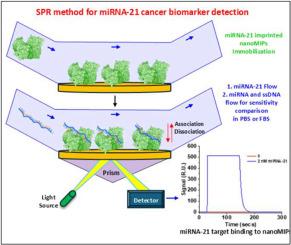
Here, we show that nanosized molecularly imprinted polymers (nanoMIPs), can selectively and sensitively detect miRNA-21 without labelling. NanoMIPs were synthesized via solid-phase polymerization. The template molecule of 5’ phosphor-capped miRNA-21 was attached to a functionalised glass bead via phosphorylimidazolide chemistry. Selected functional monomers/cross-linkers were used to generate selective nanoMIPs with recognition based on electrostatic and ionic interactions. NanoMIPs were characterized to investigate their physicochemical properties and interaction with target molecule. These nanoMIPs were then used for miRNA-21 detection studies exploring affinity and selectivity to the target with Surface Plasmon Resonance in both buffer and serum. High affinity materials (equilibrium dissociation constants – KD’ s in the nM/pM range) were demonstrated with high selectivity and when linked to the SPR sensor, a theoretical lower detection limit (LOD) of miRNA-21 was calculated as 0.49 pM in serum.

Significance

This work provides new perspectives in developing miRNA-21 specific synthetic molecular recognition materials using nanoMIPs. The nanoMIPs has potential to be suitable sensor platform, that could be promising tools for early cancer diagnostics in complex matrices.
求助全文
通过发布文献求助,成功后即可免费获取论文全文。 去求助
来源期刊
Analytica Chimica Acta
Analytica Chimica Acta 化学-分析化学
CiteScore
10.40
自引率
6.50%
发文量
1081
审稿时长
38 days
期刊介绍: Analytica Chimica Acta has an open access mirror journal Analytica Chimica Acta: X, sharing the same aims and scope, editorial team, submission system and rigorous peer review. Analytica Chimica Acta provides a forum for the rapid publication of original research, and critical, comprehensive reviews dealing with all aspects of fundamental and applied modern analytical chemistry. The journal welcomes the submission of research papers which report studies concerning the development of new and significant analytical methodologies. In determining the suitability of submitted articles for publication, particular scrutiny will be placed on the degree of novelty and impact of the research and the extent to which it adds to the existing body of knowledge in analytical chemistry.

×
引用
GB/T 7714-2015
复制
MLA
复制
APA
复制
导出至
BibTeX EndNote RefMan NoteFirst NoteExpress
×
提示
您的信息不完整,为了账户安全,请先补充。
现在去补充
×
提示
您因"违规操作"
具体请查看互助需知
我知道了
×
提示
确定
请完成安全验证×
copy
已复制链接
快去分享给好友吧!
我知道了
右上角分享
点击右上角分享
0
联系我们:info@booksci.cn Book学术提供免费学术资源搜索服务,方便国内外学者检索中英文文献。致力于提供最便捷和优质的服务体验。 Copyright © 2023 布克学术 All rights reserved.
京ICP备2023020795号-1
ghs 京公网安备 11010802042870号
Book学术文献互助
Book学术文献互助群
群 号:604180095
Book学术官方微信
小红书