O. B. Kulyasova, V. V. Astanin, R. F. Almukhametov, A. R. Khasanova, Dandan Xia, Yufeng Zheng
{"title":"Zn-0.8% Li合金相变动力学","authors":"O. B. Kulyasova, V. V. Astanin, R. F. Almukhametov, A. R. Khasanova, Dandan Xia, Yufeng Zheng","doi":"10.1134/S1067821225601261","DOIUrl":null,"url":null,"abstract":"<p>Recent research has shown that zinc alloys are among the most promising materials for bioresorbable (biosoluble) implants. This paper presents the phase transformation of a new promising bioresorbable alloy, Zn–0.8Li. It was found that after quenching from 300°C, the alloy has a structure consisting of a mixture of two isomorphic supersaturated solid solutions: a Li solution in the zinc phase and a Zn solution in the primary crystallites of the LiZn<sub>4</sub> phase. During subsequent aging for 20–50 h at room temperature, the alloy undergoes natural aging, during which thin (approximately 1 μm thick) zinc plates precipitate in the LiZn<sub>4</sub> phase, and submicron LiZn<sub>4</sub> particles precipitate in the zinc phase. The phase transformation pattern during aging was obtained based on the results of X-ray diffraction analysis, SEM microstructural studies, and electrical conductivity studies at different stages of natural aging. The maximum microhardness value is achieved after 48 h of aging.</p>","PeriodicalId":765,"journal":{"name":"Russian Journal of Non-Ferrous Metals","volume":"67 1","pages":"91 - 99"},"PeriodicalIF":0.9000,"publicationDate":"2026-04-02","publicationTypes":"Journal Article","fieldsOfStudy":null,"isOpenAccess":false,"openAccessPdf":"","citationCount":"0","resultStr":"{\"title\":\"Kinetics of Phase Transformations in the Zn–0.8% Li Alloy\",\"authors\":\"O. B. Kulyasova, V. V. Astanin, R. F. Almukhametov, A. R. Khasanova, Dandan Xia, Yufeng Zheng\",\"doi\":\"10.1134/S1067821225601261\",\"DOIUrl\":null,\"url\":null,\"abstract\":\"<p>Recent research has shown that zinc alloys are among the most promising materials for bioresorbable (biosoluble) implants. This paper presents the phase transformation of a new promising bioresorbable alloy, Zn–0.8Li. It was found that after quenching from 300°C, the alloy has a structure consisting of a mixture of two isomorphic supersaturated solid solutions: a Li solution in the zinc phase and a Zn solution in the primary crystallites of the LiZn<sub>4</sub> phase. During subsequent aging for 20–50 h at room temperature, the alloy undergoes natural aging, during which thin (approximately 1 μm thick) zinc plates precipitate in the LiZn<sub>4</sub> phase, and submicron LiZn<sub>4</sub> particles precipitate in the zinc phase. The phase transformation pattern during aging was obtained based on the results of X-ray diffraction analysis, SEM microstructural studies, and electrical conductivity studies at different stages of natural aging. The maximum microhardness value is achieved after 48 h of aging.</p>\",\"PeriodicalId\":765,\"journal\":{\"name\":\"Russian Journal of Non-Ferrous Metals\",\"volume\":\"67 1\",\"pages\":\"91 - 99\"},\"PeriodicalIF\":0.9000,\"publicationDate\":\"2026-04-02\",\"publicationTypes\":\"Journal Article\",\"fieldsOfStudy\":null,\"isOpenAccess\":false,\"openAccessPdf\":\"\",\"citationCount\":\"0\",\"resultStr\":null,\"platform\":\"Semanticscholar\",\"paperid\":null,\"PeriodicalName\":\"Russian Journal of Non-Ferrous Metals\",\"FirstCategoryId\":\"88\",\"ListUrlMain\":\"https://link.springer.com/article/10.1134/S1067821225601261\",\"RegionNum\":4,\"RegionCategory\":\"材料科学\",\"ArticlePicture\":[],\"TitleCN\":null,\"AbstractTextCN\":null,\"PMCID\":null,\"EPubDate\":\"\",\"PubModel\":\"\",\"JCR\":\"Q4\",\"JCRName\":\"METALLURGY & METALLURGICAL ENGINEERING\",\"Score\":null,\"Total\":0}","platform":"Semanticscholar","paperid":null,"PeriodicalName":"Russian Journal of Non-Ferrous Metals","FirstCategoryId":"88","ListUrlMain":"https://link.springer.com/article/10.1134/S1067821225601261","RegionNum":4,"RegionCategory":"材料科学","ArticlePicture":[],"TitleCN":null,"AbstractTextCN":null,"PMCID":null,"EPubDate":"","PubModel":"","JCR":"Q4","JCRName":"METALLURGY & METALLURGICAL ENGINEERING","Score":null,"Total":0}
Kinetics of Phase Transformations in the Zn–0.8% Li Alloy
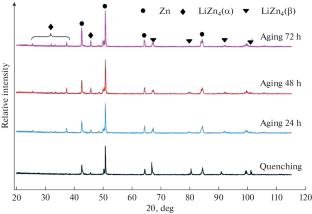
Recent research has shown that zinc alloys are among the most promising materials for bioresorbable (biosoluble) implants. This paper presents the phase transformation of a new promising bioresorbable alloy, Zn–0.8Li. It was found that after quenching from 300°C, the alloy has a structure consisting of a mixture of two isomorphic supersaturated solid solutions: a Li solution in the zinc phase and a Zn solution in the primary crystallites of the LiZn4 phase. During subsequent aging for 20–50 h at room temperature, the alloy undergoes natural aging, during which thin (approximately 1 μm thick) zinc plates precipitate in the LiZn4 phase, and submicron LiZn4 particles precipitate in the zinc phase. The phase transformation pattern during aging was obtained based on the results of X-ray diffraction analysis, SEM microstructural studies, and electrical conductivity studies at different stages of natural aging. The maximum microhardness value is achieved after 48 h of aging.
期刊介绍:
Russian Journal of Non-Ferrous Metals is a journal the main goal of which is to achieve new knowledge in the following topics: extraction metallurgy, hydro- and pirometallurgy, casting, plastic deformation, metallography and heat treatment, powder metallurgy and composites, self-propagating high-temperature synthesis, surface engineering and advanced protected coatings, environments, and energy capacity in non-ferrous metallurgy.

 求助内容:
求助内容: 应助结果提醒方式:

 京公网安备 11010802042870号


