Junxia Zhang, Changyun Liu, Yupeng Wang, Yusi Chen, Haibao Shang, Wen Zheng, Li Jin, Peng Xie, Yingjia Li, Yahan Liu, Yunxiao Zhang, Yang Wang, Wei Zhao, Han Xiao, Guisong Wang, Xin Zhang, Xiaolei Yang, Erdan Dong, Yan Zhang
{"title":"酸化拟杆菌通过微生物-宿主同工酶DPP4加重心脏缺血/再灌注损伤","authors":"Junxia Zhang, Changyun Liu, Yupeng Wang, Yusi Chen, Haibao Shang, Wen Zheng, Li Jin, Peng Xie, Yingjia Li, Yahan Liu, Yunxiao Zhang, Yang Wang, Wei Zhao, Han Xiao, Guisong Wang, Xin Zhang, Xiaolei Yang, Erdan Dong, Yan Zhang","doi":"10.1016/j.chom.2026.03.012","DOIUrl":null,"url":null,"abstract":"Ischemia/reperfusion (I/R) injury is a key driver in cardiomyocyte loss and cardiac dysfunction in ischemic heart disease. Here, we uncover a previously unrecognized gut microbiota-mediated mechanism that contributes to myocardial I/R injury. Using murine I/R models and fecal microbiota transplantation, we demonstrate that the gut microbiota mediates cardiac damage through selective enrichment of <em>Bacteroides acidifaciens</em> (<em>B. acidifaciens</em>) following I/R-induced intestinal hypoxia and elevated luminal lactate levels. <em>B. acidifaciens</em> produces dipeptidyl peptidase 4 (BaDPP4), which degrades cardioprotective peptides (e.g., glucagon-like peptide-1 [GLP-1]) in the plasma, amplifying myocardial injury. Pharmacological inhibition of BaDPP4 with daurisoline, a microbial DPP4-specific inhibitor, mitigates cardiac dysfunction. In acute myocardial infarction patients with I/R injury, <em>B. acidifaciens</em> abundance and BaDPP4 levels correlate with clinical markers of cardiac damage. Together, these findings reveal a gut-heart axis whereby microbial-derived DPP4 exacerbates cardiac I/R injury and highlight the hypoxia-lactate-BaDPP4 axis as a promising target for microbiota-based cardioprotection.","PeriodicalId":9693,"journal":{"name":"Cell host & microbe","volume":"19 1","pages":""},"PeriodicalIF":18.7000,"publicationDate":"2026-03-31","publicationTypes":"Journal Article","fieldsOfStudy":null,"isOpenAccess":false,"openAccessPdf":"","citationCount":"0","resultStr":"{\"title\":\"Bacteroides acidifaciens exacerbates cardiac ischemia/reperfusion injury via the microbial-host isozyme DPP4\",\"authors\":\"Junxia Zhang, Changyun Liu, Yupeng Wang, Yusi Chen, Haibao Shang, Wen Zheng, Li Jin, Peng Xie, Yingjia Li, Yahan Liu, Yunxiao Zhang, Yang Wang, Wei Zhao, Han Xiao, Guisong Wang, Xin Zhang, Xiaolei Yang, Erdan Dong, Yan Zhang\",\"doi\":\"10.1016/j.chom.2026.03.012\",\"DOIUrl\":null,\"url\":null,\"abstract\":\"Ischemia/reperfusion (I/R) injury is a key driver in cardiomyocyte loss and cardiac dysfunction in ischemic heart disease. Here, we uncover a previously unrecognized gut microbiota-mediated mechanism that contributes to myocardial I/R injury. Using murine I/R models and fecal microbiota transplantation, we demonstrate that the gut microbiota mediates cardiac damage through selective enrichment of <em>Bacteroides acidifaciens</em> (<em>B. acidifaciens</em>) following I/R-induced intestinal hypoxia and elevated luminal lactate levels. <em>B. acidifaciens</em> produces dipeptidyl peptidase 4 (BaDPP4), which degrades cardioprotective peptides (e.g., glucagon-like peptide-1 [GLP-1]) in the plasma, amplifying myocardial injury. Pharmacological inhibition of BaDPP4 with daurisoline, a microbial DPP4-specific inhibitor, mitigates cardiac dysfunction. In acute myocardial infarction patients with I/R injury, <em>B. acidifaciens</em> abundance and BaDPP4 levels correlate with clinical markers of cardiac damage. Together, these findings reveal a gut-heart axis whereby microbial-derived DPP4 exacerbates cardiac I/R injury and highlight the hypoxia-lactate-BaDPP4 axis as a promising target for microbiota-based cardioprotection.\",\"PeriodicalId\":9693,\"journal\":{\"name\":\"Cell host & microbe\",\"volume\":\"19 1\",\"pages\":\"\"},\"PeriodicalIF\":18.7000,\"publicationDate\":\"2026-03-31\",\"publicationTypes\":\"Journal Article\",\"fieldsOfStudy\":null,\"isOpenAccess\":false,\"openAccessPdf\":\"\",\"citationCount\":\"0\",\"resultStr\":null,\"platform\":\"Semanticscholar\",\"paperid\":null,\"PeriodicalName\":\"Cell host & microbe\",\"FirstCategoryId\":\"3\",\"ListUrlMain\":\"https://doi.org/10.1016/j.chom.2026.03.012\",\"RegionNum\":1,\"RegionCategory\":\"医学\",\"ArticlePicture\":[],\"TitleCN\":null,\"AbstractTextCN\":null,\"PMCID\":null,\"EPubDate\":\"\",\"PubModel\":\"\",\"JCR\":\"Q1\",\"JCRName\":\"MICROBIOLOGY\",\"Score\":null,\"Total\":0}","platform":"Semanticscholar","paperid":null,"PeriodicalName":"Cell host & microbe","FirstCategoryId":"3","ListUrlMain":"https://doi.org/10.1016/j.chom.2026.03.012","RegionNum":1,"RegionCategory":"医学","ArticlePicture":[],"TitleCN":null,"AbstractTextCN":null,"PMCID":null,"EPubDate":"","PubModel":"","JCR":"Q1","JCRName":"MICROBIOLOGY","Score":null,"Total":0}
Bacteroides acidifaciens exacerbates cardiac ischemia/reperfusion injury via the microbial-host isozyme DPP4
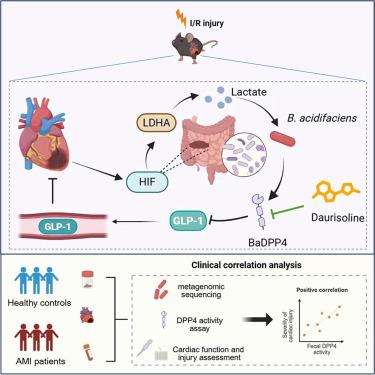
Ischemia/reperfusion (I/R) injury is a key driver in cardiomyocyte loss and cardiac dysfunction in ischemic heart disease. Here, we uncover a previously unrecognized gut microbiota-mediated mechanism that contributes to myocardial I/R injury. Using murine I/R models and fecal microbiota transplantation, we demonstrate that the gut microbiota mediates cardiac damage through selective enrichment of Bacteroides acidifaciens (B. acidifaciens) following I/R-induced intestinal hypoxia and elevated luminal lactate levels. B. acidifaciens produces dipeptidyl peptidase 4 (BaDPP4), which degrades cardioprotective peptides (e.g., glucagon-like peptide-1 [GLP-1]) in the plasma, amplifying myocardial injury. Pharmacological inhibition of BaDPP4 with daurisoline, a microbial DPP4-specific inhibitor, mitigates cardiac dysfunction. In acute myocardial infarction patients with I/R injury, B. acidifaciens abundance and BaDPP4 levels correlate with clinical markers of cardiac damage. Together, these findings reveal a gut-heart axis whereby microbial-derived DPP4 exacerbates cardiac I/R injury and highlight the hypoxia-lactate-BaDPP4 axis as a promising target for microbiota-based cardioprotection.
期刊介绍:
Cell Host & Microbe is a scientific journal that was launched in March 2007. The journal aims to provide a platform for scientists to exchange ideas and concepts related to the study of microbes and their interaction with host organisms at a molecular, cellular, and immune level. It publishes novel findings on a wide range of microorganisms including bacteria, fungi, parasites, and viruses. The journal focuses on the interface between the microbe and its host, whether the host is a vertebrate, invertebrate, or plant, and whether the microbe is pathogenic, non-pathogenic, or commensal. The integrated study of microbes and their interactions with each other, their host, and the cellular environment they inhabit is a unifying theme of the journal. The published work in Cell Host & Microbe is expected to be of exceptional significance within its field and also of interest to researchers in other areas. In addition to primary research articles, the journal features expert analysis, commentary, and reviews on current topics of interest in the field.