Peter V. Kelly, Alison Block, Brenden D. Hoehn, Pathikrit Saha, Christopher J. Ellison and Marc A. Hillmyer
{"title":"聚羟基烷酸酯嵌段聚合物粘合剂,由长链脂肪族β-内酯和丙交酯衍生而来","authors":"Peter V. Kelly, Alison Block, Brenden D. Hoehn, Pathikrit Saha, Christopher J. Ellison and Marc A. Hillmyer","doi":"10.1039/D5LP00389J","DOIUrl":null,"url":null,"abstract":"<p >Pressure sensitive adhesives (PSAs) are contained in numerous packaging products as labels, tapes, and sealants. Consequently, they are a common contaminant that complicates repulping during paper recycling and industrial composting. Degradable PSAs are an attractive alternative where complete removal or separation is not practical. In this work, we employed epoxide carbonylation to produce β-tridecalactone to prepare poly(β-tridecalactone) (PTDL) through ring-opening transesterification polymerization (ROTEP). We explored the synthetic challenges in producing high molar mass (>20 kg mol<small><sup>−1</sup></small>) PTDL. These include dehydration of the propagating chain end and adventitious initiation from impurities in the monomer. The utility of PTDL PSAs containing a rubbery midblock with semicrystalline poly(<small>L</small>-lactide) (PLLA) end blocks was probed as a function of composition, molar mass, and processing conditions. The largest PLLA volume fraction (<em>f</em><small><sub>PLLA</sub></small> = 0.31–0.35) triblock polymers exhibit commercially competitive peel strengths (5.5 ± 0.9 N cm<small><sup>−1</sup></small>) and loop tack (8.5 ± 0.9 N cm<small><sup>−1</sup></small>) values, with properties similar to office and duct tapes. This work informs how long aliphatic chain containing β-lactones can be effectively harnessed to produce high performance PSAs with the end goal of fully biodegradable adhesives.</p>","PeriodicalId":101139,"journal":{"name":"RSC Applied Polymers","volume":" 2","pages":" 796-806"},"PeriodicalIF":0.0000,"publicationDate":"2026-02-17","publicationTypes":"Journal Article","fieldsOfStudy":null,"isOpenAccess":false,"openAccessPdf":"https://pubs.rsc.org/en/content/articlepdf/2026/lp/d5lp00389j?page=search","citationCount":"0","resultStr":"{\"title\":\"Polyhydroxyalkanoate block polymer adhesives derived from long-chain aliphatic β-lactones and lactide\",\"authors\":\"Peter V. Kelly, Alison Block, Brenden D. Hoehn, Pathikrit Saha, Christopher J. Ellison and Marc A. Hillmyer\",\"doi\":\"10.1039/D5LP00389J\",\"DOIUrl\":null,\"url\":null,\"abstract\":\"<p >Pressure sensitive adhesives (PSAs) are contained in numerous packaging products as labels, tapes, and sealants. Consequently, they are a common contaminant that complicates repulping during paper recycling and industrial composting. Degradable PSAs are an attractive alternative where complete removal or separation is not practical. In this work, we employed epoxide carbonylation to produce β-tridecalactone to prepare poly(β-tridecalactone) (PTDL) through ring-opening transesterification polymerization (ROTEP). We explored the synthetic challenges in producing high molar mass (>20 kg mol<small><sup>−1</sup></small>) PTDL. These include dehydration of the propagating chain end and adventitious initiation from impurities in the monomer. The utility of PTDL PSAs containing a rubbery midblock with semicrystalline poly(<small>L</small>-lactide) (PLLA) end blocks was probed as a function of composition, molar mass, and processing conditions. The largest PLLA volume fraction (<em>f</em><small><sub>PLLA</sub></small> = 0.31–0.35) triblock polymers exhibit commercially competitive peel strengths (5.5 ± 0.9 N cm<small><sup>−1</sup></small>) and loop tack (8.5 ± 0.9 N cm<small><sup>−1</sup></small>) values, with properties similar to office and duct tapes. This work informs how long aliphatic chain containing β-lactones can be effectively harnessed to produce high performance PSAs with the end goal of fully biodegradable adhesives.</p>\",\"PeriodicalId\":101139,\"journal\":{\"name\":\"RSC Applied Polymers\",\"volume\":\" 2\",\"pages\":\" 796-806\"},\"PeriodicalIF\":0.0000,\"publicationDate\":\"2026-02-17\",\"publicationTypes\":\"Journal Article\",\"fieldsOfStudy\":null,\"isOpenAccess\":false,\"openAccessPdf\":\"https://pubs.rsc.org/en/content/articlepdf/2026/lp/d5lp00389j?page=search\",\"citationCount\":\"0\",\"resultStr\":null,\"platform\":\"Semanticscholar\",\"paperid\":null,\"PeriodicalName\":\"RSC Applied Polymers\",\"FirstCategoryId\":\"1085\",\"ListUrlMain\":\"https://pubs.rsc.org/en/content/articlelanding/2026/lp/d5lp00389j\",\"RegionNum\":0,\"RegionCategory\":null,\"ArticlePicture\":[],\"TitleCN\":null,\"AbstractTextCN\":null,\"PMCID\":null,\"EPubDate\":\"\",\"PubModel\":\"\",\"JCR\":\"\",\"JCRName\":\"\",\"Score\":null,\"Total\":0}","platform":"Semanticscholar","paperid":null,"PeriodicalName":"RSC Applied Polymers","FirstCategoryId":"1085","ListUrlMain":"https://pubs.rsc.org/en/content/articlelanding/2026/lp/d5lp00389j","RegionNum":0,"RegionCategory":null,"ArticlePicture":[],"TitleCN":null,"AbstractTextCN":null,"PMCID":null,"EPubDate":"","PubModel":"","JCR":"","JCRName":"","Score":null,"Total":0}
引用次数: 0
摘要
压敏胶(psa)包含在许多包装产品的标签,胶带和密封剂。因此,它们是一种常见的污染物,使纸张回收和工业堆肥过程中的再制浆复杂化。可降解的psa是一个有吸引力的替代品,完全去除或分离是不现实的。本研究采用环氧烷羰基化法制备β-三内酯,通过开环酯交换反应聚合(ROTEP)法制备聚β-三内酯(PTDL)。我们探索了生产高摩尔质量(> 20kg mol−1)PTDL的合成挑战。这些包括传播链末端的脱水和单体中杂质的不定起始。采用半结晶聚l -丙交酯(PLLA)端块和橡胶中间块组成、摩尔质量和加工条件对PTDL psa的效用进行了探讨。最大PLLA体积分数(fPLLA = 0.31-0.35)的三嵌段聚合物具有商业竞争力的剥离强度(5.5±0.9 N cm−1)和环粘性(8.5±0.9 N cm−1)值,其性能与办公室和导管胶带相似。这项工作告诉多长脂肪链含有β-内酯可以有效地利用生产高性能psa与完全可生物降解的粘合剂的最终目标。
Polyhydroxyalkanoate block polymer adhesives derived from long-chain aliphatic β-lactones and lactide
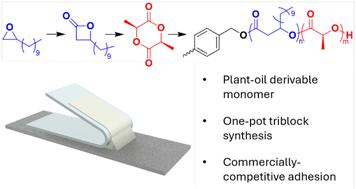
Pressure sensitive adhesives (PSAs) are contained in numerous packaging products as labels, tapes, and sealants. Consequently, they are a common contaminant that complicates repulping during paper recycling and industrial composting. Degradable PSAs are an attractive alternative where complete removal or separation is not practical. In this work, we employed epoxide carbonylation to produce β-tridecalactone to prepare poly(β-tridecalactone) (PTDL) through ring-opening transesterification polymerization (ROTEP). We explored the synthetic challenges in producing high molar mass (>20 kg mol−1) PTDL. These include dehydration of the propagating chain end and adventitious initiation from impurities in the monomer. The utility of PTDL PSAs containing a rubbery midblock with semicrystalline poly(L-lactide) (PLLA) end blocks was probed as a function of composition, molar mass, and processing conditions. The largest PLLA volume fraction (fPLLA = 0.31–0.35) triblock polymers exhibit commercially competitive peel strengths (5.5 ± 0.9 N cm−1) and loop tack (8.5 ± 0.9 N cm−1) values, with properties similar to office and duct tapes. This work informs how long aliphatic chain containing β-lactones can be effectively harnessed to produce high performance PSAs with the end goal of fully biodegradable adhesives.


 求助内容:
求助内容: 应助结果提醒方式:

 京公网安备 11010802042870号


