Lukas Rudolph, Linus Hormuth, Jan Freihardt, Vally Koubi
{"title":"对应得感的感知塑造了对孟加拉国农村环境移民的态度。","authors":"Lukas Rudolph, Linus Hormuth, Jan Freihardt, Vally Koubi","doi":"10.1038/s43247-026-03320-6","DOIUrl":null,"url":null,"abstract":"<p><p>As climate change intensifies, internal migration due to extreme climate events is becoming increasingly common in the Global South. Yet, little is known about how rural host communities respond to incoming environmental migrants. Here, we study attitudes toward environmentally displaced people in northern Bangladesh, focusing on perceived deservingness, empathy through shared experience, and exploratory proxy indicators of prior migrant exposure/contact. Using a pre-registered face-to-face survey of 265 rural residents, including a forced-choice conjoint experiment, we assess how migrant characteristics (reason for migration, occupation, religion, distance to origin) affect host community attitudes. We find that migrants displaced by riverbank erosion are more likely to be accepted than economic migrants (by 21%-points, <i>p</i> < 0.01) and face less discrimination based on other characteristics, indicating that deservingness strongly shapes attitudes. Regarding shared experience of erosion, which we propose as a proxy for empathy, models estimated a positive coefficient (13%-points, <i>p</i> = 0.122), hence not supporting, but indicative of a positive association between experiential proximity and greater acceptance of environmental migrants. We find no credible evidence for heterogeneity in migrant acceptance using coarse proxy measures of prior migrant exposure/contact. These results suggest that, even in resource-constrained regions, moral judgments play a central role, and that experiential proximity may be associated with more inclusive attitudes, informing policies for societal resilience under environmental stress.</p>","PeriodicalId":10530,"journal":{"name":"Communications Earth & Environment","volume":"7 1","pages":"247"},"PeriodicalIF":8.9000,"publicationDate":"2026-01-01","publicationTypes":"Journal Article","fieldsOfStudy":null,"isOpenAccess":false,"openAccessPdf":"https://www.ncbi.nlm.nih.gov/pmc/articles/PMC12995714/pdf/","citationCount":"0","resultStr":"{\"title\":\"Perceived deservingness shapes attitudes toward environmental migrants in rural Bangladesh.\",\"authors\":\"Lukas Rudolph, Linus Hormuth, Jan Freihardt, Vally Koubi\",\"doi\":\"10.1038/s43247-026-03320-6\",\"DOIUrl\":null,\"url\":null,\"abstract\":\"<p><p>As climate change intensifies, internal migration due to extreme climate events is becoming increasingly common in the Global South. Yet, little is known about how rural host communities respond to incoming environmental migrants. Here, we study attitudes toward environmentally displaced people in northern Bangladesh, focusing on perceived deservingness, empathy through shared experience, and exploratory proxy indicators of prior migrant exposure/contact. Using a pre-registered face-to-face survey of 265 rural residents, including a forced-choice conjoint experiment, we assess how migrant characteristics (reason for migration, occupation, religion, distance to origin) affect host community attitudes. We find that migrants displaced by riverbank erosion are more likely to be accepted than economic migrants (by 21%-points, <i>p</i> < 0.01) and face less discrimination based on other characteristics, indicating that deservingness strongly shapes attitudes. Regarding shared experience of erosion, which we propose as a proxy for empathy, models estimated a positive coefficient (13%-points, <i>p</i> = 0.122), hence not supporting, but indicative of a positive association between experiential proximity and greater acceptance of environmental migrants. We find no credible evidence for heterogeneity in migrant acceptance using coarse proxy measures of prior migrant exposure/contact. These results suggest that, even in resource-constrained regions, moral judgments play a central role, and that experiential proximity may be associated with more inclusive attitudes, informing policies for societal resilience under environmental stress.</p>\",\"PeriodicalId\":10530,\"journal\":{\"name\":\"Communications Earth & Environment\",\"volume\":\"7 1\",\"pages\":\"247\"},\"PeriodicalIF\":8.9000,\"publicationDate\":\"2026-01-01\",\"publicationTypes\":\"Journal Article\",\"fieldsOfStudy\":null,\"isOpenAccess\":false,\"openAccessPdf\":\"https://www.ncbi.nlm.nih.gov/pmc/articles/PMC12995714/pdf/\",\"citationCount\":\"0\",\"resultStr\":null,\"platform\":\"Semanticscholar\",\"paperid\":null,\"PeriodicalName\":\"Communications Earth & Environment\",\"FirstCategoryId\":\"93\",\"ListUrlMain\":\"https://doi.org/10.1038/s43247-026-03320-6\",\"RegionNum\":1,\"RegionCategory\":\"地球科学\",\"ArticlePicture\":[],\"TitleCN\":null,\"AbstractTextCN\":null,\"PMCID\":null,\"EPubDate\":\"2026/2/26 0:00:00\",\"PubModel\":\"Epub\",\"JCR\":\"Q1\",\"JCRName\":\"ENVIRONMENTAL SCIENCES\",\"Score\":null,\"Total\":0}","platform":"Semanticscholar","paperid":null,"PeriodicalName":"Communications Earth & Environment","FirstCategoryId":"93","ListUrlMain":"https://doi.org/10.1038/s43247-026-03320-6","RegionNum":1,"RegionCategory":"地球科学","ArticlePicture":[],"TitleCN":null,"AbstractTextCN":null,"PMCID":null,"EPubDate":"2026/2/26 0:00:00","PubModel":"Epub","JCR":"Q1","JCRName":"ENVIRONMENTAL SCIENCES","Score":null,"Total":0}
Perceived deservingness shapes attitudes toward environmental migrants in rural Bangladesh.
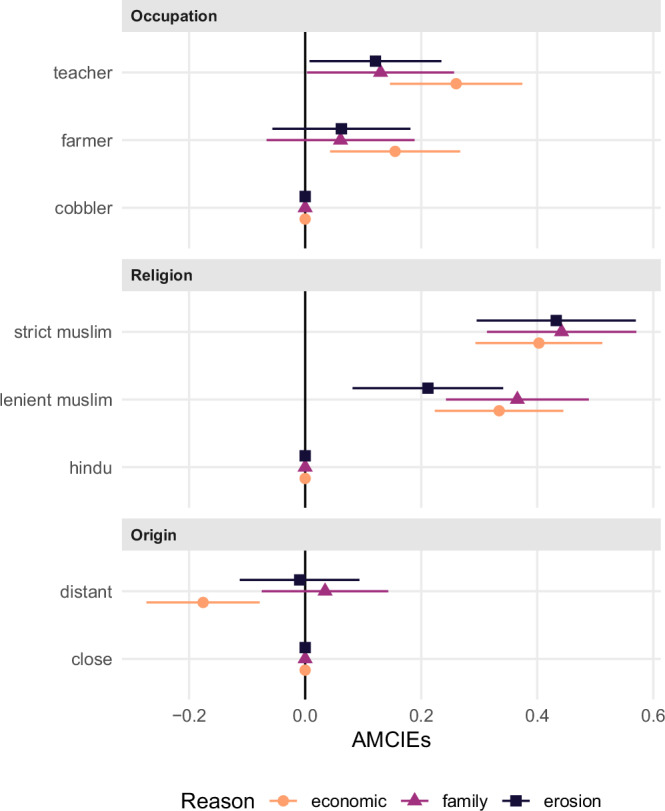
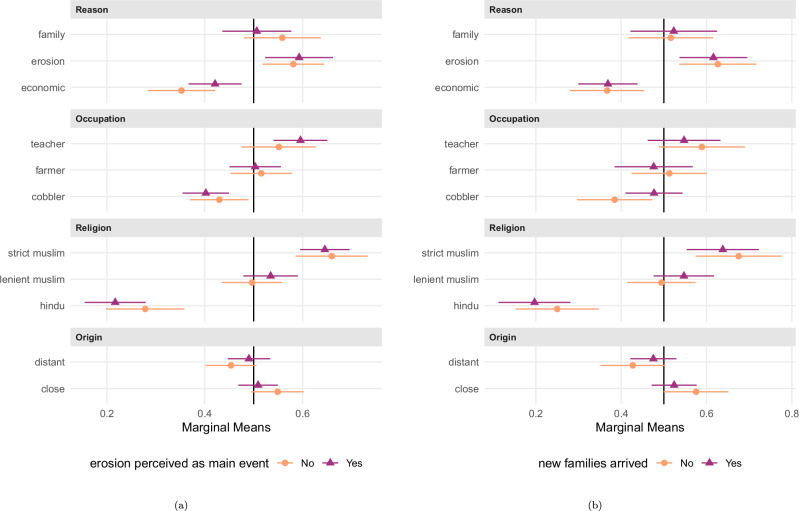
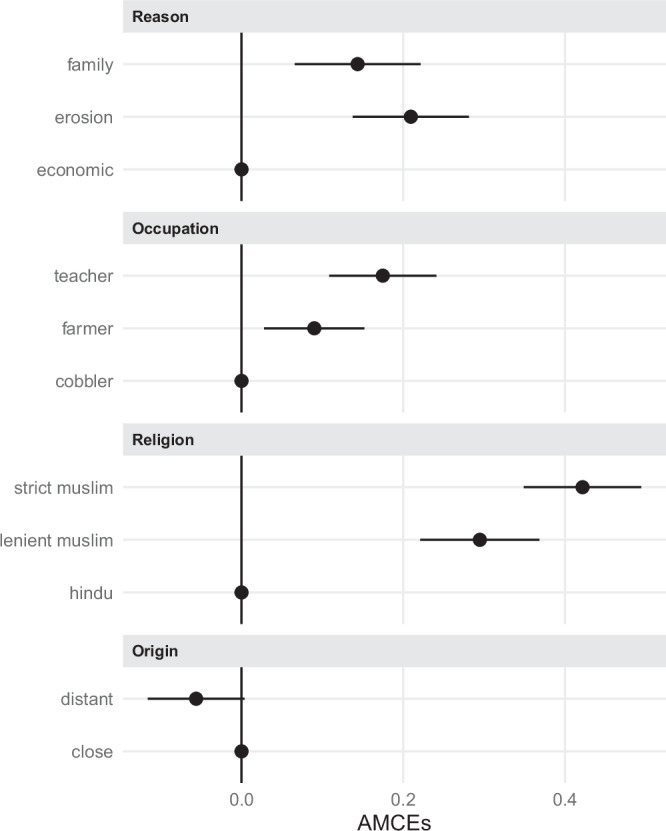
As climate change intensifies, internal migration due to extreme climate events is becoming increasingly common in the Global South. Yet, little is known about how rural host communities respond to incoming environmental migrants. Here, we study attitudes toward environmentally displaced people in northern Bangladesh, focusing on perceived deservingness, empathy through shared experience, and exploratory proxy indicators of prior migrant exposure/contact. Using a pre-registered face-to-face survey of 265 rural residents, including a forced-choice conjoint experiment, we assess how migrant characteristics (reason for migration, occupation, religion, distance to origin) affect host community attitudes. We find that migrants displaced by riverbank erosion are more likely to be accepted than economic migrants (by 21%-points, p < 0.01) and face less discrimination based on other characteristics, indicating that deservingness strongly shapes attitudes. Regarding shared experience of erosion, which we propose as a proxy for empathy, models estimated a positive coefficient (13%-points, p = 0.122), hence not supporting, but indicative of a positive association between experiential proximity and greater acceptance of environmental migrants. We find no credible evidence for heterogeneity in migrant acceptance using coarse proxy measures of prior migrant exposure/contact. These results suggest that, even in resource-constrained regions, moral judgments play a central role, and that experiential proximity may be associated with more inclusive attitudes, informing policies for societal resilience under environmental stress.
期刊介绍:
Communications Earth & Environment is an open access journal from Nature Portfolio publishing high-quality research, reviews and commentary in all areas of the Earth, environmental and planetary sciences. Research papers published by the journal represent significant advances that bring new insight to a specialized area in Earth science, planetary science or environmental science.
Communications Earth & Environment has a 2-year impact factor of 7.9 (2022 Journal Citation Reports®). Articles published in the journal in 2022 were downloaded 1,412,858 times. Median time from submission to the first editorial decision is 8 days.

 求助内容:
求助内容: 应助结果提醒方式:

 京公网安备 11010802042870号


