{"title":"Notch信号在水蛭神经发生中的作用:舌音水蛭Helobdella austinensis的表达模式和功能。","authors":"Geon-Hwi Jeong, In-Hyeok Pyo, Yam Prasad Aryal, Geon-Woo Lee, Kyoung-Bin Ryu, Hee-Jin Kwak, Sung-Jin Cho","doi":"10.1080/19768354.2026.2631845","DOIUrl":null,"url":null,"abstract":"<p><p>The Notch signaling pathway is one of the most evolutionarily conserved pathways, playing a crucial role in juxtacrine signaling between adjacent cells. Although previous studies have characterized Notch signaling in diverse models, its function in the lophotrochozoan animals is largely not understood and is only partially identified in early-stage embryos. To address this gap, we reaffirmed the expression of Notch homolog, including downstream components, in the organogenesis of the Glossiphoniid leech, <i>Helobdella austinensis</i>. We analyze the spatial and temporal expression patterns of the Notch receptor (<i>Hau-notch1</i>), ligands (<i>Hau-delta</i> and <i>Hau-jagged</i>), and transcription factors (<i>Hau-hes</i> and <i>Hau-hey</i>) from embryonic stages 8-11. Notch transcripts are expressed in the germinal plate and segmental precursor cells at stage 8, with expression expanding to the somites, ventral and supraesophageal ganglia by stage 9. In organogenesis stages (stages 9-11), Notch components are expressed in the anterior and posterior suckers, proboscis, and ventral ganglia, indicating their role in nerve differentiation. Furthermore, blocking of Notch signaling by DAPT (N-[N-(3, 5-difluorophenacetyl)-l-alanyl]-s-phenylglycine t-butyl ester) leads to the disruption of nerve formation with downregulation of transcription factors (<i>Hau-hes</i> and <i>Hau-hey</i>). Our findings provide insights into the conserved mechanisms of Notch signaling in bilaterian neural development, contributing to a deeper understanding of evolutionary developmental biology.</p>","PeriodicalId":7804,"journal":{"name":"Animal Cells and Systems","volume":"30 1","pages":"282-294"},"PeriodicalIF":3.2000,"publicationDate":"2026-02-23","publicationTypes":"Journal Article","fieldsOfStudy":null,"isOpenAccess":false,"openAccessPdf":"https://www.ncbi.nlm.nih.gov/pmc/articles/PMC12983829/pdf/","citationCount":"0","resultStr":"{\"title\":\"Notch signaling in leech neurogenesis: expression patterns and functional insights in the Glossiphoniid leech <i>Helobdella austinensis</i>.\",\"authors\":\"Geon-Hwi Jeong, In-Hyeok Pyo, Yam Prasad Aryal, Geon-Woo Lee, Kyoung-Bin Ryu, Hee-Jin Kwak, Sung-Jin Cho\",\"doi\":\"10.1080/19768354.2026.2631845\",\"DOIUrl\":null,\"url\":null,\"abstract\":\"<p><p>The Notch signaling pathway is one of the most evolutionarily conserved pathways, playing a crucial role in juxtacrine signaling between adjacent cells. Although previous studies have characterized Notch signaling in diverse models, its function in the lophotrochozoan animals is largely not understood and is only partially identified in early-stage embryos. To address this gap, we reaffirmed the expression of Notch homolog, including downstream components, in the organogenesis of the Glossiphoniid leech, <i>Helobdella austinensis</i>. We analyze the spatial and temporal expression patterns of the Notch receptor (<i>Hau-notch1</i>), ligands (<i>Hau-delta</i> and <i>Hau-jagged</i>), and transcription factors (<i>Hau-hes</i> and <i>Hau-hey</i>) from embryonic stages 8-11. Notch transcripts are expressed in the germinal plate and segmental precursor cells at stage 8, with expression expanding to the somites, ventral and supraesophageal ganglia by stage 9. In organogenesis stages (stages 9-11), Notch components are expressed in the anterior and posterior suckers, proboscis, and ventral ganglia, indicating their role in nerve differentiation. Furthermore, blocking of Notch signaling by DAPT (N-[N-(3, 5-difluorophenacetyl)-l-alanyl]-s-phenylglycine t-butyl ester) leads to the disruption of nerve formation with downregulation of transcription factors (<i>Hau-hes</i> and <i>Hau-hey</i>). Our findings provide insights into the conserved mechanisms of Notch signaling in bilaterian neural development, contributing to a deeper understanding of evolutionary developmental biology.</p>\",\"PeriodicalId\":7804,\"journal\":{\"name\":\"Animal Cells and Systems\",\"volume\":\"30 1\",\"pages\":\"282-294\"},\"PeriodicalIF\":3.2000,\"publicationDate\":\"2026-02-23\",\"publicationTypes\":\"Journal Article\",\"fieldsOfStudy\":null,\"isOpenAccess\":false,\"openAccessPdf\":\"https://www.ncbi.nlm.nih.gov/pmc/articles/PMC12983829/pdf/\",\"citationCount\":\"0\",\"resultStr\":null,\"platform\":\"Semanticscholar\",\"paperid\":null,\"PeriodicalName\":\"Animal Cells and Systems\",\"FirstCategoryId\":\"99\",\"ListUrlMain\":\"https://doi.org/10.1080/19768354.2026.2631845\",\"RegionNum\":2,\"RegionCategory\":\"生物学\",\"ArticlePicture\":[],\"TitleCN\":null,\"AbstractTextCN\":null,\"PMCID\":null,\"EPubDate\":\"2026/1/1 0:00:00\",\"PubModel\":\"eCollection\",\"JCR\":\"Q3\",\"JCRName\":\"CELL BIOLOGY\",\"Score\":null,\"Total\":0}","platform":"Semanticscholar","paperid":null,"PeriodicalName":"Animal Cells and Systems","FirstCategoryId":"99","ListUrlMain":"https://doi.org/10.1080/19768354.2026.2631845","RegionNum":2,"RegionCategory":"生物学","ArticlePicture":[],"TitleCN":null,"AbstractTextCN":null,"PMCID":null,"EPubDate":"2026/1/1 0:00:00","PubModel":"eCollection","JCR":"Q3","JCRName":"CELL BIOLOGY","Score":null,"Total":0}
Notch signaling in leech neurogenesis: expression patterns and functional insights in the Glossiphoniid leech Helobdella austinensis.
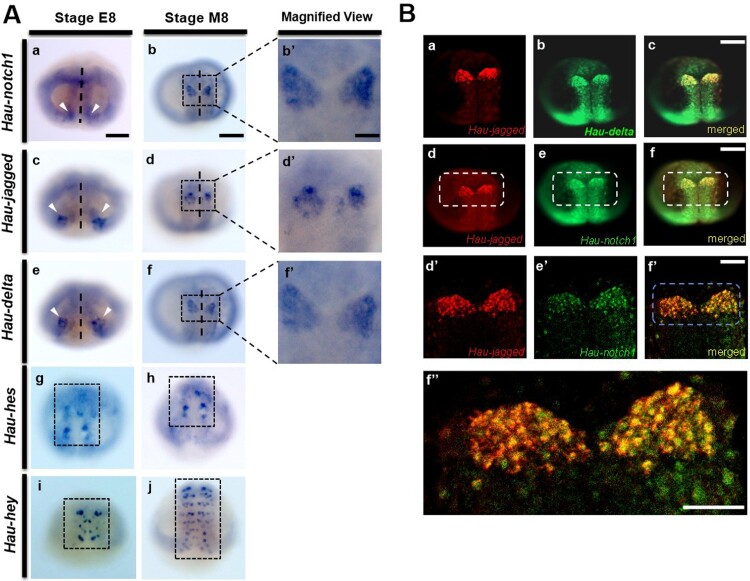
The Notch signaling pathway is one of the most evolutionarily conserved pathways, playing a crucial role in juxtacrine signaling between adjacent cells. Although previous studies have characterized Notch signaling in diverse models, its function in the lophotrochozoan animals is largely not understood and is only partially identified in early-stage embryos. To address this gap, we reaffirmed the expression of Notch homolog, including downstream components, in the organogenesis of the Glossiphoniid leech, Helobdella austinensis. We analyze the spatial and temporal expression patterns of the Notch receptor (Hau-notch1), ligands (Hau-delta and Hau-jagged), and transcription factors (Hau-hes and Hau-hey) from embryonic stages 8-11. Notch transcripts are expressed in the germinal plate and segmental precursor cells at stage 8, with expression expanding to the somites, ventral and supraesophageal ganglia by stage 9. In organogenesis stages (stages 9-11), Notch components are expressed in the anterior and posterior suckers, proboscis, and ventral ganglia, indicating their role in nerve differentiation. Furthermore, blocking of Notch signaling by DAPT (N-[N-(3, 5-difluorophenacetyl)-l-alanyl]-s-phenylglycine t-butyl ester) leads to the disruption of nerve formation with downregulation of transcription factors (Hau-hes and Hau-hey). Our findings provide insights into the conserved mechanisms of Notch signaling in bilaterian neural development, contributing to a deeper understanding of evolutionary developmental biology.
期刊介绍:
Animal Cells and Systems is the official journal of the Korean Society for Integrative Biology. This international, peer-reviewed journal publishes original papers that cover diverse aspects of biological sciences including Bioinformatics and Systems Biology, Developmental Biology, Evolution and Systematic Biology, Population Biology, & Animal Behaviour, Molecular and Cellular Biology, Neurobiology and Immunology, and Translational Medicine.



 求助内容:
求助内容: 应助结果提醒方式:

 京公网安备 11010802042870号


