通过多模态融合对中国纸浆和造纸工业的工厂级碳核算

IF 14.3 1区 环境科学与生态学 Q1 ENVIRONMENTAL SCIENCES
Environmental Science and Ecotechnology Pub Date : 2026-03-01 Epub Date: 2026-03-06 DOI:10.1016/j.ese.2026.100682
Song Hu , Huaqing Qi , Zifei Wang , Xiaoyu Wu , Yulin Han , Yi Man
{"title":"通过多模态融合对中国纸浆和造纸工业的工厂级碳核算","authors":"Song Hu ,&nbsp;Huaqing Qi ,&nbsp;Zifei Wang ,&nbsp;Xiaoyu Wu ,&nbsp;Yulin Han ,&nbsp;Yi Man","doi":"10.1016/j.ese.2026.100682","DOIUrl":null,"url":null,"abstract":"<div><div>Plant-scale industrial carbon accounting is critical for developing targeted emission-reduction policies. However, most assessments of carbon-intensive sectors rely on aggregate statistics, which obscure significant heterogeneity among individual plants. China's pulp and paper industry (PPI), the largest globally, encompasses diverse production processes, raw material inputs, and emission sources. Existing accounting frameworks rely on statistical data and average emission factors within poorly defined system boundaries, which prevents differentiation at the individual plant level. Here, we propose a multimodal data fusion framework that integrates high-resolution remote-sensing imagery with plant textual data to capture structural and operational characteristics undetectable by any single data modality. Applied to 720 pulping and papermaking plants across China, the framework achieves R<sup>2</sup> values of up to 0.96 across five plant types and estimates total sectoral carbon emissions at 163.6 million tonnes of CO<sub>2</sub> in 2022, with pronounced regional disparities concentrated in eastern coastal provinces. Analysis of functional-zone contributions further reveals that wastewater treatment areas are a consistent cross-category emission driver, and that just 5% of high-emission plants account for approximately 43% of sectoral emissions—a skewed structure that demands differentiated regulatory intervention. Incorporating regional solar radiation data, rooftop photovoltaic deployment is projected to reduce annual PPI emissions by up to 10.3%, with primary-fiber pulp plants offering the greatest mitigation leverage. Beyond China's PPI, this scalable, data-driven approach provides a transferable blueprint for granular, plant-level carbon accounting in other heterogeneous heavy industries.</div></div>","PeriodicalId":34434,"journal":{"name":"Environmental Science and Ecotechnology","volume":"30 ","pages":"Article 100682"},"PeriodicalIF":14.3000,"publicationDate":"2026-03-01","publicationTypes":"Journal Article","fieldsOfStudy":null,"isOpenAccess":false,"openAccessPdf":"","citationCount":"0","resultStr":"{\"title\":\"Plant-level carbon accounting of China's pulp and paper industry via multimodal fusion\",\"authors\":\"Song Hu ,&nbsp;Huaqing Qi ,&nbsp;Zifei Wang ,&nbsp;Xiaoyu Wu ,&nbsp;Yulin Han ,&nbsp;Yi Man\",\"doi\":\"10.1016/j.ese.2026.100682\",\"DOIUrl\":null,\"url\":null,\"abstract\":\"<div><div>Plant-scale industrial carbon accounting is critical for developing targeted emission-reduction policies. However, most assessments of carbon-intensive sectors rely on aggregate statistics, which obscure significant heterogeneity among individual plants. China's pulp and paper industry (PPI), the largest globally, encompasses diverse production processes, raw material inputs, and emission sources. Existing accounting frameworks rely on statistical data and average emission factors within poorly defined system boundaries, which prevents differentiation at the individual plant level. Here, we propose a multimodal data fusion framework that integrates high-resolution remote-sensing imagery with plant textual data to capture structural and operational characteristics undetectable by any single data modality. Applied to 720 pulping and papermaking plants across China, the framework achieves R<sup>2</sup> values of up to 0.96 across five plant types and estimates total sectoral carbon emissions at 163.6 million tonnes of CO<sub>2</sub> in 2022, with pronounced regional disparities concentrated in eastern coastal provinces. Analysis of functional-zone contributions further reveals that wastewater treatment areas are a consistent cross-category emission driver, and that just 5% of high-emission plants account for approximately 43% of sectoral emissions—a skewed structure that demands differentiated regulatory intervention. Incorporating regional solar radiation data, rooftop photovoltaic deployment is projected to reduce annual PPI emissions by up to 10.3%, with primary-fiber pulp plants offering the greatest mitigation leverage. Beyond China's PPI, this scalable, data-driven approach provides a transferable blueprint for granular, plant-level carbon accounting in other heterogeneous heavy industries.</div></div>\",\"PeriodicalId\":34434,\"journal\":{\"name\":\"Environmental Science and Ecotechnology\",\"volume\":\"30 \",\"pages\":\"Article 100682\"},\"PeriodicalIF\":14.3000,\"publicationDate\":\"2026-03-01\",\"publicationTypes\":\"Journal Article\",\"fieldsOfStudy\":null,\"isOpenAccess\":false,\"openAccessPdf\":\"\",\"citationCount\":\"0\",\"resultStr\":null,\"platform\":\"Semanticscholar\",\"paperid\":null,\"PeriodicalName\":\"Environmental Science and Ecotechnology\",\"FirstCategoryId\":\"93\",\"ListUrlMain\":\"https://www.sciencedirect.com/science/article/pii/S266649842600027X\",\"RegionNum\":1,\"RegionCategory\":\"环境科学与生态学\",\"ArticlePicture\":[],\"TitleCN\":null,\"AbstractTextCN\":null,\"PMCID\":null,\"EPubDate\":\"2026/3/6 0:00:00\",\"PubModel\":\"Epub\",\"JCR\":\"Q1\",\"JCRName\":\"ENVIRONMENTAL SCIENCES\",\"Score\":null,\"Total\":0}","platform":"Semanticscholar","paperid":null,"PeriodicalName":"Environmental Science and Ecotechnology","FirstCategoryId":"93","ListUrlMain":"https://www.sciencedirect.com/science/article/pii/S266649842600027X","RegionNum":1,"RegionCategory":"环境科学与生态学","ArticlePicture":[],"TitleCN":null,"AbstractTextCN":null,"PMCID":null,"EPubDate":"2026/3/6 0:00:00","PubModel":"Epub","JCR":"Q1","JCRName":"ENVIRONMENTAL SCIENCES","Score":null,"Total":0}
引用次数: 0

摘要

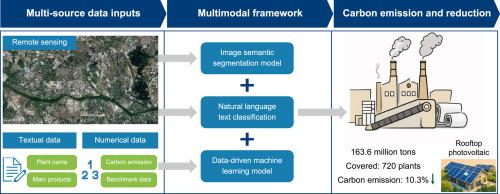
工厂规模的工业碳核算对于制定有针对性的减排政策至关重要。然而,大多数对碳密集型行业的评估依赖于总体统计数据,这掩盖了单个工厂之间的显著异质性。中国是全球最大的纸浆和造纸工业(PPI),其生产过程、原料投入和排放源多种多样。现有的核算框架依赖于统计数据和定义不明确的系统边界内的平均排放因子,这阻碍了单个工厂层面的区分。在此,我们提出了一个多模式数据融合框架,该框架将高分辨率遥感图像与植物文本数据相结合,以捕获任何单一数据模式无法检测到的结构和操作特征。该框架应用于中国720家制浆和造纸厂,在五种工厂类型中,R2值高达0.96,并估计到2022年,该行业的二氧化碳总排放量为1.636亿吨,地区差异明显,主要集中在东部沿海省份。对功能区贡献的分析进一步表明,废水处理区域是跨类别排放的一致驱动因素,仅5%的高排放工厂就占了行业排放的约43%——这种倾斜的结构需要差异化的监管干预。结合区域太阳辐射数据,屋顶光伏部署预计将减少每年高达10.3%的PPI排放,其中初级纤维纸浆厂提供了最大的减排效果。除了中国的生产者价格指数,这种可扩展的、数据驱动的方法为其他异质重工业的颗粒级、工厂级碳核算提供了可转移的蓝图。
本文章由计算机程序翻译,如有差异,请以英文原文为准。

Plant-level carbon accounting of China's pulp and paper industry via multimodal fusion

Plant-level carbon accounting of China's pulp and paper industry via multimodal fusion
Plant-scale industrial carbon accounting is critical for developing targeted emission-reduction policies. However, most assessments of carbon-intensive sectors rely on aggregate statistics, which obscure significant heterogeneity among individual plants. China's pulp and paper industry (PPI), the largest globally, encompasses diverse production processes, raw material inputs, and emission sources. Existing accounting frameworks rely on statistical data and average emission factors within poorly defined system boundaries, which prevents differentiation at the individual plant level. Here, we propose a multimodal data fusion framework that integrates high-resolution remote-sensing imagery with plant textual data to capture structural and operational characteristics undetectable by any single data modality. Applied to 720 pulping and papermaking plants across China, the framework achieves R2 values of up to 0.96 across five plant types and estimates total sectoral carbon emissions at 163.6 million tonnes of CO2 in 2022, with pronounced regional disparities concentrated in eastern coastal provinces. Analysis of functional-zone contributions further reveals that wastewater treatment areas are a consistent cross-category emission driver, and that just 5% of high-emission plants account for approximately 43% of sectoral emissions—a skewed structure that demands differentiated regulatory intervention. Incorporating regional solar radiation data, rooftop photovoltaic deployment is projected to reduce annual PPI emissions by up to 10.3%, with primary-fiber pulp plants offering the greatest mitigation leverage. Beyond China's PPI, this scalable, data-driven approach provides a transferable blueprint for granular, plant-level carbon accounting in other heterogeneous heavy industries.
求助全文
通过发布文献求助,成功后即可免费获取论文全文。 去求助
来源期刊

CiteScore
20.40
自引率
6.30%
发文量
11
审稿时长
18 days
期刊介绍: Environmental Science & Ecotechnology (ESE) is an international, open-access journal publishing original research in environmental science, engineering, ecotechnology, and related fields. Authors publishing in ESE can immediately, permanently, and freely share their work. They have license options and retain copyright. Published by Elsevier, ESE is co-organized by the Chinese Society for Environmental Sciences, Harbin Institute of Technology, and the Chinese Research Academy of Environmental Sciences, under the supervision of the China Association for Science and Technology.

×
引用
GB/T 7714-2015
复制
MLA
复制
APA
复制
导出至
BibTeX EndNote RefMan NoteFirst NoteExpress
×
提示
您的信息不完整,为了账户安全,请先补充。
现在去补充
×
提示
您因"违规操作"
具体请查看互助需知
我知道了
×
提示
确定
请完成安全验证×
copy
已复制链接
快去分享给好友吧!
我知道了
右上角分享
点击右上角分享
0
联系我们:info@booksci.cn Book学术提供免费学术资源搜索服务,方便国内外学者检索中英文文献。致力于提供最便捷和优质的服务体验。 Copyright © 2023 布克学术 All rights reserved.
京ICP备2023020795号-1
ghs 京公网安备 11010802042870号
Book学术文献互助
Book学术文献互助群
群 号:604180095
Book学术官方微信
小红书