北祁连造山带松树南沟金矿区东部金矿床成因的地质、流体包裹体和C-H-O-S-Pb同位素约束

IF 3.6 2区 地球科学 Q1 GEOLOGY
Ore Geology Reviews Pub Date : 2026-03-01 Epub Date: 2026-02-01 DOI:10.1016/j.oregeorev.2026.107149
Zifeng Ye , Xuhui Wang , Xinghai Lang , Huanli Gao , Stephanie Lohmeier , Weizhe Wu , Zuopeng Xiang , Shixin Zhong , Weicai Dong , Chao Luo , Shancai Li , Ke Li , Dengke Wang
{"title":"北祁连造山带松树南沟金矿区东部金矿床成因的地质、流体包裹体和C-H-O-S-Pb同位素约束","authors":"Zifeng Ye ,&nbsp;Xuhui Wang ,&nbsp;Xinghai Lang ,&nbsp;Huanli Gao ,&nbsp;Stephanie Lohmeier ,&nbsp;Weizhe Wu ,&nbsp;Zuopeng Xiang ,&nbsp;Shixin Zhong ,&nbsp;Weicai Dong ,&nbsp;Chao Luo ,&nbsp;Shancai Li ,&nbsp;Ke Li ,&nbsp;Dengke Wang","doi":"10.1016/j.oregeorev.2026.107149","DOIUrl":null,"url":null,"abstract":"<div><div>The Eastern deposit in the Songshunangou district is the first discovered intermediate-sulfidation (IS) epithermal gold deposit in the North Qilian orogenic belt. Gold mineralization is associated with sericite-chlorite and phyllic alteration styles. Petrographic observations of veinlets and their crosscutting relationships define three distinct hydrothermal stages (I to III): The stage I is represented by pyrite and carbonates (calcite and manganocalcite), while the stage II is reflected by the mineral assemblage galena, Fe-poor sphalerite, chalcopyrite, pyrite, native gold, and tennantite, with trace tetrahedrite and electrum. Gangue minerals are quartz and carbonates (manganocalcite, calcite, ankerite, and dolomite). The stage III is defined by carbonates (manganocalcite, calcite, ankerite, and dolomite), quartz, pyrite, and minor native gold. Homogenization temperatures and salinities obtained from fluid inclusions decrease from stage II (112–191°C; 2.74–12.96 wt% NaCl eqv.) to stage III (103–144°C; 1.40–10.49 wt% NaCl eqv.), indicating that the ore-forming fluids of the Eastern deposit were low-temperature, medium- to low-salinity fluids of the NaCl-H<sub>2</sub>O system. The isotopic signatures of S (δ<sup>34</sup>S = +1.31‰ to +9.93‰) and Pb (<sup>206</sup>Pb/<sup>204</sup>Pb, <sup>207</sup>Pb/<sup>204</sup>Pb, and <sup>208</sup>Pb/<sup>204</sup>Pb with 18.391–18.701‰, 15.623–15.635‰ and 38.186–38.414‰, respectively) point to a mantle-derived magmatic source for the ore-forming metals, with minor contributions from the upper crust. Carbon (−2.47‰ to −0.18‰), oxygen (−5.30‰ to −2.70‰), and hydrogen (−83.6‰ to −58.7‰) isotope data indicate that both magmatic fluids and meteoric water have been involved during ore precipitation. Our data suggest that the mineralization at the Eastern gold deposit in the Songshunangou gold district was formed by hydrothermal activity related to Late Ordovician magmatism. The ore-forming components, derived from a mantle magma source, were transported upward by the fluid. During migration, these fluids mixed with meteoric water and cooled, causing the precipitation of large amounts of gold.</div></div>","PeriodicalId":19644,"journal":{"name":"Ore Geology Reviews","volume":"190 ","pages":"Article 107149"},"PeriodicalIF":3.6000,"publicationDate":"2026-03-01","publicationTypes":"Journal Article","fieldsOfStudy":null,"isOpenAccess":false,"openAccessPdf":"","citationCount":"0","resultStr":"{\"title\":\"Geological, fluid inclusion, and C-H-O-S-Pb isotope constraints on the genesis of the Eastern gold deposit in the Songshunangou gold district, North Qilian orogenic belt, China\",\"authors\":\"Zifeng Ye ,&nbsp;Xuhui Wang ,&nbsp;Xinghai Lang ,&nbsp;Huanli Gao ,&nbsp;Stephanie Lohmeier ,&nbsp;Weizhe Wu ,&nbsp;Zuopeng Xiang ,&nbsp;Shixin Zhong ,&nbsp;Weicai Dong ,&nbsp;Chao Luo ,&nbsp;Shancai Li ,&nbsp;Ke Li ,&nbsp;Dengke Wang\",\"doi\":\"10.1016/j.oregeorev.2026.107149\",\"DOIUrl\":null,\"url\":null,\"abstract\":\"<div><div>The Eastern deposit in the Songshunangou district is the first discovered intermediate-sulfidation (IS) epithermal gold deposit in the North Qilian orogenic belt. Gold mineralization is associated with sericite-chlorite and phyllic alteration styles. Petrographic observations of veinlets and their crosscutting relationships define three distinct hydrothermal stages (I to III): The stage I is represented by pyrite and carbonates (calcite and manganocalcite), while the stage II is reflected by the mineral assemblage galena, Fe-poor sphalerite, chalcopyrite, pyrite, native gold, and tennantite, with trace tetrahedrite and electrum. Gangue minerals are quartz and carbonates (manganocalcite, calcite, ankerite, and dolomite). The stage III is defined by carbonates (manganocalcite, calcite, ankerite, and dolomite), quartz, pyrite, and minor native gold. Homogenization temperatures and salinities obtained from fluid inclusions decrease from stage II (112–191°C; 2.74–12.96 wt% NaCl eqv.) to stage III (103–144°C; 1.40–10.49 wt% NaCl eqv.), indicating that the ore-forming fluids of the Eastern deposit were low-temperature, medium- to low-salinity fluids of the NaCl-H<sub>2</sub>O system. The isotopic signatures of S (δ<sup>34</sup>S = +1.31‰ to +9.93‰) and Pb (<sup>206</sup>Pb/<sup>204</sup>Pb, <sup>207</sup>Pb/<sup>204</sup>Pb, and <sup>208</sup>Pb/<sup>204</sup>Pb with 18.391–18.701‰, 15.623–15.635‰ and 38.186–38.414‰, respectively) point to a mantle-derived magmatic source for the ore-forming metals, with minor contributions from the upper crust. Carbon (−2.47‰ to −0.18‰), oxygen (−5.30‰ to −2.70‰), and hydrogen (−83.6‰ to −58.7‰) isotope data indicate that both magmatic fluids and meteoric water have been involved during ore precipitation. Our data suggest that the mineralization at the Eastern gold deposit in the Songshunangou gold district was formed by hydrothermal activity related to Late Ordovician magmatism. The ore-forming components, derived from a mantle magma source, were transported upward by the fluid. During migration, these fluids mixed with meteoric water and cooled, causing the precipitation of large amounts of gold.</div></div>\",\"PeriodicalId\":19644,\"journal\":{\"name\":\"Ore Geology Reviews\",\"volume\":\"190 \",\"pages\":\"Article 107149\"},\"PeriodicalIF\":3.6000,\"publicationDate\":\"2026-03-01\",\"publicationTypes\":\"Journal Article\",\"fieldsOfStudy\":null,\"isOpenAccess\":false,\"openAccessPdf\":\"\",\"citationCount\":\"0\",\"resultStr\":null,\"platform\":\"Semanticscholar\",\"paperid\":null,\"PeriodicalName\":\"Ore Geology Reviews\",\"FirstCategoryId\":\"89\",\"ListUrlMain\":\"https://www.sciencedirect.com/science/article/pii/S016913682600048X\",\"RegionNum\":2,\"RegionCategory\":\"地球科学\",\"ArticlePicture\":[],\"TitleCN\":null,\"AbstractTextCN\":null,\"PMCID\":null,\"EPubDate\":\"2026/2/1 0:00:00\",\"PubModel\":\"Epub\",\"JCR\":\"Q1\",\"JCRName\":\"GEOLOGY\",\"Score\":null,\"Total\":0}","platform":"Semanticscholar","paperid":null,"PeriodicalName":"Ore Geology Reviews","FirstCategoryId":"89","ListUrlMain":"https://www.sciencedirect.com/science/article/pii/S016913682600048X","RegionNum":2,"RegionCategory":"地球科学","ArticlePicture":[],"TitleCN":null,"AbstractTextCN":null,"PMCID":null,"EPubDate":"2026/2/1 0:00:00","PubModel":"Epub","JCR":"Q1","JCRName":"GEOLOGY","Score":null,"Total":0}
引用次数: 0

摘要

松树南沟东部金矿床是北祁连造山带首次发现的中硫化浅成热液型金矿床。金矿化与绢绿石蚀变和叶状蚀变类型有关。细脉岩相学观察及其横切关系定义了三个不同的热液阶段(I ~ III):第一阶段以黄铁矿和碳酸盐(方解石和锰方解石)为代表,第二阶段以方铅矿、贫铁闪锌矿、黄铜矿、黄铁矿、天然金和钛矿矿物组合为代表,并伴有微量四角石和银。脉石矿物是石英和碳酸盐(锰方解石、方解石、铁白云石和白云石)。第三阶段由碳酸盐(锰方解石、方解石、铁白云石和白云石)、石英、黄铁矿和少量天然金组成。流体包裹体均一温度和盐度从第二期(112 ~ 191℃,2.74 ~ 12.96 wt% NaCl eqv)到第三期(103 ~ 144℃,1.40 ~ 10.49 wt% NaCl eqv)下降,表明东部矿床成矿流体为低温、中~低盐度的NaCl- h2o体系流体。S (δ34S = +1.31‰~ +9.93‰)和Pb (206Pb/204Pb、207Pb/204Pb、208Pb/204Pb分别为18.391‰~ 18.701‰、15.623‰~ 15.635‰、38.186‰~ 38.414‰)同位素特征表明成矿金属来源于幔源岩浆,上地壳贡献较小。碳(- 2.47‰~ - 0.18‰)、氧(- 5.30‰~ - 2.70‰)和氢(- 83.6‰~ - 58.7‰)同位素资料表明,岩浆流体和大气水均参与了成矿过程。研究结果表明,松树南沟金矿区东部金矿床的成矿作用与晚奥陶世岩浆活动有关。成矿成分来源于地幔岩浆源,被流体向上输送。在迁移过程中,这些流体与大气水混合并冷却,导致大量金的沉淀。
本文章由计算机程序翻译,如有差异,请以英文原文为准。

Geological, fluid inclusion, and C-H-O-S-Pb isotope constraints on the genesis of the Eastern gold deposit in the Songshunangou gold district, North Qilian orogenic belt, China

Geological, fluid inclusion, and C-H-O-S-Pb isotope constraints on the genesis of the Eastern gold deposit in the Songshunangou gold district, North Qilian orogenic belt, China
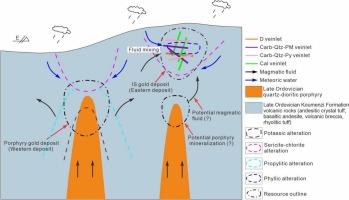
The Eastern deposit in the Songshunangou district is the first discovered intermediate-sulfidation (IS) epithermal gold deposit in the North Qilian orogenic belt. Gold mineralization is associated with sericite-chlorite and phyllic alteration styles. Petrographic observations of veinlets and their crosscutting relationships define three distinct hydrothermal stages (I to III): The stage I is represented by pyrite and carbonates (calcite and manganocalcite), while the stage II is reflected by the mineral assemblage galena, Fe-poor sphalerite, chalcopyrite, pyrite, native gold, and tennantite, with trace tetrahedrite and electrum. Gangue minerals are quartz and carbonates (manganocalcite, calcite, ankerite, and dolomite). The stage III is defined by carbonates (manganocalcite, calcite, ankerite, and dolomite), quartz, pyrite, and minor native gold. Homogenization temperatures and salinities obtained from fluid inclusions decrease from stage II (112–191°C; 2.74–12.96 wt% NaCl eqv.) to stage III (103–144°C; 1.40–10.49 wt% NaCl eqv.), indicating that the ore-forming fluids of the Eastern deposit were low-temperature, medium- to low-salinity fluids of the NaCl-H2O system. The isotopic signatures of S (δ34S = +1.31‰ to +9.93‰) and Pb (206Pb/204Pb, 207Pb/204Pb, and 208Pb/204Pb with 18.391–18.701‰, 15.623–15.635‰ and 38.186–38.414‰, respectively) point to a mantle-derived magmatic source for the ore-forming metals, with minor contributions from the upper crust. Carbon (−2.47‰ to −0.18‰), oxygen (−5.30‰ to −2.70‰), and hydrogen (−83.6‰ to −58.7‰) isotope data indicate that both magmatic fluids and meteoric water have been involved during ore precipitation. Our data suggest that the mineralization at the Eastern gold deposit in the Songshunangou gold district was formed by hydrothermal activity related to Late Ordovician magmatism. The ore-forming components, derived from a mantle magma source, were transported upward by the fluid. During migration, these fluids mixed with meteoric water and cooled, causing the precipitation of large amounts of gold.
求助全文
通过发布文献求助,成功后即可免费获取论文全文。 去求助
来源期刊
Ore Geology Reviews
Ore Geology Reviews 地学-地质学
CiteScore
6.50
自引率
27.30%
发文量
546
审稿时长
22.9 weeks
期刊介绍: Ore Geology Reviews aims to familiarize all earth scientists with recent advances in a number of interconnected disciplines related to the study of, and search for, ore deposits. The reviews range from brief to longer contributions, but the journal preferentially publishes manuscripts that fill the niche between the commonly shorter journal articles and the comprehensive book coverages, and thus has a special appeal to many authors and readers.

×
引用
GB/T 7714-2015
复制
MLA
复制
APA
复制
导出至
BibTeX EndNote RefMan NoteFirst NoteExpress
×
提示
您的信息不完整,为了账户安全,请先补充。
现在去补充
×
提示
您因"违规操作"
具体请查看互助需知
我知道了
×
提示
确定
请完成安全验证×
copy
已复制链接
快去分享给好友吧!
我知道了
右上角分享
点击右上角分享
0
联系我们:info@booksci.cn Book学术提供免费学术资源搜索服务,方便国内外学者检索中英文文献。致力于提供最便捷和优质的服务体验。 Copyright © 2023 布克学术 All rights reserved.
京ICP备2023020795号-1
ghs 京公网安备 11010802042870号
Book学术文献互助
Book学术文献互助群
群 号:604180095
Book学术官方微信
小红书