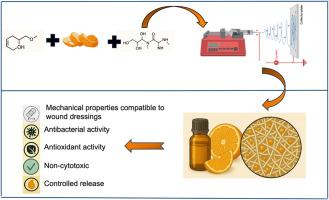
含有橙皮精油的聚(ℇ-己内酯)/明胶纳米纤维用于伤口愈合:将食物垃圾升级为伤口敷料材料

IF 3.8 Q2 BIOTECHNOLOGY & APPLIED MICROBIOLOGY
Dilara Nur Dikmetas , Aysen Akturk , Dilara Devecioglu , Zeynep Güneş-Özünal , Derya Kahveci , Funda Karbancioglu-Guler , Melek Erol-Taygun
{"title":"含有橙皮精油的聚(ℇ-己内酯)/明胶纳米纤维用于伤口愈合:将食物垃圾升级为伤口敷料材料","authors":"Dilara Nur Dikmetas ,&nbsp;Aysen Akturk ,&nbsp;Dilara Devecioglu ,&nbsp;Zeynep Güneş-Özünal ,&nbsp;Derya Kahveci ,&nbsp;Funda Karbancioglu-Guler ,&nbsp;Melek Erol-Taygun","doi":"10.1016/j.bcab.2026.103990","DOIUrl":null,"url":null,"abstract":"<div><div>Utilization of the industrial waste streams into value-added products has become important for sustainability. In this study, essential oil extracted from industrial orange waste was used to develop antibacterial wound dressings demonstrating sufficient cytocompatibility towards keratinocytes and promoting wound healing. For this purpose, orange peel essential oil (OEO), a potent natural antibacterial agent, was used. Morphological, chemical and thermal properties of nanofibers were analyzed. FTIR analysis revealed the presence of PCL and gelatin in the structure. The thermal analysis illustrated that adding a certain amount of OEO led to improved thermal stability. Mechanical properties of obtained samples met the criteria for wound dressing materials. The surface hydrophilicity of the nanofibers was assessed by water contact angle measurements. The developed scaffolds exhibited beneficial characteristics, including release of OEO and appropriate rates of swelling and breakdown, and comparable water vapor transmission rate with commercial wound dressing materials. Nanofiber with 50% of OEO showed antioxidant and antibacterial activity against Gram-positive and Gram-negative bacteria. Furthermore, there were no notable changes to cell viability induced by the obtained samples. The characterization studies, including mechanical tests, swelling capacity, water vapor, antimicrobial and antioxidant activities with cytocompatibility, present that these materials have potential as candidates for wound dressing applications.</div></div>","PeriodicalId":8774,"journal":{"name":"Biocatalysis and agricultural biotechnology","volume":"73 ","pages":"Article 103990"},"PeriodicalIF":3.8000,"publicationDate":"2026-04-01","publicationTypes":"Journal Article","fieldsOfStudy":null,"isOpenAccess":false,"openAccessPdf":"","citationCount":"0","resultStr":"{\"title\":\"Poly(ℇ-caprolactone)/gelatin nanofibers loaded with orange peel essential oils for wound healing: Upcycling of a food waste into a wound dressing material\",\"authors\":\"Dilara Nur Dikmetas ,&nbsp;Aysen Akturk ,&nbsp;Dilara Devecioglu ,&nbsp;Zeynep Güneş-Özünal ,&nbsp;Derya Kahveci ,&nbsp;Funda Karbancioglu-Guler ,&nbsp;Melek Erol-Taygun\",\"doi\":\"10.1016/j.bcab.2026.103990\",\"DOIUrl\":null,\"url\":null,\"abstract\":\"<div><div>Utilization of the industrial waste streams into value-added products has become important for sustainability. In this study, essential oil extracted from industrial orange waste was used to develop antibacterial wound dressings demonstrating sufficient cytocompatibility towards keratinocytes and promoting wound healing. For this purpose, orange peel essential oil (OEO), a potent natural antibacterial agent, was used. Morphological, chemical and thermal properties of nanofibers were analyzed. FTIR analysis revealed the presence of PCL and gelatin in the structure. The thermal analysis illustrated that adding a certain amount of OEO led to improved thermal stability. Mechanical properties of obtained samples met the criteria for wound dressing materials. The surface hydrophilicity of the nanofibers was assessed by water contact angle measurements. The developed scaffolds exhibited beneficial characteristics, including release of OEO and appropriate rates of swelling and breakdown, and comparable water vapor transmission rate with commercial wound dressing materials. Nanofiber with 50% of OEO showed antioxidant and antibacterial activity against Gram-positive and Gram-negative bacteria. Furthermore, there were no notable changes to cell viability induced by the obtained samples. The characterization studies, including mechanical tests, swelling capacity, water vapor, antimicrobial and antioxidant activities with cytocompatibility, present that these materials have potential as candidates for wound dressing applications.</div></div>\",\"PeriodicalId\":8774,\"journal\":{\"name\":\"Biocatalysis and agricultural biotechnology\",\"volume\":\"73 \",\"pages\":\"Article 103990\"},\"PeriodicalIF\":3.8000,\"publicationDate\":\"2026-04-01\",\"publicationTypes\":\"Journal Article\",\"fieldsOfStudy\":null,\"isOpenAccess\":false,\"openAccessPdf\":\"\",\"citationCount\":\"0\",\"resultStr\":null,\"platform\":\"Semanticscholar\",\"paperid\":null,\"PeriodicalName\":\"Biocatalysis and agricultural biotechnology\",\"FirstCategoryId\":\"1085\",\"ListUrlMain\":\"https://www.sciencedirect.com/science/article/pii/S1878818126000733\",\"RegionNum\":0,\"RegionCategory\":null,\"ArticlePicture\":[],\"TitleCN\":null,\"AbstractTextCN\":null,\"PMCID\":null,\"EPubDate\":\"2026/2/28 0:00:00\",\"PubModel\":\"Epub\",\"JCR\":\"Q2\",\"JCRName\":\"BIOTECHNOLOGY & APPLIED MICROBIOLOGY\",\"Score\":null,\"Total\":0}","platform":"Semanticscholar","paperid":null,"PeriodicalName":"Biocatalysis and agricultural biotechnology","FirstCategoryId":"1085","ListUrlMain":"https://www.sciencedirect.com/science/article/pii/S1878818126000733","RegionNum":0,"RegionCategory":null,"ArticlePicture":[],"TitleCN":null,"AbstractTextCN":null,"PMCID":null,"EPubDate":"2026/2/28 0:00:00","PubModel":"Epub","JCR":"Q2","JCRName":"BIOTECHNOLOGY & APPLIED MICROBIOLOGY","Score":null,"Total":0}
引用次数: 0

摘要

利用工业废物流生产增值产品对于可持续发展已经变得非常重要。在这项研究中,从工业橙子废料中提取的精油被用于开发抗菌伤口敷料,该敷料对角质形成细胞具有足够的细胞相容性,并促进伤口愈合。为此,使用了强效天然抗菌剂橙皮精油(OEO)。分析了纳米纤维的形态、化学和热性能。FTIR分析显示结构中存在PCL和明胶。热分析表明,加入一定量的OEO可以提高材料的热稳定性。所得样品的力学性能符合创面敷料标准。通过水接触角测定纳米纤维的表面亲水性。所开发的支架具有良好的特性,包括OEO的释放和适当的肿胀和分解速率,以及与商业伤口敷料相当的水蒸气透过率。含有50% OEO的纳米纤维对革兰氏阳性菌和革兰氏阴性菌均具有抗氧化和抗菌活性。此外,所获得的样品对细胞活力没有明显的影响。表征研究,包括机械测试,膨胀能力,水蒸气,抗菌和抗氧化活性与细胞相容性,表明这些材料具有潜在的候选伤口敷料应用。
本文章由计算机程序翻译,如有差异,请以英文原文为准。

Poly(ℇ-caprolactone)/gelatin nanofibers loaded with orange peel essential oils for wound healing: Upcycling of a food waste into a wound dressing material

Poly(ℇ-caprolactone)/gelatin nanofibers loaded with orange peel essential oils for wound healing: Upcycling of a food waste into a wound dressing material
Utilization of the industrial waste streams into value-added products has become important for sustainability. In this study, essential oil extracted from industrial orange waste was used to develop antibacterial wound dressings demonstrating sufficient cytocompatibility towards keratinocytes and promoting wound healing. For this purpose, orange peel essential oil (OEO), a potent natural antibacterial agent, was used. Morphological, chemical and thermal properties of nanofibers were analyzed. FTIR analysis revealed the presence of PCL and gelatin in the structure. The thermal analysis illustrated that adding a certain amount of OEO led to improved thermal stability. Mechanical properties of obtained samples met the criteria for wound dressing materials. The surface hydrophilicity of the nanofibers was assessed by water contact angle measurements. The developed scaffolds exhibited beneficial characteristics, including release of OEO and appropriate rates of swelling and breakdown, and comparable water vapor transmission rate with commercial wound dressing materials. Nanofiber with 50% of OEO showed antioxidant and antibacterial activity against Gram-positive and Gram-negative bacteria. Furthermore, there were no notable changes to cell viability induced by the obtained samples. The characterization studies, including mechanical tests, swelling capacity, water vapor, antimicrobial and antioxidant activities with cytocompatibility, present that these materials have potential as candidates for wound dressing applications.
求助全文
通过发布文献求助,成功后即可免费获取论文全文。 去求助
来源期刊
Biocatalysis and agricultural biotechnology
Biocatalysis and agricultural biotechnology Agricultural and Biological Sciences-Agronomy and Crop Science
CiteScore
7.70
自引率
2.50%
发文量
308
审稿时长
48 days
期刊介绍: Biocatalysis and Agricultural Biotechnology is the official journal of the International Society of Biocatalysis and Agricultural Biotechnology (ISBAB). The journal publishes high quality articles especially in the science and technology of biocatalysis, bioprocesses, agricultural biotechnology, biomedical biotechnology, and, if appropriate, from other related areas of biotechnology. The journal will publish peer-reviewed basic and applied research papers, authoritative reviews, and feature articles. The scope of the journal encompasses the research, industrial, and commercial aspects of biotechnology, including the areas of: biocatalysis; bioprocesses; food and agriculture; genetic engineering; molecular biology; healthcare and pharmaceuticals; biofuels; genomics; nanotechnology; environment and biodiversity; and bioremediation.

×
引用
GB/T 7714-2015
复制
MLA
复制
APA
复制
导出至
BibTeX EndNote RefMan NoteFirst NoteExpress
×
提示
您的信息不完整,为了账户安全,请先补充。
现在去补充
×
提示
您因"违规操作"
具体请查看互助需知
我知道了
×
提示
确定
请完成安全验证×
copy
已复制链接
快去分享给好友吧!
我知道了
右上角分享
点击右上角分享
0
联系我们:info@booksci.cn Book学术提供免费学术资源搜索服务,方便国内外学者检索中英文文献。致力于提供最便捷和优质的服务体验。 Copyright © 2023 布克学术 All rights reserved.
京ICP备2023020795号-1
ghs 京公网安备 11010802042870号
Book学术文献互助
Book学术文献互助群
群 号:604180095
Book学术官方微信
小红书