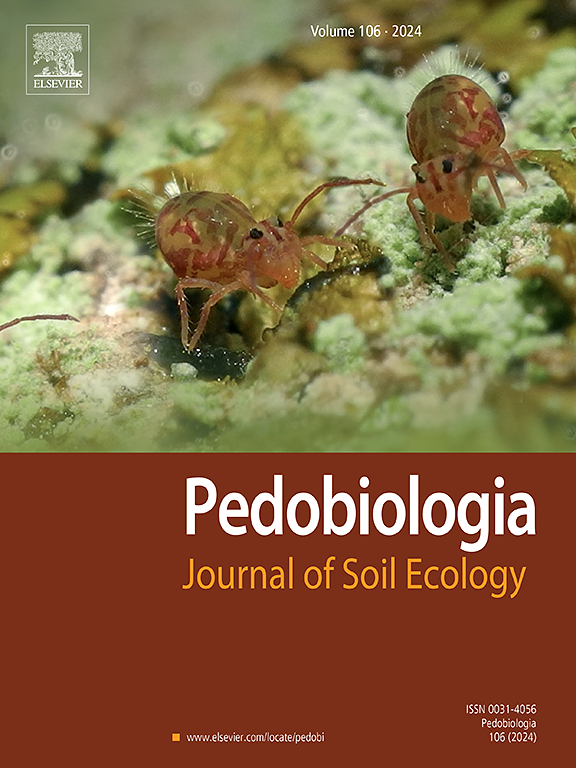
Kohsuke Tanigawa , Mika Lemoine , Floretta Setia Pradana , Sandra Jämtgård , Aimée T. Classen , David A. Wardle , Paul Kardol
{"title":"多级增温对冻土带健康生态系统土壤线虫和微节肢动物的影响","authors":"Kohsuke Tanigawa , Mika Lemoine , Floretta Setia Pradana , Sandra Jämtgård , Aimée T. Classen , David A. Wardle , Paul Kardol","doi":"10.1016/j.pedobi.2026.151122","DOIUrl":null,"url":null,"abstract":"<div><div>Soil fauna, including nematodes and microarthropods (mites and springtails), regulate nutrient cycling and decomposition, yet their responses to warming remain unclear in temperature-sensitive tundra ecosystems. We experimentally warmed intact tundra heath monoliths from northern Sweden under five temperature treatments (ambient to +9 °C) for 20 weeks. Monoliths were dominated by either <em>Betula nana</em> or <em>Empetrum nigrum</em> subsp. <em>hermaphroditum</em>. After incubation, we quantified nematode and microarthropod densities and community composition. Warming altered both nematode and microarthropod communities, with responses mediated by vegetation type, trophic group, and taxon. Microarthropods densities were generally more sensitive to warming, especially under the dominance of <em>E. nigrum</em>, whereas nematode communities showed stronger compositional shifts. Overall nematode densities were stable across warming levels, except for fungivorous nematodes, which decreased linearly with warming. In contrast, total and carnivorous microarthropod densities increased linearly with warming, while springtails and fungivorous microarthropods displayed non-linear, U-shaped responses. Together, these results demonstrate that soil fauna responses to warming range from negligible to linear and non-linear, underscoring the importance of experimental designs that span multiple warming levels. The strong dependence of these responses on vegetation context and trophic identity emphasizes the need to account for local environmental heterogeneity when predicting tundra ecosystem responses to climate change.</div></div>","PeriodicalId":49711,"journal":{"name":"Pedobiologia","volume":"114 ","pages":"Article 151122"},"PeriodicalIF":2.2000,"publicationDate":"2026-03-01","publicationTypes":"Journal Article","fieldsOfStudy":null,"isOpenAccess":false,"openAccessPdf":"","citationCount":"0","resultStr":"{\"title\":\"Effects of multi-level warming on soil nematodes and microarthropods in tundra heath mesocosms\",\"authors\":\"Kohsuke Tanigawa , Mika Lemoine , Floretta Setia Pradana , Sandra Jämtgård , Aimée T. Classen , David A. Wardle , Paul Kardol\",\"doi\":\"10.1016/j.pedobi.2026.151122\",\"DOIUrl\":null,\"url\":null,\"abstract\":\"<div><div>Soil fauna, including nematodes and microarthropods (mites and springtails), regulate nutrient cycling and decomposition, yet their responses to warming remain unclear in temperature-sensitive tundra ecosystems. We experimentally warmed intact tundra heath monoliths from northern Sweden under five temperature treatments (ambient to +9 °C) for 20 weeks. Monoliths were dominated by either <em>Betula nana</em> or <em>Empetrum nigrum</em> subsp. <em>hermaphroditum</em>. After incubation, we quantified nematode and microarthropod densities and community composition. Warming altered both nematode and microarthropod communities, with responses mediated by vegetation type, trophic group, and taxon. Microarthropods densities were generally more sensitive to warming, especially under the dominance of <em>E. nigrum</em>, whereas nematode communities showed stronger compositional shifts. Overall nematode densities were stable across warming levels, except for fungivorous nematodes, which decreased linearly with warming. In contrast, total and carnivorous microarthropod densities increased linearly with warming, while springtails and fungivorous microarthropods displayed non-linear, U-shaped responses. Together, these results demonstrate that soil fauna responses to warming range from negligible to linear and non-linear, underscoring the importance of experimental designs that span multiple warming levels. The strong dependence of these responses on vegetation context and trophic identity emphasizes the need to account for local environmental heterogeneity when predicting tundra ecosystem responses to climate change.</div></div>\",\"PeriodicalId\":49711,\"journal\":{\"name\":\"Pedobiologia\",\"volume\":\"114 \",\"pages\":\"Article 151122\"},\"PeriodicalIF\":2.2000,\"publicationDate\":\"2026-03-01\",\"publicationTypes\":\"Journal Article\",\"fieldsOfStudy\":null,\"isOpenAccess\":false,\"openAccessPdf\":\"\",\"citationCount\":\"0\",\"resultStr\":null,\"platform\":\"Semanticscholar\",\"paperid\":null,\"PeriodicalName\":\"Pedobiologia\",\"FirstCategoryId\":\"97\",\"ListUrlMain\":\"https://www.sciencedirect.com/science/article/pii/S0031405626000119\",\"RegionNum\":3,\"RegionCategory\":\"农林科学\",\"ArticlePicture\":[],\"TitleCN\":null,\"AbstractTextCN\":null,\"PMCID\":null,\"EPubDate\":\"2026/2/20 0:00:00\",\"PubModel\":\"Epub\",\"JCR\":\"Q3\",\"JCRName\":\"ECOLOGY\",\"Score\":null,\"Total\":0}","platform":"Semanticscholar","paperid":null,"PeriodicalName":"Pedobiologia","FirstCategoryId":"97","ListUrlMain":"https://www.sciencedirect.com/science/article/pii/S0031405626000119","RegionNum":3,"RegionCategory":"农林科学","ArticlePicture":[],"TitleCN":null,"AbstractTextCN":null,"PMCID":null,"EPubDate":"2026/2/20 0:00:00","PubModel":"Epub","JCR":"Q3","JCRName":"ECOLOGY","Score":null,"Total":0}
Effects of multi-level warming on soil nematodes and microarthropods in tundra heath mesocosms
Soil fauna, including nematodes and microarthropods (mites and springtails), regulate nutrient cycling and decomposition, yet their responses to warming remain unclear in temperature-sensitive tundra ecosystems. We experimentally warmed intact tundra heath monoliths from northern Sweden under five temperature treatments (ambient to +9 °C) for 20 weeks. Monoliths were dominated by either Betula nana or Empetrum nigrum subsp. hermaphroditum. After incubation, we quantified nematode and microarthropod densities and community composition. Warming altered both nematode and microarthropod communities, with responses mediated by vegetation type, trophic group, and taxon. Microarthropods densities were generally more sensitive to warming, especially under the dominance of E. nigrum, whereas nematode communities showed stronger compositional shifts. Overall nematode densities were stable across warming levels, except for fungivorous nematodes, which decreased linearly with warming. In contrast, total and carnivorous microarthropod densities increased linearly with warming, while springtails and fungivorous microarthropods displayed non-linear, U-shaped responses. Together, these results demonstrate that soil fauna responses to warming range from negligible to linear and non-linear, underscoring the importance of experimental designs that span multiple warming levels. The strong dependence of these responses on vegetation context and trophic identity emphasizes the need to account for local environmental heterogeneity when predicting tundra ecosystem responses to climate change.
期刊介绍:
Pedobiologia publishes peer reviewed articles describing original work in the field of soil ecology, which includes the study of soil organisms and their interactions with factors in their biotic and abiotic environments.
Analysis of biological structures, interactions, functions, and processes in soil is fundamental for understanding the dynamical nature of terrestrial ecosystems, a prerequisite for appropriate soil management. The scope of this journal consists of fundamental and applied aspects of soil ecology; key focal points include interactions among organisms in soil, organismal controls on soil processes, causes and consequences of soil biodiversity, and aboveground-belowground interactions.
We publish:
original research that tests clearly defined hypotheses addressing topics of current interest in soil ecology (including studies demonstrating nonsignificant effects);
descriptions of novel methodological approaches, or evaluations of current approaches, that address a clear need in soil ecology research;
innovative syntheses of the soil ecology literature, including metaanalyses, topical in depth reviews and short opinion/perspective pieces, and descriptions of original conceptual frameworks; and
short notes reporting novel observations of ecological significance.