Wen Luo , Yali Guo , Zhihu Wang , Wenying Wang , Yuanli Li , Lili Liu , Wenjuan Wang , Ming Luo , Yonggang Wang
{"title":"党参根际微生物组功能分化驱动土壤碳分配权衡","authors":"Wen Luo , Yali Guo , Zhihu Wang , Wenying Wang , Yuanli Li , Lili Liu , Wenjuan Wang , Ming Luo , Yonggang Wang","doi":"10.1016/j.ejsobi.2026.103811","DOIUrl":null,"url":null,"abstract":"<div><div>Rhizosphere microorganisms play pivotal roles in soil organic carbon dynamics; yet, their relationship with soil carbon cycling remains unclear under plant intraspecific variation, particularly for medicinal species with distinct metabolic traits. Here, we investigate how six varieties of <em>Codonopsis pilosula</em> (BT, CD, WD, WY1, WY3, WY4) influence the trade-off between soil organic matter (SOM) and microbial biomass carbon (MBC) through modulation of rhizosphere microbial communities. The results showed that a significant negative correlation was observed between SOM and MBC across varieties (<em>P</em> = 0.0025). The BT variety exhibited a rapid carbon turnover phenotype, marked by low SOM, high MBC, and enhanced peroxidase activity. In contrast, WD and WY3 adopted a carbon-accumulating strategy, sustaining high SOM with moderate to low MBC. Plant variety emerged as the dominant factor structuring rhizosphere bacterial and fungal communities. The BT variety specifically enriched taxa involved in recalcitrant carbon degradation, such as <em>Nitrospira</em> and <em>Chryseolinea</em>. Functional prediction further revealed enrichment of nitrification and lignin degradation pathways in BT microbiomes, whereas denitrification was prominent in WY4. Network analyses underscored strong associations among SOM, MBC, and carbon-cycling enzymes with microbial network modules, suggesting that environmental factors modulate carbon processes via microbiome interactions. Our findings unveil a mechanism by which plant genetic variation mediates soil carbon allocation through rhizosphere community restructuring, providing a foundation for genotype-specific breeding and microbiome management to optimize soil carbon sequestration.</div></div>","PeriodicalId":12057,"journal":{"name":"European Journal of Soil Biology","volume":"128 ","pages":"Article 103811"},"PeriodicalIF":3.3000,"publicationDate":"2026-03-01","publicationTypes":"Journal Article","fieldsOfStudy":null,"isOpenAccess":false,"openAccessPdf":"","citationCount":"0","resultStr":"{\"title\":\"Functional divergence in the rhizosphere microbiome of Codonopsis pilosula drives a soil carbon allocation trade-off\",\"authors\":\"Wen Luo , Yali Guo , Zhihu Wang , Wenying Wang , Yuanli Li , Lili Liu , Wenjuan Wang , Ming Luo , Yonggang Wang\",\"doi\":\"10.1016/j.ejsobi.2026.103811\",\"DOIUrl\":null,\"url\":null,\"abstract\":\"<div><div>Rhizosphere microorganisms play pivotal roles in soil organic carbon dynamics; yet, their relationship with soil carbon cycling remains unclear under plant intraspecific variation, particularly for medicinal species with distinct metabolic traits. Here, we investigate how six varieties of <em>Codonopsis pilosula</em> (BT, CD, WD, WY1, WY3, WY4) influence the trade-off between soil organic matter (SOM) and microbial biomass carbon (MBC) through modulation of rhizosphere microbial communities. The results showed that a significant negative correlation was observed between SOM and MBC across varieties (<em>P</em> = 0.0025). The BT variety exhibited a rapid carbon turnover phenotype, marked by low SOM, high MBC, and enhanced peroxidase activity. In contrast, WD and WY3 adopted a carbon-accumulating strategy, sustaining high SOM with moderate to low MBC. Plant variety emerged as the dominant factor structuring rhizosphere bacterial and fungal communities. The BT variety specifically enriched taxa involved in recalcitrant carbon degradation, such as <em>Nitrospira</em> and <em>Chryseolinea</em>. Functional prediction further revealed enrichment of nitrification and lignin degradation pathways in BT microbiomes, whereas denitrification was prominent in WY4. Network analyses underscored strong associations among SOM, MBC, and carbon-cycling enzymes with microbial network modules, suggesting that environmental factors modulate carbon processes via microbiome interactions. Our findings unveil a mechanism by which plant genetic variation mediates soil carbon allocation through rhizosphere community restructuring, providing a foundation for genotype-specific breeding and microbiome management to optimize soil carbon sequestration.</div></div>\",\"PeriodicalId\":12057,\"journal\":{\"name\":\"European Journal of Soil Biology\",\"volume\":\"128 \",\"pages\":\"Article 103811\"},\"PeriodicalIF\":3.3000,\"publicationDate\":\"2026-03-01\",\"publicationTypes\":\"Journal Article\",\"fieldsOfStudy\":null,\"isOpenAccess\":false,\"openAccessPdf\":\"\",\"citationCount\":\"0\",\"resultStr\":null,\"platform\":\"Semanticscholar\",\"paperid\":null,\"PeriodicalName\":\"European Journal of Soil Biology\",\"FirstCategoryId\":\"97\",\"ListUrlMain\":\"https://www.sciencedirect.com/science/article/pii/S1164556326000099\",\"RegionNum\":2,\"RegionCategory\":\"农林科学\",\"ArticlePicture\":[],\"TitleCN\":null,\"AbstractTextCN\":null,\"PMCID\":null,\"EPubDate\":\"2026/2/23 0:00:00\",\"PubModel\":\"Epub\",\"JCR\":\"Q1\",\"JCRName\":\"ECOLOGY\",\"Score\":null,\"Total\":0}","platform":"Semanticscholar","paperid":null,"PeriodicalName":"European Journal of Soil Biology","FirstCategoryId":"97","ListUrlMain":"https://www.sciencedirect.com/science/article/pii/S1164556326000099","RegionNum":2,"RegionCategory":"农林科学","ArticlePicture":[],"TitleCN":null,"AbstractTextCN":null,"PMCID":null,"EPubDate":"2026/2/23 0:00:00","PubModel":"Epub","JCR":"Q1","JCRName":"ECOLOGY","Score":null,"Total":0}
Functional divergence in the rhizosphere microbiome of Codonopsis pilosula drives a soil carbon allocation trade-off
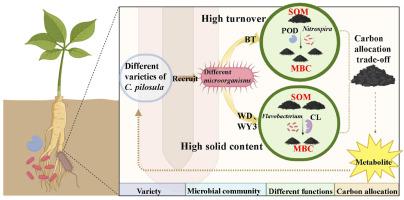
Rhizosphere microorganisms play pivotal roles in soil organic carbon dynamics; yet, their relationship with soil carbon cycling remains unclear under plant intraspecific variation, particularly for medicinal species with distinct metabolic traits. Here, we investigate how six varieties of Codonopsis pilosula (BT, CD, WD, WY1, WY3, WY4) influence the trade-off between soil organic matter (SOM) and microbial biomass carbon (MBC) through modulation of rhizosphere microbial communities. The results showed that a significant negative correlation was observed between SOM and MBC across varieties (P = 0.0025). The BT variety exhibited a rapid carbon turnover phenotype, marked by low SOM, high MBC, and enhanced peroxidase activity. In contrast, WD and WY3 adopted a carbon-accumulating strategy, sustaining high SOM with moderate to low MBC. Plant variety emerged as the dominant factor structuring rhizosphere bacterial and fungal communities. The BT variety specifically enriched taxa involved in recalcitrant carbon degradation, such as Nitrospira and Chryseolinea. Functional prediction further revealed enrichment of nitrification and lignin degradation pathways in BT microbiomes, whereas denitrification was prominent in WY4. Network analyses underscored strong associations among SOM, MBC, and carbon-cycling enzymes with microbial network modules, suggesting that environmental factors modulate carbon processes via microbiome interactions. Our findings unveil a mechanism by which plant genetic variation mediates soil carbon allocation through rhizosphere community restructuring, providing a foundation for genotype-specific breeding and microbiome management to optimize soil carbon sequestration.
期刊介绍:
The European Journal of Soil Biology covers all aspects of soil biology which deal with microbial and faunal ecology and activity in soils, as well as natural ecosystems or biomes connected to ecological interests: biodiversity, biological conservation, adaptation, impact of global changes on soil biodiversity and ecosystem functioning and effects and fate of pollutants as influenced by soil organisms. Different levels in ecosystem structure are taken into account: individuals, populations, communities and ecosystems themselves. At each level, different disciplinary approaches are welcomed: molecular biology, genetics, ecophysiology, ecology, biogeography and landscape ecology.