{"title":"四价10族金属实现芳烃氟化和三氟甲基化(‘正式’ NiIV、PdIV、PtIV)","authors":"Luca Demonti , Hana Tabikh , Noel Nebra","doi":"10.1016/j.ccr.2026.217739","DOIUrl":null,"url":null,"abstract":"<div><div>Organofluorine compounds, mainly those containing F itself or trifluoromethyls (−CF<sub>3</sub>) in arenes, are ubiquitous in pharma/agrochemical industries and material science, making them essential to the well-being of mankind. The metal-mediated aryl−R<sub>f</sub> bond formations (R<sub>f</sub> = F, CF<sub>3</sub>) are commonly hampered by multiple factors (low nucleophilicity of the F<sup>−</sup> anion, strong M−CF<sub>3</sub> bonds, difficult transmetallation, moisture sensitivity, etc.). Accordingly, the finding of synthetic schemes to build aryl−R<sub>f</sub> bonds constitutes a major challenge in modern coordination/organometallic chemistry. This review seeks to critically summarize the most appealing approaches to aryl−F/CF<sub>3</sub> couplings taking place from structurally characterized M<sup>IV</sup>R<sub>f</sub> species (M = Ni, Pd, Pt; R<sub>f</sub> = F, CF<sub>3</sub>).</div><div>The concept of inverted ligand field (ILF) often displayed by some of the <em>‘formally’</em> M<sup>IV</sup>R<sub>f</sub> species compiled herein, together with spectroscopic and reactivity insights supporting the ILF electronic structure picture, is also introduced and briefly discussed.</div></div>","PeriodicalId":289,"journal":{"name":"Coordination Chemistry Reviews","volume":"559 ","pages":"Article 217739"},"PeriodicalIF":23.5000,"publicationDate":"2026-07-15","publicationTypes":"Journal Article","fieldsOfStudy":null,"isOpenAccess":false,"openAccessPdf":"","citationCount":"0","resultStr":"{\"title\":\"Arene fluorination and trifluoromethylation enabled by tetravalent group 10 metals ('formally' NiIV, PdIV, PtIV)\",\"authors\":\"Luca Demonti , Hana Tabikh , Noel Nebra\",\"doi\":\"10.1016/j.ccr.2026.217739\",\"DOIUrl\":null,\"url\":null,\"abstract\":\"<div><div>Organofluorine compounds, mainly those containing F itself or trifluoromethyls (−CF<sub>3</sub>) in arenes, are ubiquitous in pharma/agrochemical industries and material science, making them essential to the well-being of mankind. The metal-mediated aryl−R<sub>f</sub> bond formations (R<sub>f</sub> = F, CF<sub>3</sub>) are commonly hampered by multiple factors (low nucleophilicity of the F<sup>−</sup> anion, strong M−CF<sub>3</sub> bonds, difficult transmetallation, moisture sensitivity, etc.). Accordingly, the finding of synthetic schemes to build aryl−R<sub>f</sub> bonds constitutes a major challenge in modern coordination/organometallic chemistry. This review seeks to critically summarize the most appealing approaches to aryl−F/CF<sub>3</sub> couplings taking place from structurally characterized M<sup>IV</sup>R<sub>f</sub> species (M = Ni, Pd, Pt; R<sub>f</sub> = F, CF<sub>3</sub>).</div><div>The concept of inverted ligand field (ILF) often displayed by some of the <em>‘formally’</em> M<sup>IV</sup>R<sub>f</sub> species compiled herein, together with spectroscopic and reactivity insights supporting the ILF electronic structure picture, is also introduced and briefly discussed.</div></div>\",\"PeriodicalId\":289,\"journal\":{\"name\":\"Coordination Chemistry Reviews\",\"volume\":\"559 \",\"pages\":\"Article 217739\"},\"PeriodicalIF\":23.5000,\"publicationDate\":\"2026-07-15\",\"publicationTypes\":\"Journal Article\",\"fieldsOfStudy\":null,\"isOpenAccess\":false,\"openAccessPdf\":\"\",\"citationCount\":\"0\",\"resultStr\":null,\"platform\":\"Semanticscholar\",\"paperid\":null,\"PeriodicalName\":\"Coordination Chemistry Reviews\",\"FirstCategoryId\":\"92\",\"ListUrlMain\":\"https://www.sciencedirect.com/science/article/pii/S001085452600175X\",\"RegionNum\":1,\"RegionCategory\":\"化学\",\"ArticlePicture\":[],\"TitleCN\":null,\"AbstractTextCN\":null,\"PMCID\":null,\"EPubDate\":\"2026/3/11 0:00:00\",\"PubModel\":\"Epub\",\"JCR\":\"Q1\",\"JCRName\":\"CHEMISTRY, INORGANIC & NUCLEAR\",\"Score\":null,\"Total\":0}","platform":"Semanticscholar","paperid":null,"PeriodicalName":"Coordination Chemistry Reviews","FirstCategoryId":"92","ListUrlMain":"https://www.sciencedirect.com/science/article/pii/S001085452600175X","RegionNum":1,"RegionCategory":"化学","ArticlePicture":[],"TitleCN":null,"AbstractTextCN":null,"PMCID":null,"EPubDate":"2026/3/11 0:00:00","PubModel":"Epub","JCR":"Q1","JCRName":"CHEMISTRY, INORGANIC & NUCLEAR","Score":null,"Total":0}
Arene fluorination and trifluoromethylation enabled by tetravalent group 10 metals ('formally' NiIV, PdIV, PtIV)
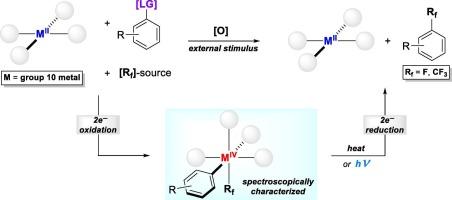
Organofluorine compounds, mainly those containing F itself or trifluoromethyls (−CF3) in arenes, are ubiquitous in pharma/agrochemical industries and material science, making them essential to the well-being of mankind. The metal-mediated aryl−Rf bond formations (Rf = F, CF3) are commonly hampered by multiple factors (low nucleophilicity of the F− anion, strong M−CF3 bonds, difficult transmetallation, moisture sensitivity, etc.). Accordingly, the finding of synthetic schemes to build aryl−Rf bonds constitutes a major challenge in modern coordination/organometallic chemistry. This review seeks to critically summarize the most appealing approaches to aryl−F/CF3 couplings taking place from structurally characterized MIVRf species (M = Ni, Pd, Pt; Rf = F, CF3).
The concept of inverted ligand field (ILF) often displayed by some of the ‘formally’ MIVRf species compiled herein, together with spectroscopic and reactivity insights supporting the ILF electronic structure picture, is also introduced and briefly discussed.
期刊介绍:
Coordination Chemistry Reviews offers rapid publication of review articles on current and significant topics in coordination chemistry, encompassing organometallic, supramolecular, theoretical, and bioinorganic chemistry. It also covers catalysis, materials chemistry, and metal-organic frameworks from a coordination chemistry perspective. Reviews summarize recent developments or discuss specific techniques, welcoming contributions from both established and emerging researchers.
The journal releases special issues on timely subjects, including those featuring contributions from specific regions or conferences. Occasional full-length book articles are also featured. Additionally, special volumes cover annual reviews of main group chemistry, transition metal group chemistry, and organometallic chemistry. These comprehensive reviews are vital resources for those engaged in coordination chemistry, further establishing Coordination Chemistry Reviews as a hub for insightful surveys in inorganic and physical inorganic chemistry.