协同癌症治疗的菁氨酸纳米组件:从聚集状态调节到光疗整合

IF 23.5 1区 化学 Q1 CHEMISTRY, INORGANIC & NUCLEAR
Coordination Chemistry Reviews Pub Date : 2026-07-15 Epub Date: 2026-03-11 DOI:10.1016/j.ccr.2026.217783
Di Zhang , Shuheng Qin , Hai Xu , Hui Bian , Yuan-Yuan Zhao , Xiao Cheng , Jinrong Zheng , Xiaojun Peng , Juyoung Yoon
{"title":"协同癌症治疗的菁氨酸纳米组件:从聚集状态调节到光疗整合","authors":"Di Zhang ,&nbsp;Shuheng Qin ,&nbsp;Hai Xu ,&nbsp;Hui Bian ,&nbsp;Yuan-Yuan Zhao ,&nbsp;Xiao Cheng ,&nbsp;Jinrong Zheng ,&nbsp;Xiaojun Peng ,&nbsp;Juyoung Yoon","doi":"10.1016/j.ccr.2026.217783","DOIUrl":null,"url":null,"abstract":"<div><div>The unique photophysical properties of cyanine dyes—strong NIR absorption, large molar extinction coefficients, and flexible structural tunability—have positioned them as an important class of photosensitizers for photothermal therapy (PTT) and photodynamic therapy (PDT). However, free cyanine dyes suffer from intrinsic limitations, including poor stability, aggregation-caused quenching (ACQ), low ROS generation, and rapid clearance, which severely restrict their biomedical utility.</div><div>Recent advances in molecular self-assembly now offer powerful strategies to overcome these obstacles. Through π–π stacking, hydrophobic interaction, electrostatic association, peptide/protein templating, or metal-ion coordination, cyanine dyes can be organized into highly ordered nanostructures—such as J-aggregates, H-aggregates, nanomicelles, and hybrid nanoassemblies—with precisely tunable morphology and optical behavior. These nanoassemblies restrict conformational freedom, stabilize the excited state, suppress ACQ, and markedly enhance ROS yield and photothermal conversion. In particular, J-aggregates enable red-shifted and sharpened absorption bands, improving tissue penetration and energy utilization for deep-tissue phototherapy.</div><div>Beyond enhancing PDT/PTT performance, self-assembled cyanine nanostructures integrate naturally into multifunctional platforms capable of tumor targeting, tumor microenvironment (TME)-responsive activation, multimodal imaging, and combination therapy—such as PTT–PDT synergy, chemo-phototherapy, SDT, or immunotherapy. Despite these promising advances, challenges remain, including controlling assembly stability in vivo, achieving batch-to-batch reproducibility, and predicting biological fate in complex physiological environments.</div><div>This review summarizes recent progress in cyanine-dye self-assembly, with emphasis on assembly mechanisms, aggregate-state engineering, structure–property relationships, and strategies for improving PDT/PTT efficacy and combination cancer therapy. We further discuss existing limitations and future opportunities for translating assembled cyanine nanotherapeutics into precision oncology. Together, these insights highlight the power of supramolecular engineering in transforming traditional cyanine dyes into robust, versatile, and clinically meaningful phototheranostic nanoplatforms.</div></div>","PeriodicalId":289,"journal":{"name":"Coordination Chemistry Reviews","volume":"559 ","pages":"Article 217783"},"PeriodicalIF":23.5000,"publicationDate":"2026-07-15","publicationTypes":"Journal Article","fieldsOfStudy":null,"isOpenAccess":false,"openAccessPdf":"","citationCount":"0","resultStr":"{\"title\":\"Cyanine Nanoassemblies for synergistic cancer therapy: From aggregate-state modulation to Phototheranostic integration\",\"authors\":\"Di Zhang ,&nbsp;Shuheng Qin ,&nbsp;Hai Xu ,&nbsp;Hui Bian ,&nbsp;Yuan-Yuan Zhao ,&nbsp;Xiao Cheng ,&nbsp;Jinrong Zheng ,&nbsp;Xiaojun Peng ,&nbsp;Juyoung Yoon\",\"doi\":\"10.1016/j.ccr.2026.217783\",\"DOIUrl\":null,\"url\":null,\"abstract\":\"<div><div>The unique photophysical properties of cyanine dyes—strong NIR absorption, large molar extinction coefficients, and flexible structural tunability—have positioned them as an important class of photosensitizers for photothermal therapy (PTT) and photodynamic therapy (PDT). However, free cyanine dyes suffer from intrinsic limitations, including poor stability, aggregation-caused quenching (ACQ), low ROS generation, and rapid clearance, which severely restrict their biomedical utility.</div><div>Recent advances in molecular self-assembly now offer powerful strategies to overcome these obstacles. Through π–π stacking, hydrophobic interaction, electrostatic association, peptide/protein templating, or metal-ion coordination, cyanine dyes can be organized into highly ordered nanostructures—such as J-aggregates, H-aggregates, nanomicelles, and hybrid nanoassemblies—with precisely tunable morphology and optical behavior. These nanoassemblies restrict conformational freedom, stabilize the excited state, suppress ACQ, and markedly enhance ROS yield and photothermal conversion. In particular, J-aggregates enable red-shifted and sharpened absorption bands, improving tissue penetration and energy utilization for deep-tissue phototherapy.</div><div>Beyond enhancing PDT/PTT performance, self-assembled cyanine nanostructures integrate naturally into multifunctional platforms capable of tumor targeting, tumor microenvironment (TME)-responsive activation, multimodal imaging, and combination therapy—such as PTT–PDT synergy, chemo-phototherapy, SDT, or immunotherapy. Despite these promising advances, challenges remain, including controlling assembly stability in vivo, achieving batch-to-batch reproducibility, and predicting biological fate in complex physiological environments.</div><div>This review summarizes recent progress in cyanine-dye self-assembly, with emphasis on assembly mechanisms, aggregate-state engineering, structure–property relationships, and strategies for improving PDT/PTT efficacy and combination cancer therapy. We further discuss existing limitations and future opportunities for translating assembled cyanine nanotherapeutics into precision oncology. Together, these insights highlight the power of supramolecular engineering in transforming traditional cyanine dyes into robust, versatile, and clinically meaningful phototheranostic nanoplatforms.</div></div>\",\"PeriodicalId\":289,\"journal\":{\"name\":\"Coordination Chemistry Reviews\",\"volume\":\"559 \",\"pages\":\"Article 217783\"},\"PeriodicalIF\":23.5000,\"publicationDate\":\"2026-07-15\",\"publicationTypes\":\"Journal Article\",\"fieldsOfStudy\":null,\"isOpenAccess\":false,\"openAccessPdf\":\"\",\"citationCount\":\"0\",\"resultStr\":null,\"platform\":\"Semanticscholar\",\"paperid\":null,\"PeriodicalName\":\"Coordination Chemistry Reviews\",\"FirstCategoryId\":\"92\",\"ListUrlMain\":\"https://www.sciencedirect.com/science/article/pii/S0010854526002195\",\"RegionNum\":1,\"RegionCategory\":\"化学\",\"ArticlePicture\":[],\"TitleCN\":null,\"AbstractTextCN\":null,\"PMCID\":null,\"EPubDate\":\"2026/3/11 0:00:00\",\"PubModel\":\"Epub\",\"JCR\":\"Q1\",\"JCRName\":\"CHEMISTRY, INORGANIC & NUCLEAR\",\"Score\":null,\"Total\":0}","platform":"Semanticscholar","paperid":null,"PeriodicalName":"Coordination Chemistry Reviews","FirstCategoryId":"92","ListUrlMain":"https://www.sciencedirect.com/science/article/pii/S0010854526002195","RegionNum":1,"RegionCategory":"化学","ArticlePicture":[],"TitleCN":null,"AbstractTextCN":null,"PMCID":null,"EPubDate":"2026/3/11 0:00:00","PubModel":"Epub","JCR":"Q1","JCRName":"CHEMISTRY, INORGANIC & NUCLEAR","Score":null,"Total":0}
引用次数: 0

摘要

菁染料独特的光物理性质-强近红外吸收,大摩尔消光系数和灵活的结构可调性-使其成为光热治疗(PTT)和光动力治疗(PDT)的重要光敏剂。然而,游离花青素染料存在固有的局限性,包括稳定性差、聚集引起的猝灭(ACQ)、低ROS生成和快速清除,这严重限制了它们的生物医学应用。分子自组装的最新进展为克服这些障碍提供了强有力的策略。通过π -π堆叠、疏水相互作用、静电结合、肽/蛋白质模板或金属离子配位,花青素染料可以被组织成高度有序的纳米结构,如j聚集体、h聚集体、纳米胶束和杂化纳米组装体,具有精确可调的形态和光学行为。这些纳米组件限制了构象自由,稳定了激发态,抑制了ACQ,显著提高了ROS产率和光热转化率。特别是,j聚集体实现了红移和锐化的吸收带,提高了组织穿透和深层组织光疗的能量利用。除了增强PDT/PTT性能外,自组装的花青素纳米结构自然集成到多功能平台中,能够靶向肿瘤、肿瘤微环境(TME)响应激活、多模态成像和联合治疗,如PTT - PDT协同、化学光疗、SDT或免疫治疗。尽管取得了这些有希望的进展,但挑战仍然存在,包括控制体内组装的稳定性,实现批对批的可重复性,以及预测复杂生理环境中的生物命运。本文综述了花青素染料自组装的最新进展,重点介绍了组装机制、聚合状态工程、结构-性质关系以及提高PDT/PTT疗效和联合癌症治疗的策略。我们进一步讨论了将组装的菁氨酸纳米疗法转化为精确肿瘤学的现有限制和未来机会。总之,这些见解突出了超分子工程的力量,将传统的花青素染料转化为强大的,通用的,临床上有意义的光治疗纳米平台。
本文章由计算机程序翻译,如有差异,请以英文原文为准。

Cyanine Nanoassemblies for synergistic cancer therapy: From aggregate-state modulation to Phototheranostic integration

Cyanine Nanoassemblies for synergistic cancer therapy: From aggregate-state modulation to Phototheranostic integration
The unique photophysical properties of cyanine dyes—strong NIR absorption, large molar extinction coefficients, and flexible structural tunability—have positioned them as an important class of photosensitizers for photothermal therapy (PTT) and photodynamic therapy (PDT). However, free cyanine dyes suffer from intrinsic limitations, including poor stability, aggregation-caused quenching (ACQ), low ROS generation, and rapid clearance, which severely restrict their biomedical utility.
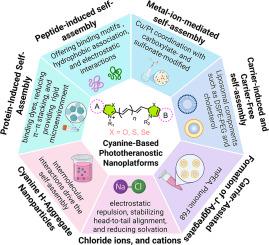
Recent advances in molecular self-assembly now offer powerful strategies to overcome these obstacles. Through π–π stacking, hydrophobic interaction, electrostatic association, peptide/protein templating, or metal-ion coordination, cyanine dyes can be organized into highly ordered nanostructures—such as J-aggregates, H-aggregates, nanomicelles, and hybrid nanoassemblies—with precisely tunable morphology and optical behavior. These nanoassemblies restrict conformational freedom, stabilize the excited state, suppress ACQ, and markedly enhance ROS yield and photothermal conversion. In particular, J-aggregates enable red-shifted and sharpened absorption bands, improving tissue penetration and energy utilization for deep-tissue phototherapy.
Beyond enhancing PDT/PTT performance, self-assembled cyanine nanostructures integrate naturally into multifunctional platforms capable of tumor targeting, tumor microenvironment (TME)-responsive activation, multimodal imaging, and combination therapy—such as PTT–PDT synergy, chemo-phototherapy, SDT, or immunotherapy. Despite these promising advances, challenges remain, including controlling assembly stability in vivo, achieving batch-to-batch reproducibility, and predicting biological fate in complex physiological environments.
This review summarizes recent progress in cyanine-dye self-assembly, with emphasis on assembly mechanisms, aggregate-state engineering, structure–property relationships, and strategies for improving PDT/PTT efficacy and combination cancer therapy. We further discuss existing limitations and future opportunities for translating assembled cyanine nanotherapeutics into precision oncology. Together, these insights highlight the power of supramolecular engineering in transforming traditional cyanine dyes into robust, versatile, and clinically meaningful phototheranostic nanoplatforms.
求助全文
通过发布文献求助,成功后即可免费获取论文全文。 去求助
来源期刊
Coordination Chemistry Reviews
Coordination Chemistry Reviews 化学-无机化学与核化学
CiteScore
34.30
自引率
5.30%
发文量
457
审稿时长
54 days
期刊介绍: Coordination Chemistry Reviews offers rapid publication of review articles on current and significant topics in coordination chemistry, encompassing organometallic, supramolecular, theoretical, and bioinorganic chemistry. It also covers catalysis, materials chemistry, and metal-organic frameworks from a coordination chemistry perspective. Reviews summarize recent developments or discuss specific techniques, welcoming contributions from both established and emerging researchers. The journal releases special issues on timely subjects, including those featuring contributions from specific regions or conferences. Occasional full-length book articles are also featured. Additionally, special volumes cover annual reviews of main group chemistry, transition metal group chemistry, and organometallic chemistry. These comprehensive reviews are vital resources for those engaged in coordination chemistry, further establishing Coordination Chemistry Reviews as a hub for insightful surveys in inorganic and physical inorganic chemistry.

×
引用
GB/T 7714-2015
复制
MLA
复制
APA
复制
导出至
BibTeX EndNote RefMan NoteFirst NoteExpress
×
提示
您的信息不完整,为了账户安全,请先补充。
现在去补充
×
提示
您因"违规操作"
具体请查看互助需知
我知道了
×
提示
确定
请完成安全验证×
copy
已复制链接
快去分享给好友吧!
我知道了
右上角分享
点击右上角分享
0
联系我们:info@booksci.cn Book学术提供免费学术资源搜索服务,方便国内外学者检索中英文文献。致力于提供最便捷和优质的服务体验。 Copyright © 2023 布克学术 All rights reserved.
京ICP备2023020795号-1
ghs 京公网安备 11010802042870号
Book学术文献互助
Book学术文献互助群
群 号:604180095
Book学术官方微信
小红书