Jim Maurice Camilleri, Jing Zhang, Tao Wang, Iqbal Ahmad, Sunan Li, Yong-Hui Zheng
{"title":"TMEM259/MEMBRALIN是一种非规范的er吞噬受体,与MAN1B1和VCP结合以消除病毒糖蛋白。","authors":"Jim Maurice Camilleri, Jing Zhang, Tao Wang, Iqbal Ahmad, Sunan Li, Yong-Hui Zheng","doi":"10.1080/27694127.2026.2639256","DOIUrl":null,"url":null,"abstract":"<p><p>Selective autophagy of the endoplasmic reticulum (ER-phagy/reticulophagy) is essential for organelle homeostasis and host defense, yet how ER quality control (ERQC) pathways distinguish viral glycoproteins from misfolded host proteins remains poorly understood. Recent work identifies TMEM259/MEMBRALIN (transmembrane protein 259) as a selective ER-phagy receptor containing a non-canonical LC3-interacting region (LIR) motif that assembles a dedicated ER-to-lysosome-associated degradation (ERLAD) complex targeting viral class I fusion glycoproteins. TMEM259 is a multi-pass ER membrane protein with luminal domains that recruit MAN1B1 (mannosyl-oligosaccharide 1,2-α-mannosidase) and cytosolic regions that engage VCP/p97 (valosin-containing protein). This TMEM259-MAN1B1-VCP axis directs diverse viral glycoproteins, including severe acute respiratory syndrome coronavirus 2 (SARS-CoV-2) spike, Ebola virus (EBOV) glycoprotein, influenza A virus (IAV) hemagglutinin (HA), and human immunodeficiency virus type 1 (HIV-1) envelope glycoprotein, to lysosomes in a ubiquitin-independent manner. In contrast, misfolded host glycoproteins are primarily cleared through canonical ER-associated degradation (ERAD) or alternative ERLAD pathways. Preferential recognition of densely glycosylated viral substrates suggests that MAN1B1 may function as a glycan-density sensor, enabling TMEM259 to couple ER proteostasis with intrinsic antiviral immunity. These findings expand the conceptual framework of selective autophagy and uncover a specialized ER-phagy pathway dedicated to eliminating viral glycoproteins.</p>","PeriodicalId":72341,"journal":{"name":"Autophagy reports","volume":"5 1","pages":"2639256"},"PeriodicalIF":0.0000,"publicationDate":"2026-03-03","publicationTypes":"Journal Article","fieldsOfStudy":null,"isOpenAccess":false,"openAccessPdf":"https://www.ncbi.nlm.nih.gov/pmc/articles/PMC12962680/pdf/","citationCount":"0","resultStr":"{\"title\":\"TMEM259/MEMBRALIN is a non-canonical ER-phagy receptor that associates with MAN1B1 and VCP to eliminate viral glycoproteins.\",\"authors\":\"Jim Maurice Camilleri, Jing Zhang, Tao Wang, Iqbal Ahmad, Sunan Li, Yong-Hui Zheng\",\"doi\":\"10.1080/27694127.2026.2639256\",\"DOIUrl\":null,\"url\":null,\"abstract\":\"<p><p>Selective autophagy of the endoplasmic reticulum (ER-phagy/reticulophagy) is essential for organelle homeostasis and host defense, yet how ER quality control (ERQC) pathways distinguish viral glycoproteins from misfolded host proteins remains poorly understood. Recent work identifies TMEM259/MEMBRALIN (transmembrane protein 259) as a selective ER-phagy receptor containing a non-canonical LC3-interacting region (LIR) motif that assembles a dedicated ER-to-lysosome-associated degradation (ERLAD) complex targeting viral class I fusion glycoproteins. TMEM259 is a multi-pass ER membrane protein with luminal domains that recruit MAN1B1 (mannosyl-oligosaccharide 1,2-α-mannosidase) and cytosolic regions that engage VCP/p97 (valosin-containing protein). This TMEM259-MAN1B1-VCP axis directs diverse viral glycoproteins, including severe acute respiratory syndrome coronavirus 2 (SARS-CoV-2) spike, Ebola virus (EBOV) glycoprotein, influenza A virus (IAV) hemagglutinin (HA), and human immunodeficiency virus type 1 (HIV-1) envelope glycoprotein, to lysosomes in a ubiquitin-independent manner. In contrast, misfolded host glycoproteins are primarily cleared through canonical ER-associated degradation (ERAD) or alternative ERLAD pathways. Preferential recognition of densely glycosylated viral substrates suggests that MAN1B1 may function as a glycan-density sensor, enabling TMEM259 to couple ER proteostasis with intrinsic antiviral immunity. These findings expand the conceptual framework of selective autophagy and uncover a specialized ER-phagy pathway dedicated to eliminating viral glycoproteins.</p>\",\"PeriodicalId\":72341,\"journal\":{\"name\":\"Autophagy reports\",\"volume\":\"5 1\",\"pages\":\"2639256\"},\"PeriodicalIF\":0.0000,\"publicationDate\":\"2026-03-03\",\"publicationTypes\":\"Journal Article\",\"fieldsOfStudy\":null,\"isOpenAccess\":false,\"openAccessPdf\":\"https://www.ncbi.nlm.nih.gov/pmc/articles/PMC12962680/pdf/\",\"citationCount\":\"0\",\"resultStr\":null,\"platform\":\"Semanticscholar\",\"paperid\":null,\"PeriodicalName\":\"Autophagy reports\",\"FirstCategoryId\":\"1085\",\"ListUrlMain\":\"https://doi.org/10.1080/27694127.2026.2639256\",\"RegionNum\":0,\"RegionCategory\":null,\"ArticlePicture\":[],\"TitleCN\":null,\"AbstractTextCN\":null,\"PMCID\":null,\"EPubDate\":\"2026/1/1 0:00:00\",\"PubModel\":\"eCollection\",\"JCR\":\"\",\"JCRName\":\"\",\"Score\":null,\"Total\":0}","platform":"Semanticscholar","paperid":null,"PeriodicalName":"Autophagy reports","FirstCategoryId":"1085","ListUrlMain":"https://doi.org/10.1080/27694127.2026.2639256","RegionNum":0,"RegionCategory":null,"ArticlePicture":[],"TitleCN":null,"AbstractTextCN":null,"PMCID":null,"EPubDate":"2026/1/1 0:00:00","PubModel":"eCollection","JCR":"","JCRName":"","Score":null,"Total":0}
TMEM259/MEMBRALIN is a non-canonical ER-phagy receptor that associates with MAN1B1 and VCP to eliminate viral glycoproteins.
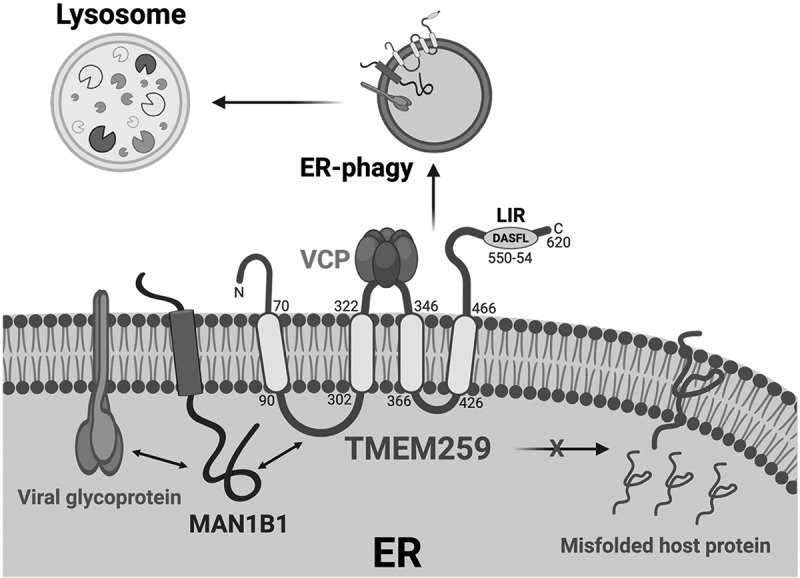
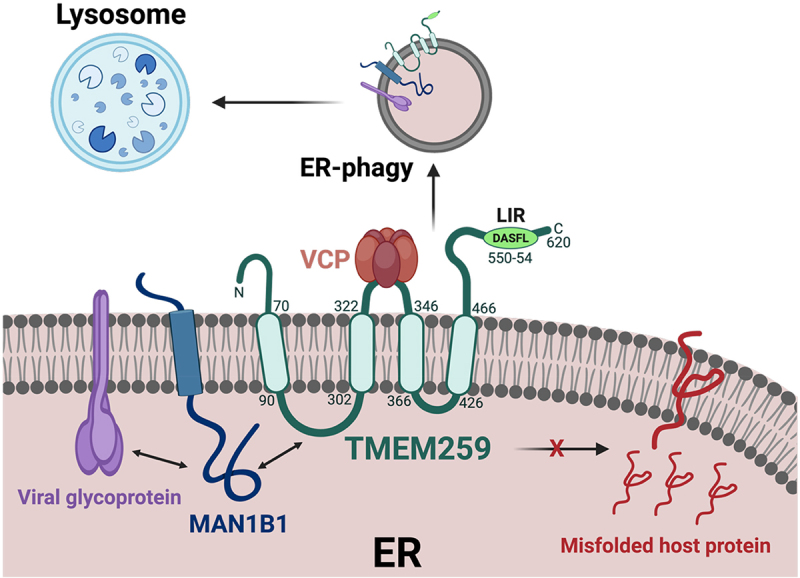
Selective autophagy of the endoplasmic reticulum (ER-phagy/reticulophagy) is essential for organelle homeostasis and host defense, yet how ER quality control (ERQC) pathways distinguish viral glycoproteins from misfolded host proteins remains poorly understood. Recent work identifies TMEM259/MEMBRALIN (transmembrane protein 259) as a selective ER-phagy receptor containing a non-canonical LC3-interacting region (LIR) motif that assembles a dedicated ER-to-lysosome-associated degradation (ERLAD) complex targeting viral class I fusion glycoproteins. TMEM259 is a multi-pass ER membrane protein with luminal domains that recruit MAN1B1 (mannosyl-oligosaccharide 1,2-α-mannosidase) and cytosolic regions that engage VCP/p97 (valosin-containing protein). This TMEM259-MAN1B1-VCP axis directs diverse viral glycoproteins, including severe acute respiratory syndrome coronavirus 2 (SARS-CoV-2) spike, Ebola virus (EBOV) glycoprotein, influenza A virus (IAV) hemagglutinin (HA), and human immunodeficiency virus type 1 (HIV-1) envelope glycoprotein, to lysosomes in a ubiquitin-independent manner. In contrast, misfolded host glycoproteins are primarily cleared through canonical ER-associated degradation (ERAD) or alternative ERLAD pathways. Preferential recognition of densely glycosylated viral substrates suggests that MAN1B1 may function as a glycan-density sensor, enabling TMEM259 to couple ER proteostasis with intrinsic antiviral immunity. These findings expand the conceptual framework of selective autophagy and uncover a specialized ER-phagy pathway dedicated to eliminating viral glycoproteins.


 求助内容:
求助内容: 应助结果提醒方式:

 京公网安备 11010802042870号


