{"title":"困难华氏导管插管技术。","authors":"Evgeniya Molotkova, Henry Hoffman","doi":"10.1002/oto2.70211","DOIUrl":null,"url":null,"abstract":"<p><p>The comparative ease of cannulating Stensen's duct is contrasted by the acknowledged difficulty in cannulating Wharton's duct. Although access to Wharton's duct can be facilitated with a floor-of-mouth incision, it is desirable to avoid this open approach. We present a technique emphasizing the use of a tapered 4-0 Prolene suture to cannulate Wharton's duct. This guide directs placement of a 26-gauge angiocatheter through a modified Seldinger technique. The suture guide is then removed to permit infusion of saline with expansion of the duct to allow for passage of a 0.38-mm guidewire and progressive dilation with a 24- and 22-gauge angiocatheter over the larger guidewire. This technique was successful in all 4 patients who had difficult access to Wharton's duct. One of these patients also underwent successful cannulation of Bartholin's duct. This novel technique for cannulation of Wharton's duct offers an alternative approach for patients with challenging anatomy.</p>","PeriodicalId":19697,"journal":{"name":"OTO Open","volume":"10 1","pages":"e70211"},"PeriodicalIF":1.8000,"publicationDate":"2026-03-05","publicationTypes":"Journal Article","fieldsOfStudy":null,"isOpenAccess":false,"openAccessPdf":"https://www.ncbi.nlm.nih.gov/pmc/articles/PMC12963782/pdf/","citationCount":"0","resultStr":"{\"title\":\"Technique for Difficult Wharton's Duct Cannulation.\",\"authors\":\"Evgeniya Molotkova, Henry Hoffman\",\"doi\":\"10.1002/oto2.70211\",\"DOIUrl\":null,\"url\":null,\"abstract\":\"<p><p>The comparative ease of cannulating Stensen's duct is contrasted by the acknowledged difficulty in cannulating Wharton's duct. Although access to Wharton's duct can be facilitated with a floor-of-mouth incision, it is desirable to avoid this open approach. We present a technique emphasizing the use of a tapered 4-0 Prolene suture to cannulate Wharton's duct. This guide directs placement of a 26-gauge angiocatheter through a modified Seldinger technique. The suture guide is then removed to permit infusion of saline with expansion of the duct to allow for passage of a 0.38-mm guidewire and progressive dilation with a 24- and 22-gauge angiocatheter over the larger guidewire. This technique was successful in all 4 patients who had difficult access to Wharton's duct. One of these patients also underwent successful cannulation of Bartholin's duct. This novel technique for cannulation of Wharton's duct offers an alternative approach for patients with challenging anatomy.</p>\",\"PeriodicalId\":19697,\"journal\":{\"name\":\"OTO Open\",\"volume\":\"10 1\",\"pages\":\"e70211\"},\"PeriodicalIF\":1.8000,\"publicationDate\":\"2026-03-05\",\"publicationTypes\":\"Journal Article\",\"fieldsOfStudy\":null,\"isOpenAccess\":false,\"openAccessPdf\":\"https://www.ncbi.nlm.nih.gov/pmc/articles/PMC12963782/pdf/\",\"citationCount\":\"0\",\"resultStr\":null,\"platform\":\"Semanticscholar\",\"paperid\":null,\"PeriodicalName\":\"OTO Open\",\"FirstCategoryId\":\"1085\",\"ListUrlMain\":\"https://doi.org/10.1002/oto2.70211\",\"RegionNum\":0,\"RegionCategory\":null,\"ArticlePicture\":[],\"TitleCN\":null,\"AbstractTextCN\":null,\"PMCID\":null,\"EPubDate\":\"2026/1/1 0:00:00\",\"PubModel\":\"eCollection\",\"JCR\":\"Q2\",\"JCRName\":\"OTORHINOLARYNGOLOGY\",\"Score\":null,\"Total\":0}","platform":"Semanticscholar","paperid":null,"PeriodicalName":"OTO Open","FirstCategoryId":"1085","ListUrlMain":"https://doi.org/10.1002/oto2.70211","RegionNum":0,"RegionCategory":null,"ArticlePicture":[],"TitleCN":null,"AbstractTextCN":null,"PMCID":null,"EPubDate":"2026/1/1 0:00:00","PubModel":"eCollection","JCR":"Q2","JCRName":"OTORHINOLARYNGOLOGY","Score":null,"Total":0}
Technique for Difficult Wharton's Duct Cannulation.
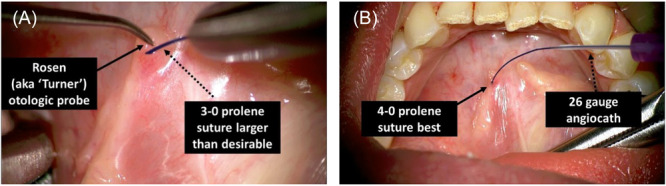
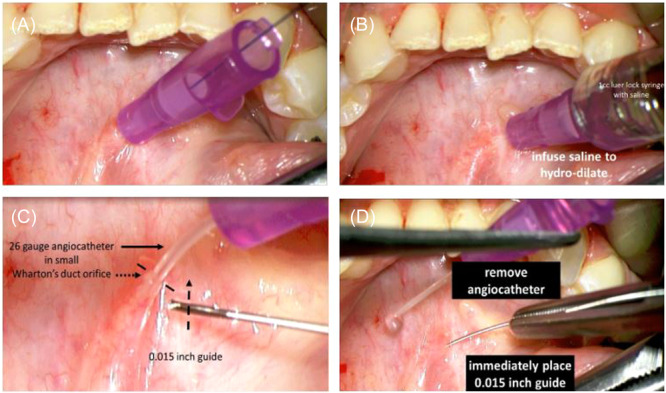
The comparative ease of cannulating Stensen's duct is contrasted by the acknowledged difficulty in cannulating Wharton's duct. Although access to Wharton's duct can be facilitated with a floor-of-mouth incision, it is desirable to avoid this open approach. We present a technique emphasizing the use of a tapered 4-0 Prolene suture to cannulate Wharton's duct. This guide directs placement of a 26-gauge angiocatheter through a modified Seldinger technique. The suture guide is then removed to permit infusion of saline with expansion of the duct to allow for passage of a 0.38-mm guidewire and progressive dilation with a 24- and 22-gauge angiocatheter over the larger guidewire. This technique was successful in all 4 patients who had difficult access to Wharton's duct. One of these patients also underwent successful cannulation of Bartholin's duct. This novel technique for cannulation of Wharton's duct offers an alternative approach for patients with challenging anatomy.



 求助内容:
求助内容: 应助结果提醒方式:

 京公网安备 11010802042870号


