{"title":"一项试点研究,检验两种市售心率监测装置在不同强度和泳姿游泳期间的收敛有效性。","authors":"Hope Reynolds, Scott A Conger, Brian C Rider","doi":"10.70252/IJES2026701","DOIUrl":null,"url":null,"abstract":"<p><p>The purpose of this study was to determine the feasibility of heart rate (HR) monitoring using an optical monitor (OHR) across different swimming strokes and intensities. Nineteen collegiate swimmers (7M, 12F) completed two swimming protocols (P1: nine 75m freestyle swims at three intensities, P2: two 100m swims using their preferred stroke). During P1, four swimming bouts were completed at light intensity (HR 145-155 beats per minute [bpm]), three at moderate intensity (HR 155-170bpm) and two at vigorous intensity (HR > 170bpm). During P2, participants completing one swimming bout using their preferred stroke (freestyle [n=7], backstroke [n=5], breast stroke [n=4], and butterfly [n=3]) at moderate intensity and one vigorous intensity with one-minute rest between each swim. A repeated measures ANOVA (RM ANOVA) with post hoc analysis was completed between the OHR and a traditional chest monitor (THR) with significance set at <i>p</i><0.05. There was an overall significant difference between mean OHR and THR (OHR: 150.7 ± 17.0 vs. THR: 155.9 ± 19.0 bpm, <i>p</i>=0.02) and significant differences during the recovery stage between P1 and P2 (OHR: 126.1 ± 17.8 vs. THR: 122.3 ± 18.0 bpm, <i>p</i>=0.007) and the first 100m swim of P2 (OHR: 148.3 ± 21.3 vs. THR: 159.1 ± 20.1 bpm, <i>p</i>=0.002). The OHR monitor captured 99.9 ± 0.1% of the HR data whereas the THR captured only 58.98 ± 31.3% of the participants' HR data. The OHR significantly underestimated HR compared to the THR but more consistently captured HR than the THR throughout the duration of the swim test.</p>","PeriodicalId":14171,"journal":{"name":"International journal of exercise science","volume":"19 7","pages":"7001"},"PeriodicalIF":0.0000,"publicationDate":"2026-02-01","publicationTypes":"Journal Article","fieldsOfStudy":null,"isOpenAccess":false,"openAccessPdf":"https://www.ncbi.nlm.nih.gov/pmc/articles/PMC12965795/pdf/","citationCount":"0","resultStr":"{\"title\":\"A Pilot Study Examining the Convergent Validity of Two Commercially Available Heart Rate Monitoring Devices During Swimming of Different Intensities and Strokes.\",\"authors\":\"Hope Reynolds, Scott A Conger, Brian C Rider\",\"doi\":\"10.70252/IJES2026701\",\"DOIUrl\":null,\"url\":null,\"abstract\":\"<p><p>The purpose of this study was to determine the feasibility of heart rate (HR) monitoring using an optical monitor (OHR) across different swimming strokes and intensities. Nineteen collegiate swimmers (7M, 12F) completed two swimming protocols (P1: nine 75m freestyle swims at three intensities, P2: two 100m swims using their preferred stroke). During P1, four swimming bouts were completed at light intensity (HR 145-155 beats per minute [bpm]), three at moderate intensity (HR 155-170bpm) and two at vigorous intensity (HR > 170bpm). During P2, participants completing one swimming bout using their preferred stroke (freestyle [n=7], backstroke [n=5], breast stroke [n=4], and butterfly [n=3]) at moderate intensity and one vigorous intensity with one-minute rest between each swim. A repeated measures ANOVA (RM ANOVA) with post hoc analysis was completed between the OHR and a traditional chest monitor (THR) with significance set at <i>p</i><0.05. There was an overall significant difference between mean OHR and THR (OHR: 150.7 ± 17.0 vs. THR: 155.9 ± 19.0 bpm, <i>p</i>=0.02) and significant differences during the recovery stage between P1 and P2 (OHR: 126.1 ± 17.8 vs. THR: 122.3 ± 18.0 bpm, <i>p</i>=0.007) and the first 100m swim of P2 (OHR: 148.3 ± 21.3 vs. THR: 159.1 ± 20.1 bpm, <i>p</i>=0.002). The OHR monitor captured 99.9 ± 0.1% of the HR data whereas the THR captured only 58.98 ± 31.3% of the participants' HR data. The OHR significantly underestimated HR compared to the THR but more consistently captured HR than the THR throughout the duration of the swim test.</p>\",\"PeriodicalId\":14171,\"journal\":{\"name\":\"International journal of exercise science\",\"volume\":\"19 7\",\"pages\":\"7001\"},\"PeriodicalIF\":0.0000,\"publicationDate\":\"2026-02-01\",\"publicationTypes\":\"Journal Article\",\"fieldsOfStudy\":null,\"isOpenAccess\":false,\"openAccessPdf\":\"https://www.ncbi.nlm.nih.gov/pmc/articles/PMC12965795/pdf/\",\"citationCount\":\"0\",\"resultStr\":null,\"platform\":\"Semanticscholar\",\"paperid\":null,\"PeriodicalName\":\"International journal of exercise science\",\"FirstCategoryId\":\"1085\",\"ListUrlMain\":\"https://doi.org/10.70252/IJES2026701\",\"RegionNum\":0,\"RegionCategory\":null,\"ArticlePicture\":[],\"TitleCN\":null,\"AbstractTextCN\":null,\"PMCID\":null,\"EPubDate\":\"2026/1/1 0:00:00\",\"PubModel\":\"eCollection\",\"JCR\":\"Q1\",\"JCRName\":\"Health Professions\",\"Score\":null,\"Total\":0}","platform":"Semanticscholar","paperid":null,"PeriodicalName":"International journal of exercise science","FirstCategoryId":"1085","ListUrlMain":"https://doi.org/10.70252/IJES2026701","RegionNum":0,"RegionCategory":null,"ArticlePicture":[],"TitleCN":null,"AbstractTextCN":null,"PMCID":null,"EPubDate":"2026/1/1 0:00:00","PubModel":"eCollection","JCR":"Q1","JCRName":"Health Professions","Score":null,"Total":0}
A Pilot Study Examining the Convergent Validity of Two Commercially Available Heart Rate Monitoring Devices During Swimming of Different Intensities and Strokes.
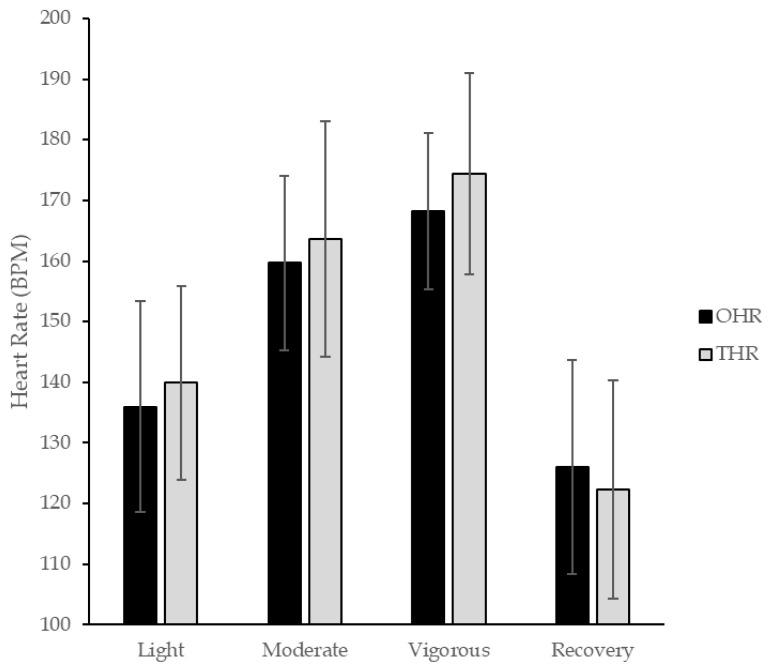
The purpose of this study was to determine the feasibility of heart rate (HR) monitoring using an optical monitor (OHR) across different swimming strokes and intensities. Nineteen collegiate swimmers (7M, 12F) completed two swimming protocols (P1: nine 75m freestyle swims at three intensities, P2: two 100m swims using their preferred stroke). During P1, four swimming bouts were completed at light intensity (HR 145-155 beats per minute [bpm]), three at moderate intensity (HR 155-170bpm) and two at vigorous intensity (HR > 170bpm). During P2, participants completing one swimming bout using their preferred stroke (freestyle [n=7], backstroke [n=5], breast stroke [n=4], and butterfly [n=3]) at moderate intensity and one vigorous intensity with one-minute rest between each swim. A repeated measures ANOVA (RM ANOVA) with post hoc analysis was completed between the OHR and a traditional chest monitor (THR) with significance set at p<0.05. There was an overall significant difference between mean OHR and THR (OHR: 150.7 ± 17.0 vs. THR: 155.9 ± 19.0 bpm, p=0.02) and significant differences during the recovery stage between P1 and P2 (OHR: 126.1 ± 17.8 vs. THR: 122.3 ± 18.0 bpm, p=0.007) and the first 100m swim of P2 (OHR: 148.3 ± 21.3 vs. THR: 159.1 ± 20.1 bpm, p=0.002). The OHR monitor captured 99.9 ± 0.1% of the HR data whereas the THR captured only 58.98 ± 31.3% of the participants' HR data. The OHR significantly underestimated HR compared to the THR but more consistently captured HR than the THR throughout the duration of the swim test.



 求助内容:
求助内容: 应助结果提醒方式:

 京公网安备 11010802042870号


