{"title":"早期帕金森病纵向MDS-UPDRS III评分轨迹相关因素","authors":"Wen Zhou, Duan Liu, Tian-Fang Zeng, Qing-Qing Xia","doi":"10.3389/fnins.2026.1759090","DOIUrl":null,"url":null,"abstract":"<p><strong>Background: </strong>Parkinson's disease (PD) exhibits significant clinical heterogeneity, particularly in motor symptom progression. This study aims to identify distinct trajectories of motor progression in PD and explore associated predictive factors.</p><p><strong>Methods: </strong>Data were obtained from the Parkinson's Progression Markers Initiative (PPMI) database on [2025-3-25]. Motor symptom severity was measured using the MDS-UPDRS III scores. Latent class trajectory analysis was used to identify distinct progression patterns. Multinomial logistic regression and machine learning models were used to evaluate predictors.</p><p><strong>Results: </strong>Three distinct motor progression trajectories were identified: slow progression (38%), moderate progression (55.9%), and rapid progression (6.1%). Compared to the slow progression group, a higher baseline MDS-UPDRS III score was strongly associated with both moderate (OR = 1.27, 95% CI: 1.23-1.31, <i>p</i> < 0.001) and rapid progression (OR = 1.49, 95% CI: 1.43-1.57, <i>p</i> < 0.001). Lower serum albumin levels also significantly increased the likelihood of moderate (OR = 0.95, 95% CI: 0.91-0.99, <i>p</i> = 0.014) and rapid progression (OR = 0.89, 95% CI: 0.81-0.98, <i>p</i> = 0.016). Additionally, higher baseline BMI (per 5 kg/m<sup>2</sup> increase) was associated with greater odds of moderate (OR = 1.19, 95% CI: 1.01-1.41, <i>p</i> = 0.042). Finally, each 1-unit lower mean striatum specific binding ratio (SBR) reduced the odds of moderate progression by 32% compared with the slow-progression group (OR = 0.68, 95% CI: 0.46-0.99, <i>p</i> = 0.044). Machine learning analysis confirmed the predictive importance of these factors, with the Random Forest model achieving an AUC of 0.950.</p><p><strong>Conclusion: </strong>Baseline motor severity, dopaminergic imaging, nutritional status, and body weight are key predictors of motor progression in PD. These findings highlight the potential for early risk stratification and personalized management strategies.</p>","PeriodicalId":12639,"journal":{"name":"Frontiers in Neuroscience","volume":"20 ","pages":"1759090"},"PeriodicalIF":3.2000,"publicationDate":"2026-02-20","publicationTypes":"Journal Article","fieldsOfStudy":null,"isOpenAccess":false,"openAccessPdf":"https://www.ncbi.nlm.nih.gov/pmc/articles/PMC12963062/pdf/","citationCount":"0","resultStr":"{\"title\":\"Factors associated with longitudinal MDS-UPDRS III score trajectories in early-stage Parkinson's disease.\",\"authors\":\"Wen Zhou, Duan Liu, Tian-Fang Zeng, Qing-Qing Xia\",\"doi\":\"10.3389/fnins.2026.1759090\",\"DOIUrl\":null,\"url\":null,\"abstract\":\"<p><strong>Background: </strong>Parkinson's disease (PD) exhibits significant clinical heterogeneity, particularly in motor symptom progression. This study aims to identify distinct trajectories of motor progression in PD and explore associated predictive factors.</p><p><strong>Methods: </strong>Data were obtained from the Parkinson's Progression Markers Initiative (PPMI) database on [2025-3-25]. Motor symptom severity was measured using the MDS-UPDRS III scores. Latent class trajectory analysis was used to identify distinct progression patterns. Multinomial logistic regression and machine learning models were used to evaluate predictors.</p><p><strong>Results: </strong>Three distinct motor progression trajectories were identified: slow progression (38%), moderate progression (55.9%), and rapid progression (6.1%). Compared to the slow progression group, a higher baseline MDS-UPDRS III score was strongly associated with both moderate (OR = 1.27, 95% CI: 1.23-1.31, <i>p</i> < 0.001) and rapid progression (OR = 1.49, 95% CI: 1.43-1.57, <i>p</i> < 0.001). Lower serum albumin levels also significantly increased the likelihood of moderate (OR = 0.95, 95% CI: 0.91-0.99, <i>p</i> = 0.014) and rapid progression (OR = 0.89, 95% CI: 0.81-0.98, <i>p</i> = 0.016). Additionally, higher baseline BMI (per 5 kg/m<sup>2</sup> increase) was associated with greater odds of moderate (OR = 1.19, 95% CI: 1.01-1.41, <i>p</i> = 0.042). Finally, each 1-unit lower mean striatum specific binding ratio (SBR) reduced the odds of moderate progression by 32% compared with the slow-progression group (OR = 0.68, 95% CI: 0.46-0.99, <i>p</i> = 0.044). Machine learning analysis confirmed the predictive importance of these factors, with the Random Forest model achieving an AUC of 0.950.</p><p><strong>Conclusion: </strong>Baseline motor severity, dopaminergic imaging, nutritional status, and body weight are key predictors of motor progression in PD. These findings highlight the potential for early risk stratification and personalized management strategies.</p>\",\"PeriodicalId\":12639,\"journal\":{\"name\":\"Frontiers in Neuroscience\",\"volume\":\"20 \",\"pages\":\"1759090\"},\"PeriodicalIF\":3.2000,\"publicationDate\":\"2026-02-20\",\"publicationTypes\":\"Journal Article\",\"fieldsOfStudy\":null,\"isOpenAccess\":false,\"openAccessPdf\":\"https://www.ncbi.nlm.nih.gov/pmc/articles/PMC12963062/pdf/\",\"citationCount\":\"0\",\"resultStr\":null,\"platform\":\"Semanticscholar\",\"paperid\":null,\"PeriodicalName\":\"Frontiers in Neuroscience\",\"FirstCategoryId\":\"3\",\"ListUrlMain\":\"https://doi.org/10.3389/fnins.2026.1759090\",\"RegionNum\":3,\"RegionCategory\":\"医学\",\"ArticlePicture\":[],\"TitleCN\":null,\"AbstractTextCN\":null,\"PMCID\":null,\"EPubDate\":\"2026/1/1 0:00:00\",\"PubModel\":\"eCollection\",\"JCR\":\"Q2\",\"JCRName\":\"NEUROSCIENCES\",\"Score\":null,\"Total\":0}","platform":"Semanticscholar","paperid":null,"PeriodicalName":"Frontiers in Neuroscience","FirstCategoryId":"3","ListUrlMain":"https://doi.org/10.3389/fnins.2026.1759090","RegionNum":3,"RegionCategory":"医学","ArticlePicture":[],"TitleCN":null,"AbstractTextCN":null,"PMCID":null,"EPubDate":"2026/1/1 0:00:00","PubModel":"eCollection","JCR":"Q2","JCRName":"NEUROSCIENCES","Score":null,"Total":0}
引用次数: 0
摘要
背景:帕金森病(PD)表现出明显的临床异质性,特别是在运动症状进展方面。本研究旨在确定帕金森病患者运动进展的不同轨迹,并探讨相关的预测因素。方法:数据来自帕金森进展标志物倡议(PPMI)数据库[2025年3月25日]。使用MDS-UPDRS III评分测量运动症状严重程度。潜在类别轨迹分析用于识别不同的进展模式。使用多项逻辑回归和机器学习模型来评估预测因子。结果:确定了三种不同的运动进展轨迹:缓慢进展(38%),中度进展(55.9%)和快速进展(6.1%)。缓慢进展组相比,高基线MDS-UPDRS三世分值与温和派密切相关(或 = 1.27,95%置信区间CI: 1.23 - -1.31, p = 0.014页)和快速进展(或 = 0.89,95%置信区间CI: 0.81 - -0.98, p = 0.016)。此外,较高的基线BMI(每增加5 kg/m2)与较高的中度风险相关(OR = 1.19,95% CI: 1.01-1.41, p = 0.042)。最后,平均纹状体特异性结合比(SBR)每降低1个单位,与缓慢进展组相比,中度进展的几率降低32% (OR = 0.68,95% CI: 0.46-0.99, p = 0.044)。机器学习分析证实了这些因素的预测重要性,随机森林模型的AUC为0.950。结论:基线运动严重程度、多巴胺能成像、营养状况和体重是帕金森病运动进展的关键预测因素。这些发现强调了早期风险分层和个性化管理策略的潜力。
Factors associated with longitudinal MDS-UPDRS III score trajectories in early-stage Parkinson's disease.
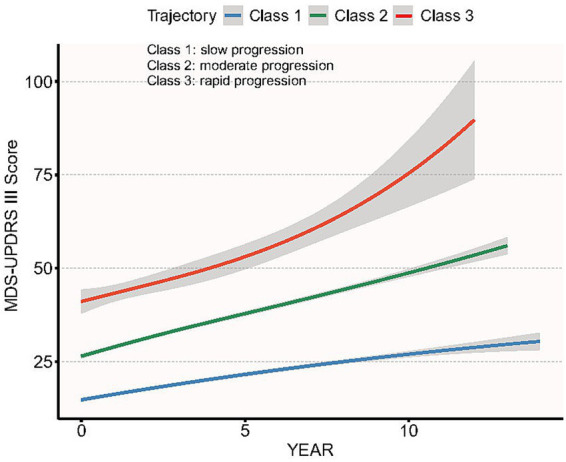
Background: Parkinson's disease (PD) exhibits significant clinical heterogeneity, particularly in motor symptom progression. This study aims to identify distinct trajectories of motor progression in PD and explore associated predictive factors.
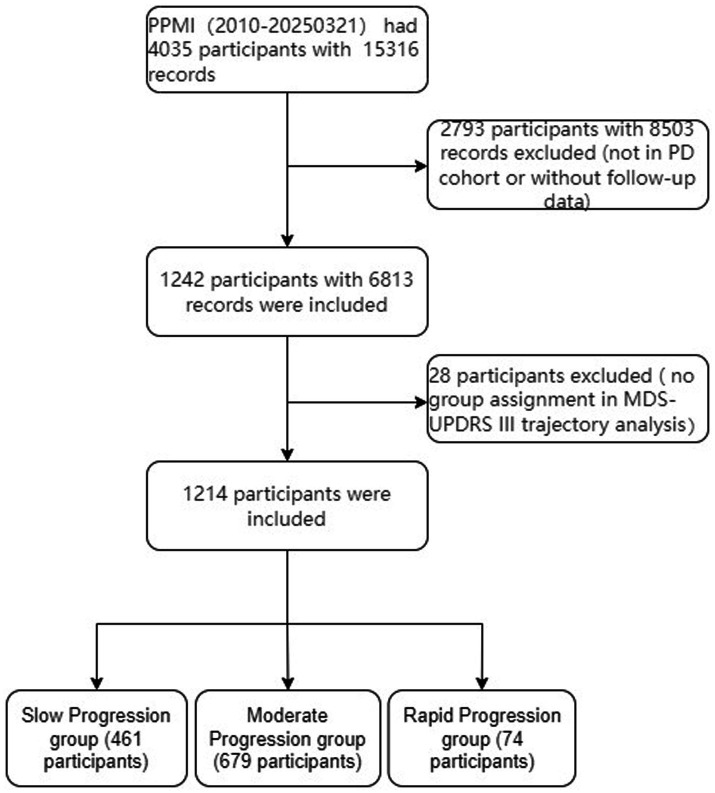
Methods: Data were obtained from the Parkinson's Progression Markers Initiative (PPMI) database on [2025-3-25]. Motor symptom severity was measured using the MDS-UPDRS III scores. Latent class trajectory analysis was used to identify distinct progression patterns. Multinomial logistic regression and machine learning models were used to evaluate predictors.
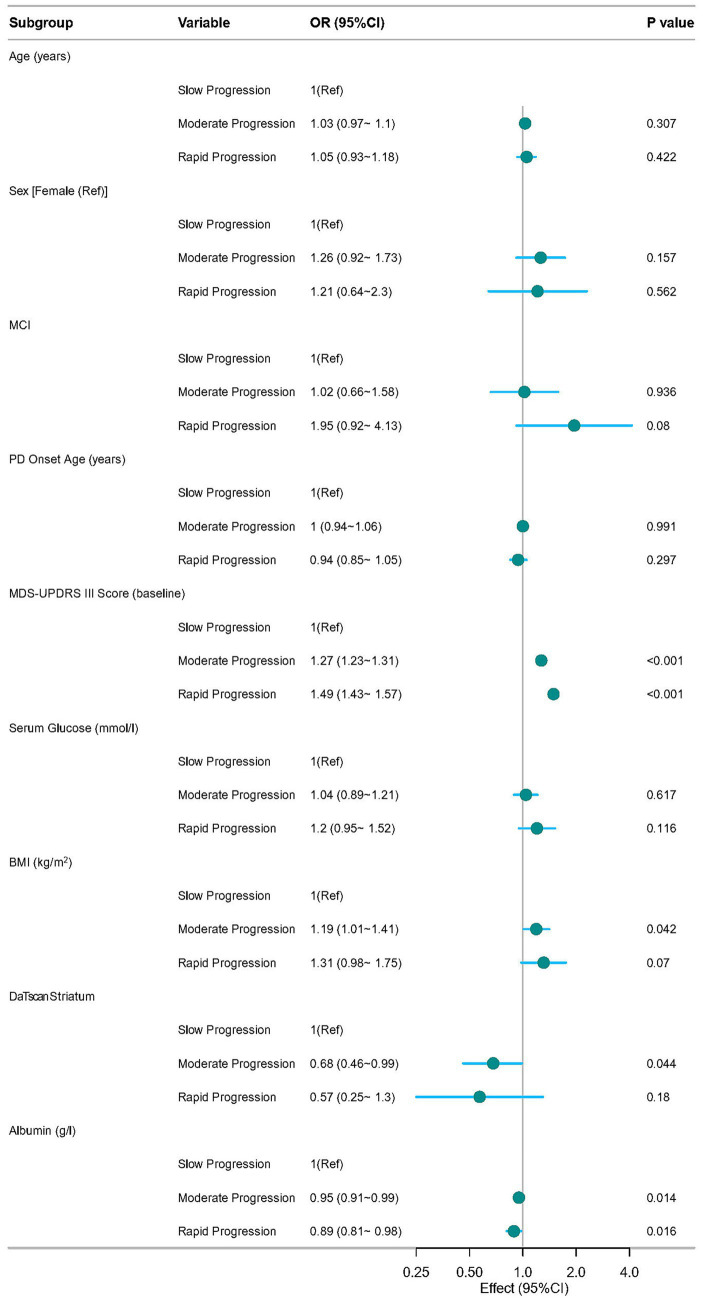
Results: Three distinct motor progression trajectories were identified: slow progression (38%), moderate progression (55.9%), and rapid progression (6.1%). Compared to the slow progression group, a higher baseline MDS-UPDRS III score was strongly associated with both moderate (OR = 1.27, 95% CI: 1.23-1.31, p < 0.001) and rapid progression (OR = 1.49, 95% CI: 1.43-1.57, p < 0.001). Lower serum albumin levels also significantly increased the likelihood of moderate (OR = 0.95, 95% CI: 0.91-0.99, p = 0.014) and rapid progression (OR = 0.89, 95% CI: 0.81-0.98, p = 0.016). Additionally, higher baseline BMI (per 5 kg/m2 increase) was associated with greater odds of moderate (OR = 1.19, 95% CI: 1.01-1.41, p = 0.042). Finally, each 1-unit lower mean striatum specific binding ratio (SBR) reduced the odds of moderate progression by 32% compared with the slow-progression group (OR = 0.68, 95% CI: 0.46-0.99, p = 0.044). Machine learning analysis confirmed the predictive importance of these factors, with the Random Forest model achieving an AUC of 0.950.
Conclusion: Baseline motor severity, dopaminergic imaging, nutritional status, and body weight are key predictors of motor progression in PD. These findings highlight the potential for early risk stratification and personalized management strategies.
期刊介绍:
Neural Technology is devoted to the convergence between neurobiology and quantum-, nano- and micro-sciences. In our vision, this interdisciplinary approach should go beyond the technological development of sophisticated methods and should contribute in generating a genuine change in our discipline.

 求助内容:
求助内容: 应助结果提醒方式:

 京公网安备 11010802042870号


