MaryJane Shimell , Robert Connacher , Sangbin Park , Aidan J. Peterson , Kavita Arora , Michael B. O'Connor
{"title":"鼩鼱是一个重要的,最近进化的,果蝇特定的基因需要形成胚胎BMP活性梯度。","authors":"MaryJane Shimell , Robert Connacher , Sangbin Park , Aidan J. Peterson , Kavita Arora , Michael B. O'Connor","doi":"10.1016/j.ydbio.2026.03.001","DOIUrl":null,"url":null,"abstract":"<div><div>Patterning the dorsal surface of the Drosophila blastoderm embryo requires the rapid redistribution of a BMP heterodimer (Decapentaplegic/Screw) from lateral regions of the embryo to the dorsal midline as cellularization is completed. BMP redistribution creates a steeply graded signal with peak activity in the mid-dorsal region and requires four additional secreted gene products: Short gastrulation (Sog), Twisted gastrulation (Tsg), Tolloid (Tld), and Shrew (Srw). While the functions of Sog, Tsg, Tld, and their vertebrate homologs, in generating BMP activity gradients have been well-described, the role of Drosophila Srw remains an enigma. Here we show that Srw encodes a secreted, N-terminally truncated paralog of Tsg that, like Tsg, stimulates the cleavage of Sog by Tld. However, unlike Tsg, it does not form a stable interaction with any identified component of the patterning machinery. Structural modeling and mutant analysis suggest Srw transiently binds to the Sog/Tsg/BMP complex to facilitate proteolysis of Sog. We further demonstrate that the requirement for Srw can be bypassed by providing additional Tsg in <em>srw</em> mutant embryos prior to cellularization. Phylogenetic analysis suggests that Tsg and Srw emerged from separate duplications of the Crossveinless (Cv) paralog in higher Diptera, and then Drosophilid lineages respectively, thus providing components for progressive specialization of insect embryo patterning. Taking into consideration our genetic, biochemical and phylogenetic data, we present three possible mechanistic models for how Srw might accelerate Sog cleavage by Tld, to hasten BMP gradient formation in rapidly developing Drosophila embryos.</div></div>","PeriodicalId":11070,"journal":{"name":"Developmental biology","volume":"534 ","pages":"Pages 9-22"},"PeriodicalIF":2.1000,"publicationDate":"2026-06-01","publicationTypes":"Journal Article","fieldsOfStudy":null,"isOpenAccess":false,"openAccessPdf":"","citationCount":"0","resultStr":"{\"title\":\"Shrew is an essential, recently evolved, Drosophila specific gene required for formation of the embryonic BMP activity gradient\",\"authors\":\"MaryJane Shimell , Robert Connacher , Sangbin Park , Aidan J. Peterson , Kavita Arora , Michael B. O'Connor\",\"doi\":\"10.1016/j.ydbio.2026.03.001\",\"DOIUrl\":null,\"url\":null,\"abstract\":\"<div><div>Patterning the dorsal surface of the Drosophila blastoderm embryo requires the rapid redistribution of a BMP heterodimer (Decapentaplegic/Screw) from lateral regions of the embryo to the dorsal midline as cellularization is completed. BMP redistribution creates a steeply graded signal with peak activity in the mid-dorsal region and requires four additional secreted gene products: Short gastrulation (Sog), Twisted gastrulation (Tsg), Tolloid (Tld), and Shrew (Srw). While the functions of Sog, Tsg, Tld, and their vertebrate homologs, in generating BMP activity gradients have been well-described, the role of Drosophila Srw remains an enigma. Here we show that Srw encodes a secreted, N-terminally truncated paralog of Tsg that, like Tsg, stimulates the cleavage of Sog by Tld. However, unlike Tsg, it does not form a stable interaction with any identified component of the patterning machinery. Structural modeling and mutant analysis suggest Srw transiently binds to the Sog/Tsg/BMP complex to facilitate proteolysis of Sog. We further demonstrate that the requirement for Srw can be bypassed by providing additional Tsg in <em>srw</em> mutant embryos prior to cellularization. Phylogenetic analysis suggests that Tsg and Srw emerged from separate duplications of the Crossveinless (Cv) paralog in higher Diptera, and then Drosophilid lineages respectively, thus providing components for progressive specialization of insect embryo patterning. Taking into consideration our genetic, biochemical and phylogenetic data, we present three possible mechanistic models for how Srw might accelerate Sog cleavage by Tld, to hasten BMP gradient formation in rapidly developing Drosophila embryos.</div></div>\",\"PeriodicalId\":11070,\"journal\":{\"name\":\"Developmental biology\",\"volume\":\"534 \",\"pages\":\"Pages 9-22\"},\"PeriodicalIF\":2.1000,\"publicationDate\":\"2026-06-01\",\"publicationTypes\":\"Journal Article\",\"fieldsOfStudy\":null,\"isOpenAccess\":false,\"openAccessPdf\":\"\",\"citationCount\":\"0\",\"resultStr\":null,\"platform\":\"Semanticscholar\",\"paperid\":null,\"PeriodicalName\":\"Developmental biology\",\"FirstCategoryId\":\"99\",\"ListUrlMain\":\"https://www.sciencedirect.com/science/article/pii/S0012160626000497\",\"RegionNum\":3,\"RegionCategory\":\"生物学\",\"ArticlePicture\":[],\"TitleCN\":null,\"AbstractTextCN\":null,\"PMCID\":null,\"EPubDate\":\"2026/3/4 0:00:00\",\"PubModel\":\"Epub\",\"JCR\":\"Q2\",\"JCRName\":\"DEVELOPMENTAL BIOLOGY\",\"Score\":null,\"Total\":0}","platform":"Semanticscholar","paperid":null,"PeriodicalName":"Developmental biology","FirstCategoryId":"99","ListUrlMain":"https://www.sciencedirect.com/science/article/pii/S0012160626000497","RegionNum":3,"RegionCategory":"生物学","ArticlePicture":[],"TitleCN":null,"AbstractTextCN":null,"PMCID":null,"EPubDate":"2026/3/4 0:00:00","PubModel":"Epub","JCR":"Q2","JCRName":"DEVELOPMENTAL BIOLOGY","Score":null,"Total":0}
Shrew is an essential, recently evolved, Drosophila specific gene required for formation of the embryonic BMP activity gradient
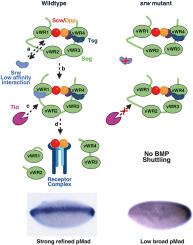
Patterning the dorsal surface of the Drosophila blastoderm embryo requires the rapid redistribution of a BMP heterodimer (Decapentaplegic/Screw) from lateral regions of the embryo to the dorsal midline as cellularization is completed. BMP redistribution creates a steeply graded signal with peak activity in the mid-dorsal region and requires four additional secreted gene products: Short gastrulation (Sog), Twisted gastrulation (Tsg), Tolloid (Tld), and Shrew (Srw). While the functions of Sog, Tsg, Tld, and their vertebrate homologs, in generating BMP activity gradients have been well-described, the role of Drosophila Srw remains an enigma. Here we show that Srw encodes a secreted, N-terminally truncated paralog of Tsg that, like Tsg, stimulates the cleavage of Sog by Tld. However, unlike Tsg, it does not form a stable interaction with any identified component of the patterning machinery. Structural modeling and mutant analysis suggest Srw transiently binds to the Sog/Tsg/BMP complex to facilitate proteolysis of Sog. We further demonstrate that the requirement for Srw can be bypassed by providing additional Tsg in srw mutant embryos prior to cellularization. Phylogenetic analysis suggests that Tsg and Srw emerged from separate duplications of the Crossveinless (Cv) paralog in higher Diptera, and then Drosophilid lineages respectively, thus providing components for progressive specialization of insect embryo patterning. Taking into consideration our genetic, biochemical and phylogenetic data, we present three possible mechanistic models for how Srw might accelerate Sog cleavage by Tld, to hasten BMP gradient formation in rapidly developing Drosophila embryos.
期刊介绍:
Developmental Biology (DB) publishes original research on mechanisms of development, differentiation, and growth in animals and plants at the molecular, cellular, genetic and evolutionary levels. Areas of particular emphasis include transcriptional control mechanisms, embryonic patterning, cell-cell interactions, growth factors and signal transduction, and regulatory hierarchies in developing plants and animals.