添加必需脂肪酸和共轭亚油酸对围产期奶牛肝脏游离脂肪酸受体表达的影响。

IF 2.2
JDS communications Pub Date : 2026-03-01 Epub Date: 2025-12-13 DOI:10.3168/jdsc.2025-0867
Tainara C. Michelotti , Alyssa Imbert , Arash Veshkini , Guillaume Durand , Harald M. Hammon , Muriel Bonnet
{"title":"添加必需脂肪酸和共轭亚油酸对围产期奶牛肝脏游离脂肪酸受体表达的影响。","authors":"Tainara C. Michelotti ,&nbsp;Alyssa Imbert ,&nbsp;Arash Veshkini ,&nbsp;Guillaume Durand ,&nbsp;Harald M. Hammon ,&nbsp;Muriel Bonnet","doi":"10.3168/jdsc.2025-0867","DOIUrl":null,"url":null,"abstract":"<div><div>Free fatty acid receptors (FFAR) are molecular sensors involved in the regulation of energy metabolism. Free fatty acid receptors are expressed in the bovine liver, although their biological functions are not fully understood. Our objectives were to study the expression of hepatic FFAR in periparturient dairy cows supplemented or not with a mixture of essential fatty acids (EFA) and CLA, and to investigate potential associations between FFAR and metabolic adaptation during the transition period. Multiparous Holstein cows received abomasal infusions of either coconut oil (control; n = 8) or a mixture of EFA and CLA (EFACLA; n = 8) from −9 to 9 wk relative to parturition. Liver samples were collected at −3, 0, 4, and 9 wk relative to parturition. We quantified the liver expression of FFAR (<em>FFAR1</em>–<em>4</em> and <em>GPR84</em>) and peroxisome proliferator-activated receptor delta (<em>PPARD</em>) by real-time quantitative PCR. Repeated-measurement correlations and multilevel multiple factor analysis (MFA) were used to investigate the links between FFAR and other metabolic parameters (i.e., energy balance, blood metabolic indicators, liver proteomics, and liver gene expression). All targeted FFAR were expressed in the liver, except for <em>FFAR4</em>. We found no effects of EFACLA or interactions with time for the expressed FFAR. <em>FFAR1</em>, <em>FFAR2</em>, and <em>GPR84</em> expression decreased from −3 to 9 wk relative to parturition, whereas <em>FFAR3</em> remained constant from −3 to 4 wk, then decreased at 9 wk postpartum. We observed strong correlations between FFAR, and moderate correlations between FFAR and <em>PPARD.</em> Multivariate (MFA) and univariate (correlation) analyses revealed weak links between FFAR liver expression and other metabolic parameters (e.g., <em>IGFBP3</em> liver expression and plasma IGFBP-2). Downregulation of FFAR in the liver from pre- to postpartum may prevent receptors hyperactivation during periods of high free fatty acid concentrations. Physiological relevance and individual contributions of FFAR to the hepatic metabolism require further investigation.</div></div>","PeriodicalId":94061,"journal":{"name":"JDS communications","volume":"7 2","pages":"Pages 278-283"},"PeriodicalIF":2.2000,"publicationDate":"2026-03-01","publicationTypes":"Journal Article","fieldsOfStudy":null,"isOpenAccess":false,"openAccessPdf":"","citationCount":"0","resultStr":"{\"title\":\"Expression of free fatty acid receptors in the liver of periparturient dairy cows supplemented with essential fatty acids and conjugated linoleic acid\",\"authors\":\"Tainara C. Michelotti ,&nbsp;Alyssa Imbert ,&nbsp;Arash Veshkini ,&nbsp;Guillaume Durand ,&nbsp;Harald M. Hammon ,&nbsp;Muriel Bonnet\",\"doi\":\"10.3168/jdsc.2025-0867\",\"DOIUrl\":null,\"url\":null,\"abstract\":\"<div><div>Free fatty acid receptors (FFAR) are molecular sensors involved in the regulation of energy metabolism. Free fatty acid receptors are expressed in the bovine liver, although their biological functions are not fully understood. Our objectives were to study the expression of hepatic FFAR in periparturient dairy cows supplemented or not with a mixture of essential fatty acids (EFA) and CLA, and to investigate potential associations between FFAR and metabolic adaptation during the transition period. Multiparous Holstein cows received abomasal infusions of either coconut oil (control; n = 8) or a mixture of EFA and CLA (EFACLA; n = 8) from −9 to 9 wk relative to parturition. Liver samples were collected at −3, 0, 4, and 9 wk relative to parturition. We quantified the liver expression of FFAR (<em>FFAR1</em>–<em>4</em> and <em>GPR84</em>) and peroxisome proliferator-activated receptor delta (<em>PPARD</em>) by real-time quantitative PCR. Repeated-measurement correlations and multilevel multiple factor analysis (MFA) were used to investigate the links between FFAR and other metabolic parameters (i.e., energy balance, blood metabolic indicators, liver proteomics, and liver gene expression). All targeted FFAR were expressed in the liver, except for <em>FFAR4</em>. We found no effects of EFACLA or interactions with time for the expressed FFAR. <em>FFAR1</em>, <em>FFAR2</em>, and <em>GPR84</em> expression decreased from −3 to 9 wk relative to parturition, whereas <em>FFAR3</em> remained constant from −3 to 4 wk, then decreased at 9 wk postpartum. We observed strong correlations between FFAR, and moderate correlations between FFAR and <em>PPARD.</em> Multivariate (MFA) and univariate (correlation) analyses revealed weak links between FFAR liver expression and other metabolic parameters (e.g., <em>IGFBP3</em> liver expression and plasma IGFBP-2). Downregulation of FFAR in the liver from pre- to postpartum may prevent receptors hyperactivation during periods of high free fatty acid concentrations. Physiological relevance and individual contributions of FFAR to the hepatic metabolism require further investigation.</div></div>\",\"PeriodicalId\":94061,\"journal\":{\"name\":\"JDS communications\",\"volume\":\"7 2\",\"pages\":\"Pages 278-283\"},\"PeriodicalIF\":2.2000,\"publicationDate\":\"2026-03-01\",\"publicationTypes\":\"Journal Article\",\"fieldsOfStudy\":null,\"isOpenAccess\":false,\"openAccessPdf\":\"\",\"citationCount\":\"0\",\"resultStr\":null,\"platform\":\"Semanticscholar\",\"paperid\":null,\"PeriodicalName\":\"JDS communications\",\"FirstCategoryId\":\"1085\",\"ListUrlMain\":\"https://www.sciencedirect.com/science/article/pii/S2666910225002352\",\"RegionNum\":0,\"RegionCategory\":null,\"ArticlePicture\":[],\"TitleCN\":null,\"AbstractTextCN\":null,\"PMCID\":null,\"EPubDate\":\"2025/12/13 0:00:00\",\"PubModel\":\"Epub\",\"JCR\":\"\",\"JCRName\":\"\",\"Score\":null,\"Total\":0}","platform":"Semanticscholar","paperid":null,"PeriodicalName":"JDS communications","FirstCategoryId":"1085","ListUrlMain":"https://www.sciencedirect.com/science/article/pii/S2666910225002352","RegionNum":0,"RegionCategory":null,"ArticlePicture":[],"TitleCN":null,"AbstractTextCN":null,"PMCID":null,"EPubDate":"2025/12/13 0:00:00","PubModel":"Epub","JCR":"","JCRName":"","Score":null,"Total":0}
引用次数: 0

摘要

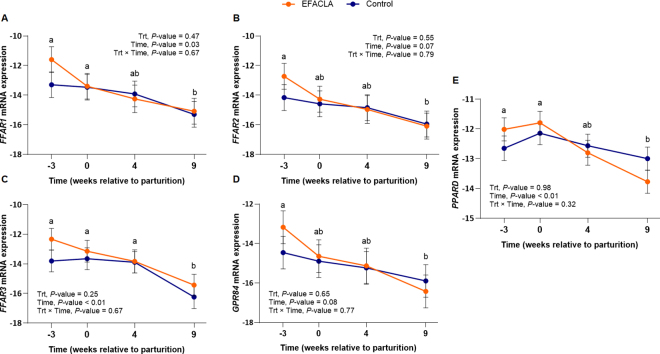
游离脂肪酸受体(FFAR)是参与调节能量代谢的分子传感器。游离脂肪酸受体在牛肝脏中表达,但其生物学功能尚不完全清楚。本研究的目的是研究饲粮中添加或不添加必需脂肪酸(EFA)和CLA混合物的围产期奶牛肝脏FFAR的表达,并探讨FFAR与过渡期代谢适应之间的潜在关联。在分娩后的-9至9周内,对多产荷斯坦奶牛进行了椰子油(对照,n = 8)或EFA和CLA混合物(EFACLA, n = 8)的鼻灌胃。在相对于分娩的3、0、4和9周采集肝脏样本。我们通过实时定量PCR定量了肝脏中FFAR (FFAR1-4和GPR84)和过氧化物酶体增殖物激活受体(PPARD)的表达。使用重复测量相关性和多水平多因素分析(MFA)来研究FFAR与其他代谢参数(即能量平衡、血液代谢指标、肝脏蛋白质组学和肝脏基因表达)之间的联系。除FFAR4外,所有靶向FFAR均在肝脏中表达。我们发现EFACLA或与时间的相互作用对表达的FFAR没有影响。相对于分娩,FFAR1、FFAR2和GPR84的表达在产后-3至9周下降,而FFAR3在产后-3至4周保持不变,然后在产后9周下降。我们观察到FFAR与PPARD之间存在强相关性,而FFAR与PPARD之间存在中度相关性。多变量(MFA)和单变量(相关性)分析显示,FFAR肝脏表达与其他代谢参数(如IGFBP3肝脏表达和血浆IGFBP-2)之间存在弱联系。从产前到产后肝脏中FFAR的下调可能会在高游离脂肪酸浓度期间防止受体过度激活。FFAR与肝脏代谢的生理相关性和个体贡献有待进一步研究。
本文章由计算机程序翻译,如有差异,请以英文原文为准。

Expression of free fatty acid receptors in the liver of periparturient dairy cows supplemented with essential fatty acids and conjugated linoleic acid

Expression of free fatty acid receptors in the liver of periparturient dairy cows supplemented with essential fatty acids and conjugated linoleic acid

Expression of free fatty acid receptors in the liver of periparturient dairy cows supplemented with essential fatty acids and conjugated linoleic acid

Expression of free fatty acid receptors in the liver of periparturient dairy cows supplemented with essential fatty acids and conjugated linoleic acid
Free fatty acid receptors (FFAR) are molecular sensors involved in the regulation of energy metabolism. Free fatty acid receptors are expressed in the bovine liver, although their biological functions are not fully understood. Our objectives were to study the expression of hepatic FFAR in periparturient dairy cows supplemented or not with a mixture of essential fatty acids (EFA) and CLA, and to investigate potential associations between FFAR and metabolic adaptation during the transition period. Multiparous Holstein cows received abomasal infusions of either coconut oil (control; n = 8) or a mixture of EFA and CLA (EFACLA; n = 8) from −9 to 9 wk relative to parturition. Liver samples were collected at −3, 0, 4, and 9 wk relative to parturition. We quantified the liver expression of FFAR (FFAR14 and GPR84) and peroxisome proliferator-activated receptor delta (PPARD) by real-time quantitative PCR. Repeated-measurement correlations and multilevel multiple factor analysis (MFA) were used to investigate the links between FFAR and other metabolic parameters (i.e., energy balance, blood metabolic indicators, liver proteomics, and liver gene expression). All targeted FFAR were expressed in the liver, except for FFAR4. We found no effects of EFACLA or interactions with time for the expressed FFAR. FFAR1, FFAR2, and GPR84 expression decreased from −3 to 9 wk relative to parturition, whereas FFAR3 remained constant from −3 to 4 wk, then decreased at 9 wk postpartum. We observed strong correlations between FFAR, and moderate correlations between FFAR and PPARD. Multivariate (MFA) and univariate (correlation) analyses revealed weak links between FFAR liver expression and other metabolic parameters (e.g., IGFBP3 liver expression and plasma IGFBP-2). Downregulation of FFAR in the liver from pre- to postpartum may prevent receptors hyperactivation during periods of high free fatty acid concentrations. Physiological relevance and individual contributions of FFAR to the hepatic metabolism require further investigation.
求助全文
通过发布文献求助,成功后即可免费获取论文全文。 去求助
来源期刊
JDS communications
JDS communications Animal Science and Zoology
CiteScore
2.00
自引率
0.00%
发文量
0
×
引用
GB/T 7714-2015
复制
MLA
复制
APA
复制
导出至
BibTeX EndNote RefMan NoteFirst NoteExpress
×
提示
您的信息不完整,为了账户安全,请先补充。
现在去补充
×
提示
您因"违规操作"
具体请查看互助需知
我知道了
×
提示
确定
请完成安全验证×
copy
已复制链接
快去分享给好友吧!
我知道了
右上角分享
点击右上角分享
0
联系我们:info@booksci.cn Book学术提供免费学术资源搜索服务,方便国内外学者检索中英文文献。致力于提供最便捷和优质的服务体验。 Copyright © 2023 布克学术 All rights reserved.
京ICP备2023020795号-1
ghs 京公网安备 11010802042870号
Book学术文献互助
Book学术文献互助群
群 号:604180095
Book学术官方微信
小红书