{"title":"饲粮中添加橄榄叶多酚可提高褐飞蛾(Oncorhynchus mykiss)的生长、免疫血液学指标、抗氧化能力、免疫和紧密连接基因表达以及氨胁迫耐受性。","authors":"Rudabeh Rufchaei , Seyed Hossein Hoseinifar , Mojtaba Pourahad Anzabi , Roghieh Safari , Mohammad Sayad Bourani , Mohadeseh Ahmadnezhad , Mohammad Sadegh Aramli","doi":"10.1016/j.cbpb.2026.111221","DOIUrl":null,"url":null,"abstract":"<div><div>Over an eight-week feeding trial, this work evaluated the effects of olive leaf derived polyphenols (OLP) (<em>Olea europaea</em> L.) on growth performance, humoral and mucosal immune parameters, hematological and antioxidant status, the expression of immunity- and tight junction-related genes and resistance to ammonia stress in rainbow trout (<em>Oncorhynchus mykiss</em>). A total of 120 fish (average initial weight: 6.5 ± 0.1 g) were randomly assigned to four dietary treatments containing graded OLP levels of 0 (control), 0.5, 1, and 2 g kg<sup>−1</sup>. OLP supplementation significantly improved growth parameters, including final weight, weight gain, specific growth rate, and feed conversion ratio (<em>P</em> < 0.05). Serum and mucosal immune factors (immunoglobulin and lysozyme) were significantly enhanced in fish fed 1 and 2 g kg<sup>−1</sup> OLP diets. Hematological indices increased at all OLP inclusion levels (<em>P</em> < 0.05). Moreover, elevated antioxidant enzyme activities were observed in fish fed OLP. Gene expression analysis revealed significant upregulation of immune-related genes (interleukin-1 beta and tumor necrosis factor alpha) and tight junction-associated genes (claudin-12, occludin, and zonula occludens) in fish fed 1 and 2 g kg<sup>−1</sup> OLP diets. Following ammonia exposure, OLP-fed groups demonstrated elevated hematological and antioxidant responses, and the 2 g kg<sup>−1</sup> OLP group achieved the highest post-stress survival rate. Overall, supplementation with 1–2 g kg<sup>−1</sup> OLP effectively enhanced growth, immunity, antioxidant capacity, and stress tolerance in rainbow trout, suggesting that OLP may serve as a promising natural dietary additive for improving fish health and performance.</div></div>","PeriodicalId":55236,"journal":{"name":"Comparative Biochemistry and Physiology B-Biochemistry & Molecular Biology","volume":"284 ","pages":"Article 111221"},"PeriodicalIF":2.5000,"publicationDate":"2026-06-01","publicationTypes":"Journal Article","fieldsOfStudy":null,"isOpenAccess":false,"openAccessPdf":"","citationCount":"0","resultStr":"{\"title\":\"Dietary olive leaf polyphenols enhance growth, immuno-hematological parameters, antioxidant capacity, immune and tight junction gene expression, and ammonia stress tolerance in Oncorhynchus mykiss\",\"authors\":\"Rudabeh Rufchaei , Seyed Hossein Hoseinifar , Mojtaba Pourahad Anzabi , Roghieh Safari , Mohammad Sayad Bourani , Mohadeseh Ahmadnezhad , Mohammad Sadegh Aramli\",\"doi\":\"10.1016/j.cbpb.2026.111221\",\"DOIUrl\":null,\"url\":null,\"abstract\":\"<div><div>Over an eight-week feeding trial, this work evaluated the effects of olive leaf derived polyphenols (OLP) (<em>Olea europaea</em> L.) on growth performance, humoral and mucosal immune parameters, hematological and antioxidant status, the expression of immunity- and tight junction-related genes and resistance to ammonia stress in rainbow trout (<em>Oncorhynchus mykiss</em>). A total of 120 fish (average initial weight: 6.5 ± 0.1 g) were randomly assigned to four dietary treatments containing graded OLP levels of 0 (control), 0.5, 1, and 2 g kg<sup>−1</sup>. OLP supplementation significantly improved growth parameters, including final weight, weight gain, specific growth rate, and feed conversion ratio (<em>P</em> < 0.05). Serum and mucosal immune factors (immunoglobulin and lysozyme) were significantly enhanced in fish fed 1 and 2 g kg<sup>−1</sup> OLP diets. Hematological indices increased at all OLP inclusion levels (<em>P</em> < 0.05). Moreover, elevated antioxidant enzyme activities were observed in fish fed OLP. Gene expression analysis revealed significant upregulation of immune-related genes (interleukin-1 beta and tumor necrosis factor alpha) and tight junction-associated genes (claudin-12, occludin, and zonula occludens) in fish fed 1 and 2 g kg<sup>−1</sup> OLP diets. Following ammonia exposure, OLP-fed groups demonstrated elevated hematological and antioxidant responses, and the 2 g kg<sup>−1</sup> OLP group achieved the highest post-stress survival rate. Overall, supplementation with 1–2 g kg<sup>−1</sup> OLP effectively enhanced growth, immunity, antioxidant capacity, and stress tolerance in rainbow trout, suggesting that OLP may serve as a promising natural dietary additive for improving fish health and performance.</div></div>\",\"PeriodicalId\":55236,\"journal\":{\"name\":\"Comparative Biochemistry and Physiology B-Biochemistry & Molecular Biology\",\"volume\":\"284 \",\"pages\":\"Article 111221\"},\"PeriodicalIF\":2.5000,\"publicationDate\":\"2026-06-01\",\"publicationTypes\":\"Journal Article\",\"fieldsOfStudy\":null,\"isOpenAccess\":false,\"openAccessPdf\":\"\",\"citationCount\":\"0\",\"resultStr\":null,\"platform\":\"Semanticscholar\",\"paperid\":null,\"PeriodicalName\":\"Comparative Biochemistry and Physiology B-Biochemistry & Molecular Biology\",\"FirstCategoryId\":\"99\",\"ListUrlMain\":\"https://www.sciencedirect.com/science/article/pii/S1096495926000291\",\"RegionNum\":3,\"RegionCategory\":\"生物学\",\"ArticlePicture\":[],\"TitleCN\":null,\"AbstractTextCN\":null,\"PMCID\":null,\"EPubDate\":\"2026/3/3 0:00:00\",\"PubModel\":\"Epub\",\"JCR\":\"Q4\",\"JCRName\":\"BIOCHEMISTRY & MOLECULAR BIOLOGY\",\"Score\":null,\"Total\":0}","platform":"Semanticscholar","paperid":null,"PeriodicalName":"Comparative Biochemistry and Physiology B-Biochemistry & Molecular Biology","FirstCategoryId":"99","ListUrlMain":"https://www.sciencedirect.com/science/article/pii/S1096495926000291","RegionNum":3,"RegionCategory":"生物学","ArticlePicture":[],"TitleCN":null,"AbstractTextCN":null,"PMCID":null,"EPubDate":"2026/3/3 0:00:00","PubModel":"Epub","JCR":"Q4","JCRName":"BIOCHEMISTRY & MOLECULAR BIOLOGY","Score":null,"Total":0}
引用次数: 0
摘要
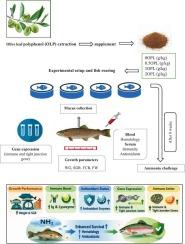
在为期8周的饲养试验中,本研究评估了橄榄叶衍生多酚(OLP)对虹鳟鱼生长性能、体液和粘膜免疫参数、血液学和抗氧化状态、免疫和紧密连接相关基因表达以及对氨胁迫的抗性的影响。试验选取120尾鱼(初始平均体重为6.5 ± 0.1 g),随机分为4组,OLP水平分别为0(对照)、0.5、1和2 g kg-1。添加OLP显著提高了饲粮的生长参数,包括末重、增重、特定生长率和饲料系数(P -1)。所有OLP添加水平的血液学指标均升高(P -1 OLP饲料)。在氨暴露后,OLP喂养组表现出血液和抗氧化反应升高,2 g kg-1 OLP组达到了最高的应激后存活率。总体而言,添加1-2 g kg-1的OLP可有效促进虹鳟鱼的生长、免疫、抗氧化能力和应激耐受性,表明OLP可能是一种有前景的天然饲料添加剂,可改善鱼类健康和生产性能。
Dietary olive leaf polyphenols enhance growth, immuno-hematological parameters, antioxidant capacity, immune and tight junction gene expression, and ammonia stress tolerance in Oncorhynchus mykiss
Over an eight-week feeding trial, this work evaluated the effects of olive leaf derived polyphenols (OLP) (Olea europaea L.) on growth performance, humoral and mucosal immune parameters, hematological and antioxidant status, the expression of immunity- and tight junction-related genes and resistance to ammonia stress in rainbow trout (Oncorhynchus mykiss). A total of 120 fish (average initial weight: 6.5 ± 0.1 g) were randomly assigned to four dietary treatments containing graded OLP levels of 0 (control), 0.5, 1, and 2 g kg−1. OLP supplementation significantly improved growth parameters, including final weight, weight gain, specific growth rate, and feed conversion ratio (P < 0.05). Serum and mucosal immune factors (immunoglobulin and lysozyme) were significantly enhanced in fish fed 1 and 2 g kg−1 OLP diets. Hematological indices increased at all OLP inclusion levels (P < 0.05). Moreover, elevated antioxidant enzyme activities were observed in fish fed OLP. Gene expression analysis revealed significant upregulation of immune-related genes (interleukin-1 beta and tumor necrosis factor alpha) and tight junction-associated genes (claudin-12, occludin, and zonula occludens) in fish fed 1 and 2 g kg−1 OLP diets. Following ammonia exposure, OLP-fed groups demonstrated elevated hematological and antioxidant responses, and the 2 g kg−1 OLP group achieved the highest post-stress survival rate. Overall, supplementation with 1–2 g kg−1 OLP effectively enhanced growth, immunity, antioxidant capacity, and stress tolerance in rainbow trout, suggesting that OLP may serve as a promising natural dietary additive for improving fish health and performance.
期刊介绍:
Comparative Biochemistry & Physiology (CBP) publishes papers in comparative, environmental and evolutionary physiology.
Part B: Biochemical and Molecular Biology (CBPB), focuses on biochemical physiology, primarily bioenergetics/energy metabolism, cell biology, cellular stress responses, enzymology, intermediary metabolism, macromolecular structure and function, gene regulation, evolutionary genetics. Most studies focus on biochemical or molecular analyses that have clear ramifications for physiological processes.