{"title":"以PEG2k为限制生长剂的α‑Fe2O3/Fe3O4磁性非均相纳米棒的制备与表征","authors":"Zhongjun Pan, Wuzhuofei Luo, Zishu Zhou, Ruiping Chen, Tiebin Wan, Zhixiang Lv","doi":"10.1186/s11671-026-04490-0","DOIUrl":null,"url":null,"abstract":"<div><p>For realizing the control of the preparation process for α-Fe<sub>2</sub>O<sub>3</sub>/Fe<sub>3</sub>O<sub>4</sub> magnetic heterogeneous nanorods (MHNRs), the influence rules of key factors on the preparations of β-FeOOH nanorods (NRs) and α-Fe<sub>2</sub>O<sub>3</sub>/Fe<sub>3</sub>O<sub>4</sub> MHNRs were revealed. Firstly, β-FeOOH nanorods (NRs) were fabricated with polyethylene glycol 2000 (PEG<sub>2k</sub>) as the growth inhibitor in specific directions via the hydrolysis process, for smaller size, the fabrication conditions for β-FeOOH NRs including Fe<sup>3+</sup> concentration, PEG<sub>2k</sub> volume, hydrolytic temperature, and hydrolytic duration were optimized, and the optimal conditions were selected as 0.02 M of Fe<sup>3+</sup>, 0.20 g/L of PEG<sub>2k</sub>, 80 °C of hydrolytic temperature, and 2 h of hydrolytic duration, the β-FeOOH NRs with average length and diameter of 199 nm and 55 nm were obtained. Secondly, α-Fe<sub>2</sub>O<sub>3</sub>/Fe<sub>3</sub>O<sub>4</sub> magnetic heterogeneous nanorods (MHNRs) were prepared with PEG<sub>2k</sub> as the reductant via the calcination-reduction process. For larger saturation magnetization (Ms) of α-Fe<sub>2</sub>O<sub>3</sub>/Fe<sub>3</sub>O<sub>4</sub> MHNRs, the mass ratio of PEG<sub>2k</sub> and β-FeOOH NRs, calcination temperature, and calcination time were investigated as were 3:1, 450 °C, and 2 h, respectively. And α-Fe<sub>2</sub>O<sub>3</sub>/Fe<sub>3</sub>O<sub>4</sub> MHNRs with the average length of 229 nm, average diameter of 55 nm, and Ms of 81.3 emu/g were obtained. The novel and facile preparation process for α-Fe<sub>2</sub>O<sub>3</sub>/Fe<sub>3</sub>O<sub>4</sub> MHNRs shortened the preparation period, omitted the reduction process using hydrogen enhancing the preparation security, and relized the controlled particle size and properties, there were not heavy metal elements in the nanosystem, laying the groundwork for the biomedical applications of α-Fe<sub>2</sub>O<sub>3</sub>/Fe<sub>3</sub>O<sub>4</sub> MHNRs.</p><h3>Graphical abstract</h3><div><figure><div><div><picture><img></picture></div></div></figure></div></div>","PeriodicalId":51136,"journal":{"name":"Nanoscale Research Letters","volume":"21 1","pages":""},"PeriodicalIF":4.1000,"publicationDate":"2026-03-07","publicationTypes":"Journal Article","fieldsOfStudy":null,"isOpenAccess":false,"openAccessPdf":"https://link.springer.com/content/pdf/10.1186/s11671-026-04490-0.pdf","citationCount":"0","resultStr":"{\"title\":\"Fabrication and characterization of α‑Fe2O3/Fe3O4 magnetic heterogeneous nanorods with PEG2k as restricted growth agent\",\"authors\":\"Zhongjun Pan, Wuzhuofei Luo, Zishu Zhou, Ruiping Chen, Tiebin Wan, Zhixiang Lv\",\"doi\":\"10.1186/s11671-026-04490-0\",\"DOIUrl\":null,\"url\":null,\"abstract\":\"<div><p>For realizing the control of the preparation process for α-Fe<sub>2</sub>O<sub>3</sub>/Fe<sub>3</sub>O<sub>4</sub> magnetic heterogeneous nanorods (MHNRs), the influence rules of key factors on the preparations of β-FeOOH nanorods (NRs) and α-Fe<sub>2</sub>O<sub>3</sub>/Fe<sub>3</sub>O<sub>4</sub> MHNRs were revealed. Firstly, β-FeOOH nanorods (NRs) were fabricated with polyethylene glycol 2000 (PEG<sub>2k</sub>) as the growth inhibitor in specific directions via the hydrolysis process, for smaller size, the fabrication conditions for β-FeOOH NRs including Fe<sup>3+</sup> concentration, PEG<sub>2k</sub> volume, hydrolytic temperature, and hydrolytic duration were optimized, and the optimal conditions were selected as 0.02 M of Fe<sup>3+</sup>, 0.20 g/L of PEG<sub>2k</sub>, 80 °C of hydrolytic temperature, and 2 h of hydrolytic duration, the β-FeOOH NRs with average length and diameter of 199 nm and 55 nm were obtained. Secondly, α-Fe<sub>2</sub>O<sub>3</sub>/Fe<sub>3</sub>O<sub>4</sub> magnetic heterogeneous nanorods (MHNRs) were prepared with PEG<sub>2k</sub> as the reductant via the calcination-reduction process. For larger saturation magnetization (Ms) of α-Fe<sub>2</sub>O<sub>3</sub>/Fe<sub>3</sub>O<sub>4</sub> MHNRs, the mass ratio of PEG<sub>2k</sub> and β-FeOOH NRs, calcination temperature, and calcination time were investigated as were 3:1, 450 °C, and 2 h, respectively. And α-Fe<sub>2</sub>O<sub>3</sub>/Fe<sub>3</sub>O<sub>4</sub> MHNRs with the average length of 229 nm, average diameter of 55 nm, and Ms of 81.3 emu/g were obtained. The novel and facile preparation process for α-Fe<sub>2</sub>O<sub>3</sub>/Fe<sub>3</sub>O<sub>4</sub> MHNRs shortened the preparation period, omitted the reduction process using hydrogen enhancing the preparation security, and relized the controlled particle size and properties, there were not heavy metal elements in the nanosystem, laying the groundwork for the biomedical applications of α-Fe<sub>2</sub>O<sub>3</sub>/Fe<sub>3</sub>O<sub>4</sub> MHNRs.</p><h3>Graphical abstract</h3><div><figure><div><div><picture><img></picture></div></div></figure></div></div>\",\"PeriodicalId\":51136,\"journal\":{\"name\":\"Nanoscale Research Letters\",\"volume\":\"21 1\",\"pages\":\"\"},\"PeriodicalIF\":4.1000,\"publicationDate\":\"2026-03-07\",\"publicationTypes\":\"Journal Article\",\"fieldsOfStudy\":null,\"isOpenAccess\":false,\"openAccessPdf\":\"https://link.springer.com/content/pdf/10.1186/s11671-026-04490-0.pdf\",\"citationCount\":\"0\",\"resultStr\":null,\"platform\":\"Semanticscholar\",\"paperid\":null,\"PeriodicalName\":\"Nanoscale Research Letters\",\"FirstCategoryId\":\"88\",\"ListUrlMain\":\"https://link.springer.com/article/10.1186/s11671-026-04490-0\",\"RegionNum\":3,\"RegionCategory\":\"材料科学\",\"ArticlePicture\":[],\"TitleCN\":null,\"AbstractTextCN\":null,\"PMCID\":null,\"EPubDate\":\"\",\"PubModel\":\"\",\"JCR\":\"Q2\",\"JCRName\":\"MATERIALS SCIENCE, MULTIDISCIPLINARY\",\"Score\":null,\"Total\":0}","platform":"Semanticscholar","paperid":null,"PeriodicalName":"Nanoscale Research Letters","FirstCategoryId":"88","ListUrlMain":"https://link.springer.com/article/10.1186/s11671-026-04490-0","RegionNum":3,"RegionCategory":"材料科学","ArticlePicture":[],"TitleCN":null,"AbstractTextCN":null,"PMCID":null,"EPubDate":"","PubModel":"","JCR":"Q2","JCRName":"MATERIALS SCIENCE, MULTIDISCIPLINARY","Score":null,"Total":0}
Fabrication and characterization of α‑Fe2O3/Fe3O4 magnetic heterogeneous nanorods with PEG2k as restricted growth agent
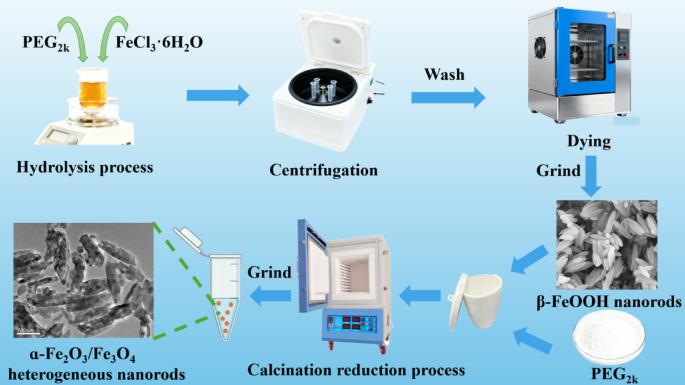
For realizing the control of the preparation process for α-Fe2O3/Fe3O4 magnetic heterogeneous nanorods (MHNRs), the influence rules of key factors on the preparations of β-FeOOH nanorods (NRs) and α-Fe2O3/Fe3O4 MHNRs were revealed. Firstly, β-FeOOH nanorods (NRs) were fabricated with polyethylene glycol 2000 (PEG2k) as the growth inhibitor in specific directions via the hydrolysis process, for smaller size, the fabrication conditions for β-FeOOH NRs including Fe3+ concentration, PEG2k volume, hydrolytic temperature, and hydrolytic duration were optimized, and the optimal conditions were selected as 0.02 M of Fe3+, 0.20 g/L of PEG2k, 80 °C of hydrolytic temperature, and 2 h of hydrolytic duration, the β-FeOOH NRs with average length and diameter of 199 nm and 55 nm were obtained. Secondly, α-Fe2O3/Fe3O4 magnetic heterogeneous nanorods (MHNRs) were prepared with PEG2k as the reductant via the calcination-reduction process. For larger saturation magnetization (Ms) of α-Fe2O3/Fe3O4 MHNRs, the mass ratio of PEG2k and β-FeOOH NRs, calcination temperature, and calcination time were investigated as were 3:1, 450 °C, and 2 h, respectively. And α-Fe2O3/Fe3O4 MHNRs with the average length of 229 nm, average diameter of 55 nm, and Ms of 81.3 emu/g were obtained. The novel and facile preparation process for α-Fe2O3/Fe3O4 MHNRs shortened the preparation period, omitted the reduction process using hydrogen enhancing the preparation security, and relized the controlled particle size and properties, there were not heavy metal elements in the nanosystem, laying the groundwork for the biomedical applications of α-Fe2O3/Fe3O4 MHNRs.
期刊介绍:
Nanoscale Research Letters (NRL) provides an interdisciplinary forum for communication of scientific and technological advances in the creation and use of objects at the nanometer scale. NRL is the first nanotechnology journal from a major publisher to be published with Open Access.


 求助内容:
求助内容: 应助结果提醒方式:

 京公网安备 11010802042870号


