Gaia Cicioni , Immacolata Iannone , Daniele Crocetti , Mariarita Tarallo , Paolo Sapienza , Giuseppe Cavallaro , Giorgio De Toma , Luigi Petramala , Claudio Letizia , Maria Irene Bellini
{"title":"肾上腺疾病的外科手术。有高等教育中心的工作经验。","authors":"Gaia Cicioni , Immacolata Iannone , Daniele Crocetti , Mariarita Tarallo , Paolo Sapienza , Giuseppe Cavallaro , Giorgio De Toma , Luigi Petramala , Claudio Letizia , Maria Irene Bellini","doi":"10.1016/j.sopen.2026.01.009","DOIUrl":null,"url":null,"abstract":"<div><h3>Introduction</h3><div>Laparoscopic adrenalectomy and robotic adrenalectomy are increasingly accepted methods for removing adrenal lesions, especially for benign conditions. This study investigated the evolution of surgical techniques and patient characteristics at a tertiary centre during the transition from open to minimally invasive surgery.</div></div><div><h3>Patients and methods</h3><div>The analysis included all adrenal surgery cases referred to our institution between January 2009 and June 2025. The following were recorded for each patient: demographics, diagnosis, surgical approach, intraoperative blood loss, histology, length of hospital stays, and complications.</div></div><div><h3>Results</h3><div>A total of 292 adrenalectomies were performed (56% female; mean age 54.5 ± 12.6 years). The left adrenal was more frequently affected (59%), and the mean tumor size was 46.8 ± 25.1 mm. Indications included primary hyperaldosteronism (37%), Cushing's syndrome (28%), pheochromocytoma (15%), adrenal cysts or myelolipomas (17%), adrenocortical carcinomas (4%), and adrenal metastases (2%). Laparoscopy was the most common approach (76%), followed by open (10%) and robotic adrenalectomy (9%); overall 7 (2%) patients required conversion to open surgery and postoperative morbidity was 7%. Minimally invasive procedures were associated with shorter operative times, less blood loss, and shorter in-hospital stays when compared to open surgery (<em>p</em> < 0.05). Robotic adrenalectomy had the lowest intraoperative blood loss, while laparoscopy had the fastest operative time.</div></div><div><h3>Conclusions</h3><div>Minimally invasive adrenalectomy is safe and effective for adrenal tumors. In our series, robotic-assisted surgery is becoming increasingly prevalent and has excellent results; however, its implementation needs to be balanced with the associated costs.</div></div>","PeriodicalId":74892,"journal":{"name":"Surgery open science","volume":"30 ","pages":"Pages 46-50"},"PeriodicalIF":1.7000,"publicationDate":"2026-03-01","publicationTypes":"Journal Article","fieldsOfStudy":null,"isOpenAccess":false,"openAccessPdf":"","citationCount":"0","resultStr":"{\"title\":\"Surgery for adrenal gland disease. Experience of a tertiary center\",\"authors\":\"Gaia Cicioni , Immacolata Iannone , Daniele Crocetti , Mariarita Tarallo , Paolo Sapienza , Giuseppe Cavallaro , Giorgio De Toma , Luigi Petramala , Claudio Letizia , Maria Irene Bellini\",\"doi\":\"10.1016/j.sopen.2026.01.009\",\"DOIUrl\":null,\"url\":null,\"abstract\":\"<div><h3>Introduction</h3><div>Laparoscopic adrenalectomy and robotic adrenalectomy are increasingly accepted methods for removing adrenal lesions, especially for benign conditions. This study investigated the evolution of surgical techniques and patient characteristics at a tertiary centre during the transition from open to minimally invasive surgery.</div></div><div><h3>Patients and methods</h3><div>The analysis included all adrenal surgery cases referred to our institution between January 2009 and June 2025. The following were recorded for each patient: demographics, diagnosis, surgical approach, intraoperative blood loss, histology, length of hospital stays, and complications.</div></div><div><h3>Results</h3><div>A total of 292 adrenalectomies were performed (56% female; mean age 54.5 ± 12.6 years). The left adrenal was more frequently affected (59%), and the mean tumor size was 46.8 ± 25.1 mm. Indications included primary hyperaldosteronism (37%), Cushing's syndrome (28%), pheochromocytoma (15%), adrenal cysts or myelolipomas (17%), adrenocortical carcinomas (4%), and adrenal metastases (2%). Laparoscopy was the most common approach (76%), followed by open (10%) and robotic adrenalectomy (9%); overall 7 (2%) patients required conversion to open surgery and postoperative morbidity was 7%. Minimally invasive procedures were associated with shorter operative times, less blood loss, and shorter in-hospital stays when compared to open surgery (<em>p</em> < 0.05). Robotic adrenalectomy had the lowest intraoperative blood loss, while laparoscopy had the fastest operative time.</div></div><div><h3>Conclusions</h3><div>Minimally invasive adrenalectomy is safe and effective for adrenal tumors. In our series, robotic-assisted surgery is becoming increasingly prevalent and has excellent results; however, its implementation needs to be balanced with the associated costs.</div></div>\",\"PeriodicalId\":74892,\"journal\":{\"name\":\"Surgery open science\",\"volume\":\"30 \",\"pages\":\"Pages 46-50\"},\"PeriodicalIF\":1.7000,\"publicationDate\":\"2026-03-01\",\"publicationTypes\":\"Journal Article\",\"fieldsOfStudy\":null,\"isOpenAccess\":false,\"openAccessPdf\":\"\",\"citationCount\":\"0\",\"resultStr\":null,\"platform\":\"Semanticscholar\",\"paperid\":null,\"PeriodicalName\":\"Surgery open science\",\"FirstCategoryId\":\"1085\",\"ListUrlMain\":\"https://www.sciencedirect.com/science/article/pii/S2589845026000102\",\"RegionNum\":0,\"RegionCategory\":null,\"ArticlePicture\":[],\"TitleCN\":null,\"AbstractTextCN\":null,\"PMCID\":null,\"EPubDate\":\"2026/2/10 0:00:00\",\"PubModel\":\"Epub\",\"JCR\":\"Q3\",\"JCRName\":\"SURGERY\",\"Score\":null,\"Total\":0}","platform":"Semanticscholar","paperid":null,"PeriodicalName":"Surgery open science","FirstCategoryId":"1085","ListUrlMain":"https://www.sciencedirect.com/science/article/pii/S2589845026000102","RegionNum":0,"RegionCategory":null,"ArticlePicture":[],"TitleCN":null,"AbstractTextCN":null,"PMCID":null,"EPubDate":"2026/2/10 0:00:00","PubModel":"Epub","JCR":"Q3","JCRName":"SURGERY","Score":null,"Total":0}
Surgery for adrenal gland disease. Experience of a tertiary center
Introduction
Laparoscopic adrenalectomy and robotic adrenalectomy are increasingly accepted methods for removing adrenal lesions, especially for benign conditions. This study investigated the evolution of surgical techniques and patient characteristics at a tertiary centre during the transition from open to minimally invasive surgery.
Patients and methods
The analysis included all adrenal surgery cases referred to our institution between January 2009 and June 2025. The following were recorded for each patient: demographics, diagnosis, surgical approach, intraoperative blood loss, histology, length of hospital stays, and complications.
Results
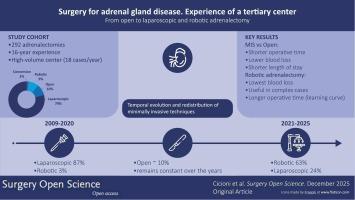
A total of 292 adrenalectomies were performed (56% female; mean age 54.5 ± 12.6 years). The left adrenal was more frequently affected (59%), and the mean tumor size was 46.8 ± 25.1 mm. Indications included primary hyperaldosteronism (37%), Cushing's syndrome (28%), pheochromocytoma (15%), adrenal cysts or myelolipomas (17%), adrenocortical carcinomas (4%), and adrenal metastases (2%). Laparoscopy was the most common approach (76%), followed by open (10%) and robotic adrenalectomy (9%); overall 7 (2%) patients required conversion to open surgery and postoperative morbidity was 7%. Minimally invasive procedures were associated with shorter operative times, less blood loss, and shorter in-hospital stays when compared to open surgery (p < 0.05). Robotic adrenalectomy had the lowest intraoperative blood loss, while laparoscopy had the fastest operative time.
Conclusions
Minimally invasive adrenalectomy is safe and effective for adrenal tumors. In our series, robotic-assisted surgery is becoming increasingly prevalent and has excellent results; however, its implementation needs to be balanced with the associated costs.


 求助内容:
求助内容: 应助结果提醒方式:

 京公网安备 11010802042870号


