Julio Cruz-Vila , Alexandre Mestre , Lucía Villarroya-Villalba , Alex Martínez , Francesc Mesquita-Joanes
{"title":"两种临时池塘介形类(甲壳纲:介形纲)对不同温度和盐含量的摄氧量:代谢性冷适应假说的检验。","authors":"Julio Cruz-Vila , Alexandre Mestre , Lucía Villarroya-Villalba , Alex Martínez , Francesc Mesquita-Joanes","doi":"10.1016/j.jtherbio.2026.104414","DOIUrl":null,"url":null,"abstract":"<div><div>Temporary ponds experience wide variation in their physical and chemical conditions, including changes in temperature and salinity, two critical factors strongly affecting aquatic life metabolism. Although ostracods are common in these habitats, little is known on the combined effects of temperature and salt content on their metabolic rates. Here, we compared the oxygen consumption rates of two cosmopolitan ostracods common in temporary ponds: <em>Eucypris virens</em>, which mostly grows dense populations during winter-spring in temperate climates, and <em>Heterocypris incongruens</em>, mostly considered a spring-summer inhabitant in the same habitats. We performed respirometry experiments combining five different temperatures (5-25 °C) and six salinities (0.1-10 PSU), and quantified their combined effects on mass-specific oxygen consumption rates of both species. According to the Metabolic Cold Adaptation (MCA) hypothesis, we expected differences in metabolic rate associated with their different phenologies, with the winter species showing a higher rate at the same temperature. We observed significant effects of temperature and salinity with no interaction between them on the oxygen consumption rates of both species, and confirmed that the winter species had higher energetic demands at all the temperatures tested, as predicted by MCA. Furthermore, significant interaction effects between species and salinity were consistent with their different salinity tolerances. These results provide support for MCA in ostracods and call for further experimental work with a wider range of conditions to better evaluate variation in ostracod metabolic responses at more extreme values of salinity and temperature.</div></div>","PeriodicalId":17428,"journal":{"name":"Journal of thermal biology","volume":"136 ","pages":"Article 104414"},"PeriodicalIF":2.9000,"publicationDate":"2026-02-01","publicationTypes":"Journal Article","fieldsOfStudy":null,"isOpenAccess":false,"openAccessPdf":"","citationCount":"0","resultStr":"{\"title\":\"Oxygen uptake in two temporary pond ostracods (Crustacea: Ostracoda) in response to different temperatures and salt contents: testing the Metabolic Cold Adaptation hypothesis\",\"authors\":\"Julio Cruz-Vila , Alexandre Mestre , Lucía Villarroya-Villalba , Alex Martínez , Francesc Mesquita-Joanes\",\"doi\":\"10.1016/j.jtherbio.2026.104414\",\"DOIUrl\":null,\"url\":null,\"abstract\":\"<div><div>Temporary ponds experience wide variation in their physical and chemical conditions, including changes in temperature and salinity, two critical factors strongly affecting aquatic life metabolism. Although ostracods are common in these habitats, little is known on the combined effects of temperature and salt content on their metabolic rates. Here, we compared the oxygen consumption rates of two cosmopolitan ostracods common in temporary ponds: <em>Eucypris virens</em>, which mostly grows dense populations during winter-spring in temperate climates, and <em>Heterocypris incongruens</em>, mostly considered a spring-summer inhabitant in the same habitats. We performed respirometry experiments combining five different temperatures (5-25 °C) and six salinities (0.1-10 PSU), and quantified their combined effects on mass-specific oxygen consumption rates of both species. According to the Metabolic Cold Adaptation (MCA) hypothesis, we expected differences in metabolic rate associated with their different phenologies, with the winter species showing a higher rate at the same temperature. We observed significant effects of temperature and salinity with no interaction between them on the oxygen consumption rates of both species, and confirmed that the winter species had higher energetic demands at all the temperatures tested, as predicted by MCA. Furthermore, significant interaction effects between species and salinity were consistent with their different salinity tolerances. These results provide support for MCA in ostracods and call for further experimental work with a wider range of conditions to better evaluate variation in ostracod metabolic responses at more extreme values of salinity and temperature.</div></div>\",\"PeriodicalId\":17428,\"journal\":{\"name\":\"Journal of thermal biology\",\"volume\":\"136 \",\"pages\":\"Article 104414\"},\"PeriodicalIF\":2.9000,\"publicationDate\":\"2026-02-01\",\"publicationTypes\":\"Journal Article\",\"fieldsOfStudy\":null,\"isOpenAccess\":false,\"openAccessPdf\":\"\",\"citationCount\":\"0\",\"resultStr\":null,\"platform\":\"Semanticscholar\",\"paperid\":null,\"PeriodicalName\":\"Journal of thermal biology\",\"FirstCategoryId\":\"99\",\"ListUrlMain\":\"https://www.sciencedirect.com/science/article/pii/S0306456526000471\",\"RegionNum\":2,\"RegionCategory\":\"生物学\",\"ArticlePicture\":[],\"TitleCN\":null,\"AbstractTextCN\":null,\"PMCID\":null,\"EPubDate\":\"2026/2/11 0:00:00\",\"PubModel\":\"Epub\",\"JCR\":\"Q2\",\"JCRName\":\"BIOLOGY\",\"Score\":null,\"Total\":0}","platform":"Semanticscholar","paperid":null,"PeriodicalName":"Journal of thermal biology","FirstCategoryId":"99","ListUrlMain":"https://www.sciencedirect.com/science/article/pii/S0306456526000471","RegionNum":2,"RegionCategory":"生物学","ArticlePicture":[],"TitleCN":null,"AbstractTextCN":null,"PMCID":null,"EPubDate":"2026/2/11 0:00:00","PubModel":"Epub","JCR":"Q2","JCRName":"BIOLOGY","Score":null,"Total":0}
Oxygen uptake in two temporary pond ostracods (Crustacea: Ostracoda) in response to different temperatures and salt contents: testing the Metabolic Cold Adaptation hypothesis
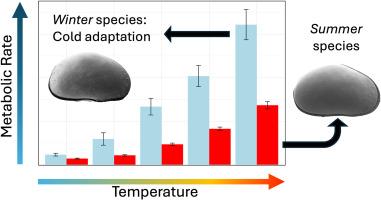
Temporary ponds experience wide variation in their physical and chemical conditions, including changes in temperature and salinity, two critical factors strongly affecting aquatic life metabolism. Although ostracods are common in these habitats, little is known on the combined effects of temperature and salt content on their metabolic rates. Here, we compared the oxygen consumption rates of two cosmopolitan ostracods common in temporary ponds: Eucypris virens, which mostly grows dense populations during winter-spring in temperate climates, and Heterocypris incongruens, mostly considered a spring-summer inhabitant in the same habitats. We performed respirometry experiments combining five different temperatures (5-25 °C) and six salinities (0.1-10 PSU), and quantified their combined effects on mass-specific oxygen consumption rates of both species. According to the Metabolic Cold Adaptation (MCA) hypothesis, we expected differences in metabolic rate associated with their different phenologies, with the winter species showing a higher rate at the same temperature. We observed significant effects of temperature and salinity with no interaction between them on the oxygen consumption rates of both species, and confirmed that the winter species had higher energetic demands at all the temperatures tested, as predicted by MCA. Furthermore, significant interaction effects between species and salinity were consistent with their different salinity tolerances. These results provide support for MCA in ostracods and call for further experimental work with a wider range of conditions to better evaluate variation in ostracod metabolic responses at more extreme values of salinity and temperature.
期刊介绍:
The Journal of Thermal Biology publishes articles that advance our knowledge on the ways and mechanisms through which temperature affects man and animals. This includes studies of their responses to these effects and on the ecological consequences. Directly relevant to this theme are:
• The mechanisms of thermal limitation, heat and cold injury, and the resistance of organisms to extremes of temperature
• The mechanisms involved in acclimation, acclimatization and evolutionary adaptation to temperature
• Mechanisms underlying the patterns of hibernation, torpor, dormancy, aestivation and diapause
• Effects of temperature on reproduction and development, growth, ageing and life-span
• Studies on modelling heat transfer between organisms and their environment
• The contributions of temperature to effects of climate change on animal species and man
• Studies of conservation biology and physiology related to temperature
• Behavioural and physiological regulation of body temperature including its pathophysiology and fever
• Medical applications of hypo- and hyperthermia
Article types:
• Original articles
• Review articles