Raúl Díaz , Guadalupe González Argüello , Edith Filippini , Mariana Peralta , Juan Manuel Rodríguez
{"title":"两种沙棘地衣的表型可塑性:海拔和微生境对生理生化反应的影响","authors":"Raúl Díaz , Guadalupe González Argüello , Edith Filippini , Mariana Peralta , Juan Manuel Rodríguez","doi":"10.1016/j.funeco.2026.101497","DOIUrl":null,"url":null,"abstract":"<div><div>Transplant experiments are vital for discerning environmental drivers of phenotypic plasticity. We used a transplant experiment along an elevational gradient in Central Argentina to evaluate plasticity in physiological and biochemical traits in two saxicolous lichen species, <em>Parmotrema reticulatum</em> and <em>Usnea amblyoclada</em>. We transplanted thalli to different elevations and microsites (differing rock aspect) and measured photosynthetic performance, hydrophobicity, and water retention traits in both species, and usnic acid concentration and extract yield in <em>U. amblyoclada</em>. We found that transplant to higher elevations reduced hydrophobicity and water holding capacity in both species. Transplantation to southern microsites increased water holding capacity. Usnic acid levels exhibited contrasting patterns, increasing in thalli transplanted to higher elevations and to northern microsites but decreasing in those moved to southern microsites. Extract yield was affected by both factors. Photosynthetic parameters showed no significant differences. Overall, elevation exerted a stronger influence on traits than microsite conditions. Our findings reveal that these lichen species possess a greater degree of phenotypic plasticity than traditionally assumed. The stronger effect of the broad elevational gradient over fine-scale microsite variation provides a key insight into the scale of environmental factors driving phenotypic change. This mechanistic, trait-based understanding of how organism-environment interactions scale from individual physiology to distribution patterns is critical for predicting species responses to environmental change.</div></div>","PeriodicalId":55136,"journal":{"name":"Fungal Ecology","volume":"81 ","pages":"Article 101497"},"PeriodicalIF":2.2000,"publicationDate":"2026-06-01","publicationTypes":"Journal Article","fieldsOfStudy":null,"isOpenAccess":false,"openAccessPdf":"","citationCount":"0","resultStr":"{\"title\":\"Phenotypic plasticity in two saxicolous lichen species: elevation and microsite effects on physiological and biochemical responses\",\"authors\":\"Raúl Díaz , Guadalupe González Argüello , Edith Filippini , Mariana Peralta , Juan Manuel Rodríguez\",\"doi\":\"10.1016/j.funeco.2026.101497\",\"DOIUrl\":null,\"url\":null,\"abstract\":\"<div><div>Transplant experiments are vital for discerning environmental drivers of phenotypic plasticity. We used a transplant experiment along an elevational gradient in Central Argentina to evaluate plasticity in physiological and biochemical traits in two saxicolous lichen species, <em>Parmotrema reticulatum</em> and <em>Usnea amblyoclada</em>. We transplanted thalli to different elevations and microsites (differing rock aspect) and measured photosynthetic performance, hydrophobicity, and water retention traits in both species, and usnic acid concentration and extract yield in <em>U. amblyoclada</em>. We found that transplant to higher elevations reduced hydrophobicity and water holding capacity in both species. Transplantation to southern microsites increased water holding capacity. Usnic acid levels exhibited contrasting patterns, increasing in thalli transplanted to higher elevations and to northern microsites but decreasing in those moved to southern microsites. Extract yield was affected by both factors. Photosynthetic parameters showed no significant differences. Overall, elevation exerted a stronger influence on traits than microsite conditions. Our findings reveal that these lichen species possess a greater degree of phenotypic plasticity than traditionally assumed. The stronger effect of the broad elevational gradient over fine-scale microsite variation provides a key insight into the scale of environmental factors driving phenotypic change. This mechanistic, trait-based understanding of how organism-environment interactions scale from individual physiology to distribution patterns is critical for predicting species responses to environmental change.</div></div>\",\"PeriodicalId\":55136,\"journal\":{\"name\":\"Fungal Ecology\",\"volume\":\"81 \",\"pages\":\"Article 101497\"},\"PeriodicalIF\":2.2000,\"publicationDate\":\"2026-06-01\",\"publicationTypes\":\"Journal Article\",\"fieldsOfStudy\":null,\"isOpenAccess\":false,\"openAccessPdf\":\"\",\"citationCount\":\"0\",\"resultStr\":null,\"platform\":\"Semanticscholar\",\"paperid\":null,\"PeriodicalName\":\"Fungal Ecology\",\"FirstCategoryId\":\"93\",\"ListUrlMain\":\"https://www.sciencedirect.com/science/article/pii/S1754504826000036\",\"RegionNum\":3,\"RegionCategory\":\"环境科学与生态学\",\"ArticlePicture\":[],\"TitleCN\":null,\"AbstractTextCN\":null,\"PMCID\":null,\"EPubDate\":\"2026/2/13 0:00:00\",\"PubModel\":\"Epub\",\"JCR\":\"Q3\",\"JCRName\":\"ECOLOGY\",\"Score\":null,\"Total\":0}","platform":"Semanticscholar","paperid":null,"PeriodicalName":"Fungal Ecology","FirstCategoryId":"93","ListUrlMain":"https://www.sciencedirect.com/science/article/pii/S1754504826000036","RegionNum":3,"RegionCategory":"环境科学与生态学","ArticlePicture":[],"TitleCN":null,"AbstractTextCN":null,"PMCID":null,"EPubDate":"2026/2/13 0:00:00","PubModel":"Epub","JCR":"Q3","JCRName":"ECOLOGY","Score":null,"Total":0}
Phenotypic plasticity in two saxicolous lichen species: elevation and microsite effects on physiological and biochemical responses
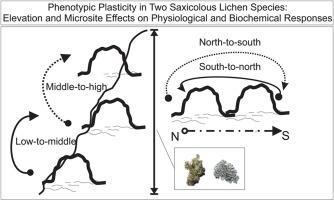
Transplant experiments are vital for discerning environmental drivers of phenotypic plasticity. We used a transplant experiment along an elevational gradient in Central Argentina to evaluate plasticity in physiological and biochemical traits in two saxicolous lichen species, Parmotrema reticulatum and Usnea amblyoclada. We transplanted thalli to different elevations and microsites (differing rock aspect) and measured photosynthetic performance, hydrophobicity, and water retention traits in both species, and usnic acid concentration and extract yield in U. amblyoclada. We found that transplant to higher elevations reduced hydrophobicity and water holding capacity in both species. Transplantation to southern microsites increased water holding capacity. Usnic acid levels exhibited contrasting patterns, increasing in thalli transplanted to higher elevations and to northern microsites but decreasing in those moved to southern microsites. Extract yield was affected by both factors. Photosynthetic parameters showed no significant differences. Overall, elevation exerted a stronger influence on traits than microsite conditions. Our findings reveal that these lichen species possess a greater degree of phenotypic plasticity than traditionally assumed. The stronger effect of the broad elevational gradient over fine-scale microsite variation provides a key insight into the scale of environmental factors driving phenotypic change. This mechanistic, trait-based understanding of how organism-environment interactions scale from individual physiology to distribution patterns is critical for predicting species responses to environmental change.
期刊介绍:
Fungal Ecology publishes investigations into all aspects of fungal ecology, including the following (not exclusive): population dynamics; adaptation; evolution; role in ecosystem functioning, nutrient cycling, decomposition, carbon allocation; ecophysiology; intra- and inter-specific mycelial interactions, fungus-plant (pathogens, mycorrhizas, lichens, endophytes), fungus-invertebrate and fungus-microbe interaction; genomics and (evolutionary) genetics; conservation and biodiversity; remote sensing; bioremediation and biodegradation; quantitative and computational aspects - modelling, indicators, complexity, informatics. The usual prerequisites for publication will be originality, clarity, and significance as relevant to a better understanding of the ecology of fungi.